BoltBill Pro guide
How to Deal with Late Paying Clients in Canada
Learn how to deal with late paying clients in Canada using structured follow-ups, interest charges, statutory holdbacks, and prompt payment rules.

To deal with late paying clients, stop ongoing work immediately, issue a formal statement of account referencing the original invoice date, and enforce contractual interest charges. If the client does not pay within seven business days of written escalation, pause all future deliverables, confirm whether statutory prompt payment rules or construction liens apply to your trade, and initiate formal collections or statutory dispute adjudication.
The Immediate Response and Recovery Hierarchy
Unpaid invoices stall cash flow and distract you from billable work. When a client misses a due date, treat the issue as an operational breakdown rather than a personal insult. Most late payments stem from administrative oversights, missing documentation, or internal cash hoarding by the client's accounting department.
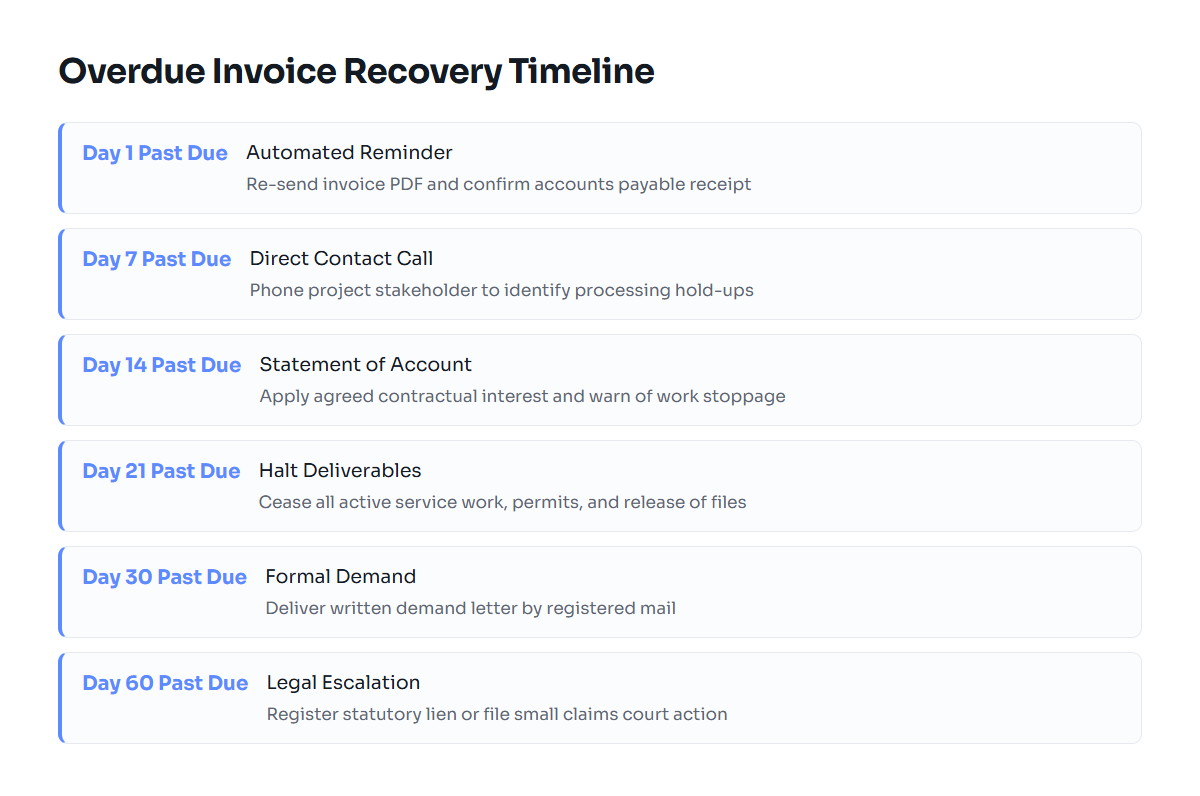
Handle overdue accounts using a firm, multi-stage protocol:
- Day 1 past due: Send a polite, automated reminder with the invoice PDF attached. Ask whether the invoice was received and if the accounts payable team requires purchase order adjustments or revised billing details.
- Day 7 past due: Make a direct phone call to your project contact. State clearly that the account is past due and request an exact payment processing date.
- Day 14 past due: Issue a formal notice of overdue balance. Re-attach the invoice, apply contractual late fees, and notify the client that active work pauses on Day 21 if the balance remains outstanding.
- Day 21 past due: Stop all billable work. Withhold work-in-progress files, sealed engineering drawings, or physical site deliveries. Notify the client in writing that work has halted due to non-payment.
- Day 30 past due: Issue a final demand letter delivered by registered mail or courier. Begin assessing legal collection options, statutory adjudication, or lien registration.
Adhering to strict timelines prevents clients from running up unrecoverable balances while maintaining your professional boundaries. If you use standard terms, see our guide on Payment Terms Net 30 in Canada: Rules and Timelines to align your invoice language with commercial standards.
Governing Rules: Contracts, Prompt Payment, and the CRA
In Canada, dealing with late payments depends on your contractual terms, provincial commercial statutes, and federal tax obligations. Knowing the legal boundary lines protects your leverage when a debtor stalls.
Alberta Prompt Payment and Construction Lien Act (PPCLA)
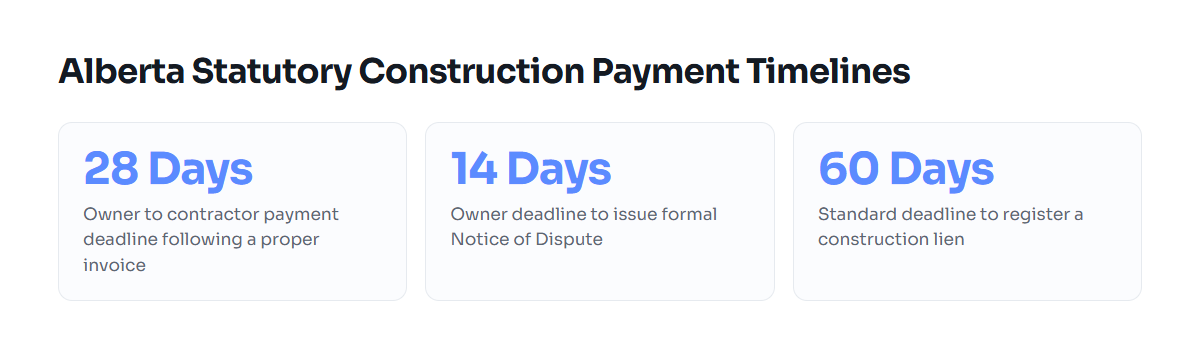
If you perform work in Alberta related to an improvement on real property—including consulting engineering, architecture, mechanical contracting, and trade labour—your billing cycle may fall under the Alberta Prompt Payment and Construction Lien Act. Under this statute, delivering a proper invoice triggers strict statutory payment windows:
- 28 calendar days: An owner must pay the general contractor within 28 days of receiving a proper invoice.
- 14 calendar days: An owner who disputes an invoice must issue a formal Notice of Dispute within 14 days, detailing the reasons and exact disputed amount.
- 7 calendar days: A general contractor must pay its subcontractors within 7 days of receiving payment from the owner.
- 10% Statutory Holdback: Section 18 of the PPCLA mandates a 10% statutory holdback on construction contracts. Owners retain this amount to protect against subcontractor liens, payable only after the lien expiry period elapses.
Ontario operates under similar prompt payment timelines within its Construction Act, and Saskatchewan enforces prompt payment via The Builders' Lien (Prompt Payment) Amendment Act. Outside physical site improvements, professional service agreements between consultants and corporate clients remain governed by general provincial contract law.
CRA Tax and Record-Retention Realities
Even if a client refuses to pay, the Canada Revenue Agency expects compliance. Under the Excise Tax Act, GST or HST liability occurs when an invoice is issued or when payment is received—whichever comes first. On an accrual accounting basis, you owe the federal government the GST or HST charged on an unpaid invoice during that reporting period.
If the debt becomes uncollectible, you may claim a bad debt deduction under Section 231 of the Excise Tax Act to recover the remitted tax. Section 286 requires you to retain all records, contracts, invoices, and communication logs for at least six years from the end of the tax year to which they relate. Never discard overdue invoices or billing disputes prematurely.
| Province | Tax Type | Total Rate | Late Fee Taxability |
|---|---|---|---|
| Alberta | GST | 5% | Late fees exempt if true financing charge |
| British Columbia | GST + PST | 12% (5% + 7%) | PST generally does not apply to financing interest |
| Ontario | HST | 13% | Harmonized sales tax applies to services, not statutory interest |
| Quebec | GST + QST | 14.975% (5% + 9.975%) | Financing fees generally exempt from GST and QST |
Worked Example: Recovering an Overdue Commercial Invoice
Consider an independent electrical consultant based in Calgary, Alberta, invoicing a general contractor for commercial distribution design. The agreed contract specifies monthly milestone billings, Net 30 payment terms, and a late fee of 1.5% per month (18% per annum, non-compounded) on balances past due.
The invoice details:
- Design Phase Milestone: $10,000.00
- 5% Alberta GST: $500.00
- Total Invoice Amount: $10,500.00
- Invoice Date: September 1
- Payment Due Date: October 1
On October 1, payment does not arrive. The consultant initiates the late-payment sequence.
Calculating Late Payment Interest
The contract specifies an interest rate of 1.5% per month applied to outstanding balances. By October 31 (30 days past due), the client has still not remitted payment. The consultant issues a revised Statement of Account including the accrued financing charge:
Monthly Interest = $10,500.00 × 0.015 = $157.50
The updated statement presented to the client totals $10,657.50. Under Canadian tax rules, pure interest charges on overdue commercial accounts do not carry GST, provided the contract specifies the amount as an interest penalty rather than an adjusted service fee.
Pausing Deliverables
On November 1, with the invoice 31 days overdue, the general contractor requests final sealed permit drawings required by the municipal safety codes inspector. The consultant refuses to release the sealed schedules or submit documentation to the local utility provider until the account is settled in full.
Because the original signed engagement letter specified that copyright and drawing ownership remain with the consultant until full payment, the client cannot legally issue those drawings for construction. The contractor wires the full balance of $10,657.50 within 48 hours to prevent project delay penalties on the jobsite.
Tools like BoltBill Pro streamline this process by generating professional statements of account that clearly separate original deliverables from calculated interest charges, leaving no room for payment confusion.
Where Late Payment Management Goes Wrong
Businesses often handle late collections poorly, either surrendering their financial leverage or compromising their legal standing. Avoid these common operational traps:
- Continuing to work on goodwill: The most expensive mistake a freelancer or trade contractor can make is continuing project work while an invoice sits overdue. Clients with cash constraints prioritize vendors who stop work over vendors who continue delivering services for free.
- Failing to specify late fee terms in advance: You cannot retroactively add an 18% annual interest charge to an overdue bill if the client never agreed to it in writing before work began. Under Canadian common law, unauthorized interest charges are legally unenforceable.
- Missing provincial lien deadlines: In Alberta, contractors and consultants have 60 calendar days from the date of last work or contract completion to register a construction lien under the PPCLA (extended to 90 days for concrete-related work). Waiting 90 days on regular engineering or carpentry work extinguishes your statutory lien rights entirely.
- Arguing over emotional points: Demanding payment through hostile emails damages business relationships and produces defensive delays. Keep all communication objective. Cite the contract clause, state the days overdue, and quantify the balance.
- Neglecting accounting reconciliations: Invoicing software errors, missing GST numbers, or mismatched purchase order references account for a significant percentage of delayed payments in corporate accounting departments. Always confirm the invoice arrived with correct metadata before escalating.
Checklist: Handling an Overdue Client Account
Use this sequential checklist whenever an invoice crosses its contractual due date:
- Audit the original record: Verify that the invoice was emailed to the designated accounts payable address, references the correct PO number, and includes your CRA business number (GST/HST).
- Send a neutral inquiry (Day 1 past due): Issue a reminder verifying receipt and asking for the target disbursement date.
- Call the project stakeholder (Day 7 past due): Speak with the person who authorized the work. Explain that accounting has not processed payment and request their direct internal intervention.
- Issue a formal Statement of Account (Day 14 past due): Itemize outstanding invoices, add contractual late fees, and establish a firm five-business-day deadline.
- Cease all billable activities (Day 21 past due): Stop active design, site work, or software delivery. Send written notification citing the suspension clause in your agreement.
- Verify statutory lien windows (Day 30 past due): If your work qualifies as a real property improvement under provincial acts like Alberta's PPCLA, review your 60-day calendar limit to preserve lien rights.
- Send a formal demand letter (Day 45 past due): Send a legal demand letter giving seven days to settle before legal escalation.
- Engage third-party resolution (Day 60+ past due): File for statutory prompt payment dispute adjudication, engage a collections agency, or lodge a claim in your provincial small claims court (such as the Alberta Court of Justice Civil Division).
Common questions
Can I legally charge interest on late payments in Canada?
Yes, but only if the interest terms were explicitly agreed upon in your signed contract or service agreement before the work was performed. You cannot retroactively impose late fees on an invoice if the client did not previously consent to the rate in writing.
Do I have to charge GST or HST on late payment interest charges?
No. Under the Canadian Excise Tax Act, pure late payment penalties and interest charges applied to commercial accounts are generally considered exempt financial services, provided they are structured strictly as interest rather than an increased price for services.
What is the statutory payment timeline under the Alberta PPCLA?
Under the Alberta Prompt Payment and Construction Lien Act, an owner must pay a contractor within 28 calendar days of receiving a proper invoice. The contractor must then distribute payment to subcontractors within 7 calendar days of receiving funds from the owner.
Can I withhold finished drawings or files if a client refuses to pay?
Yes, provided your contract specifies that intellectual property and ownership of instruments of service remain with you until all outstanding balances are paid in full. If ownership transferred upon delivery under your contract, withholding files may create legal liabilities.
How long can I wait before filing a construction lien in Alberta?
Under Alberta's PPCLA, standard construction liens must be registered within 60 calendar days from the date the work was completed, abandoned, or the materials were furnished. Improvements involving concrete work allow a 90-day lien registration window.
Related guides
Payment Terms Net 30 in Canada: Rules and Timelines
A clear breakdown of how Net 30 payment terms operate under Canadian contract law, provincial prompt payment rules, and CRA tax requirements.
Reimbursable Expenses Consulting Guide: Rules & Tax
A guide to billing reimbursable expenses in Canadian consulting, covering GST/HST out-of-pocket rules, markups, and CRA record retention.
Engineering Fee Proposal Template: Canada Guide
Learn how to structure a Canadian engineering fee proposal with clear scope boundaries, milestone payments, and provincial tax compliance.
Progress Billing Construction: Rules & Worked Guide
A complete guide to progress billing in Canadian construction, covering statutory holdback, prompt payment timelines, and step-by-step billing math.