BoltBill Pro guide
Best Quotation Software for Small Engineering Firms
Compare quotation software for small Canadian engineering and design practices. Evaluate phase billing, Alberta PPCLA compliance, and CRA tax rules.

For small Canadian design firms including engineering practices, architectural studios, and drafting consultants, the best quotation software balances fee estimate drafting with scope control and seamless conversion to progress billing. Generic quoting tools fail because they lack hourly-versus-fixed fee breakdown structures, CRA tax handling, and construction holdback tracking required under provincial legislation like Alberta's Prompt Payment and Construction Lien Act.
The Verdict: Proposal Tools Built for Canadian Technical Practices
General-purpose proposal software like PandaDoc or Proposify excels at visual presentation for marketing agencies, but falls short when converting design fees into phased billing schedules. Accounting software like QuickBooks Online handles simple quotes well, but lacks scope revision history, hourly upset limits, and direct alignment with engineering phase deliverables.
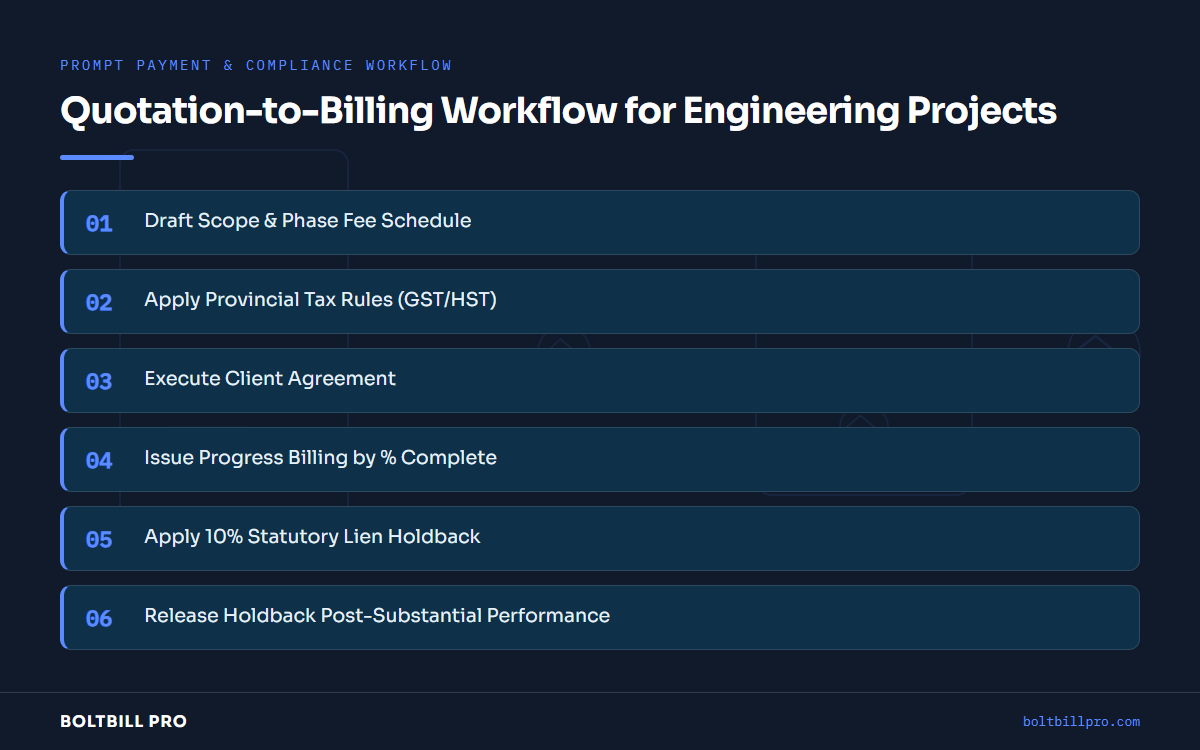
For Canadian sole practitioners and small engineering teams (2 to 15 staff), the operational gap sits between drafting the scope of work and issuing monthly progress invoices. Using a platform like BoltBill Pro connects fee estimation directly to percentage-of-completion progress billing, provincial GST/HST/PST calculations, and statutory holdback tracking. Practices that handle municipal permits, detailed drawings, and field reviews require quotation tools that preserve structural scope definitions from signature to final project closeout.
Core Requirements for Engineering and Architecture Proposals
Engineering proposals are legally binding scope definitions that directly dictate project profitability. When evaluating quotation software for a design consultancy, four technical capabilities dictate whether the tool fits daily practice workflows.
1. Phase-Based Fee Structuring
Design contracts rarely use single line-item pricing. Proposals must support split fee structures across standard project stages: Schematic Design, Detailed Design/Permitting, Construction Documentation, and Contract Administration. The software must accommodate three distinct billing types within a single proposal:
- Stipulated Price (Lump Sum): Fixed dollar amounts tied to project milestones.
- Time and Materials with Upset Limit: Hourly billing capped at a maximum fee unless scope changes are approved in writing.
- Percentage of Construction Cost: Estimated fees indexed to estimated capital expenditures.
2. CRA Compliance and Multi-Jurisdictional Tax Handling
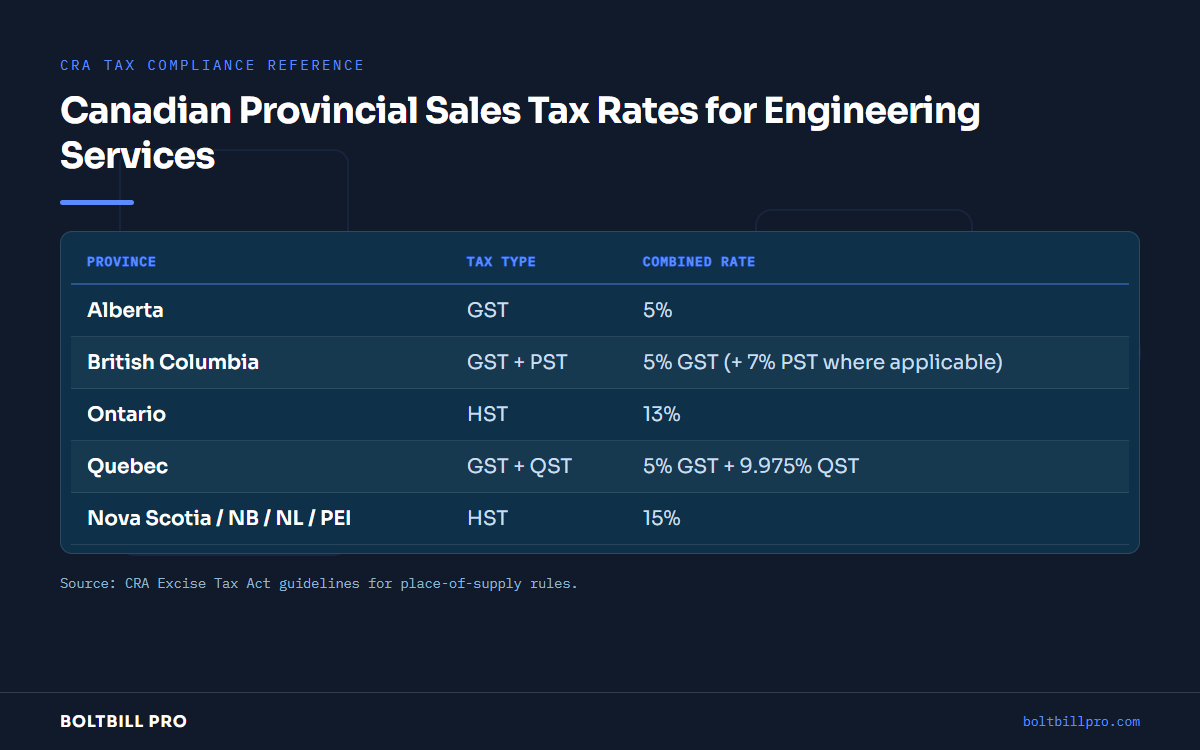
Canadian design practices frequently service clients across provincial borders. Quotation software must automatically map provincial sales tax rules to fee proposals based on where the work or real property is located:
- Alberta: 5% Goods and Services Tax (GST), no Provincial Sales Tax (PST).
- British Columbia: 5% GST; PST rules vary based on whether deliverables involve software, physical models, or pure professional services.
- Ontario: 13% Harmonized Sales Tax (HST).
- Quebec: 5% GST plus 9.975% Quebec Sales Tax (QST) calculated independently on the net subtotal.
- Atlantic Provinces: 15% HST (Nova Scotia, New Brunswick, PEI, Newfoundland and Labrador).
Under Section 230(4) of the CRA Income Tax Act and Section 286(1) of the Excise Tax Act, small businesses must retain complete quotation records, scope revisions, accepted agreements, and tax invoices for six years from the end of the relevant tax year. Generic quote tools that allow unrecorded edits without version history create audit vulnerabilities.
3. Statutory Holdback and Prompt Payment Integration
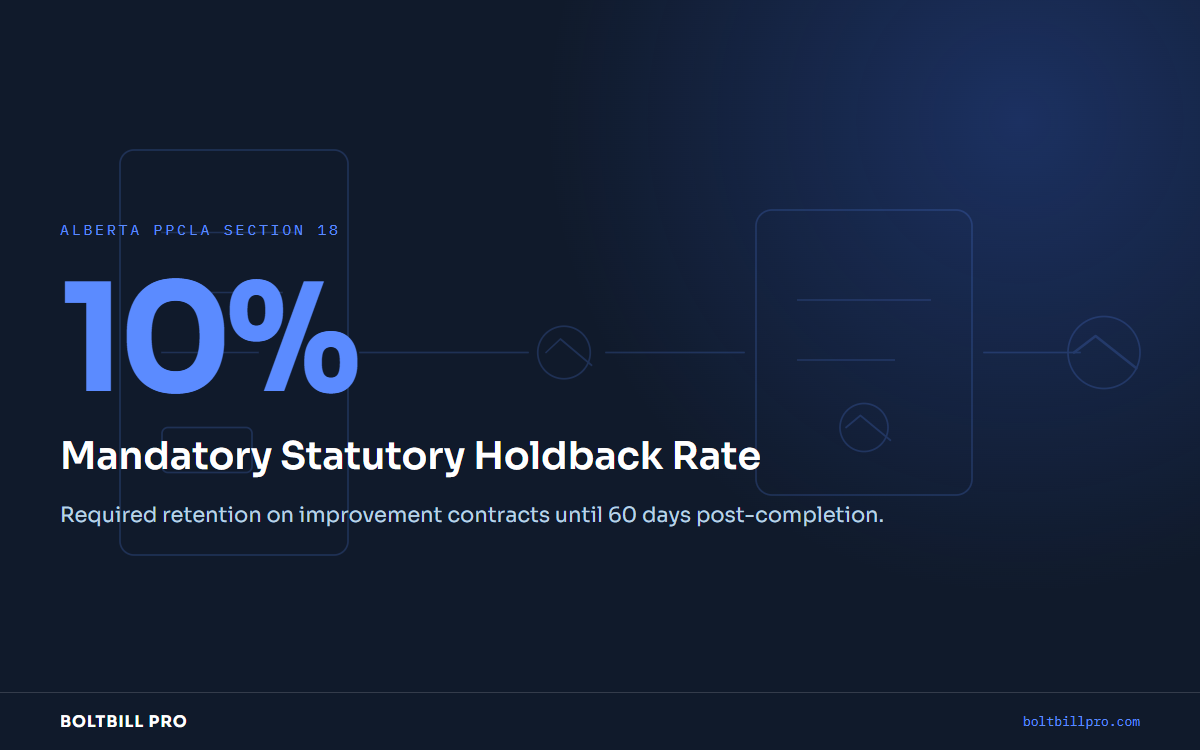
In construction-adjacent engineering (such as structural, mechanical, civil, and electrical design for commercial buildings), fee proposals must factor in statutory holdbacks. Under Alberta's Prompt Payment and Construction Lien Act (PPCLA, S.A. 2021, c. P-26.4), owners must retain a 10% statutory holdback on contracts connected to an improvement. Quotation software should allow engineers to explicitly define holdback terms, statutory payment windows (such as 28-day owner payment cycles), and field review milestone releases upfront.
Head-to-Head Comparison: Quoting Tools for Technical Consultants
To evaluate how market options perform for Canadian consultants, we compared four software categories across key operational criteria.
| Feature / Capability | Generic Sales Proposal Software (e.g., PandaDoc) | Standard Accounting Tools (e.g., QuickBooks) | Generic Project Management (e.g., Asana + Add-ons) | Design-Engineering Platforms (e.g., BoltBill Pro) |
|---|---|---|---|---|
| Phase-Based Fee Calculation | Manual text tables | Single line items only | Requires spreadsheet plug-ins | Native multi-phase fee engines |
| Scope Change Control | Overwrites original doc | No formal scope control | Task tracking only | Formal revision tracking |
| Canadian Tax Rules | Manual tax rates | Automated basic tax | No native invoicing | Native provincial tax rules |
| Statutory Holdback Tracking | None | Manual workaround ledger | None | Automated 10% lien holdback ledger |
| Progress Invoicing Link | No invoice sync | Converts quote to 100% invoice | Third-party integration needed | Direct phase percentage billing |
Worked Example: Commercial Tenant Improvement Proposal
To illustrate the operational impact of proposal tools, consider a mechanical and electrical engineering proposal for a 5,000 square foot commercial tenant improvement in Calgary, Alberta. The scope includes Development Permit (DP) support, Building Permit (BP) mechanical/electrical drawings, electrical service load calculations, and four site inspections for Schedule C-1 sign-off under the Alberta Building Code (NBC 2023 AE).
Baseline Fee Schedule:
- Phase 1: Schematic Design & DP Drawing Package — $4,000 (Fixed Fee)
- Phase 2: Detailed Design, Load Calculations & BP Set — $10,000 (Fixed Fee)
- Phase 3: Bidding & Construction Administration — $6,000 (Hourly with Upset Limit)
- Reimbursable Disbursements: City of Calgary permit review submittals and CAD plotting — $1,000 (Estimated Upset Limit)
Financial Summary:
- Base Professional Fee Subtotal: $20,000.00 CAD
- Estimated Disbursements: $1,000.00 CAD
- Subtotal subject to GST: $21,000.00 CAD
- 5% Alberta GST: $1,050.00 CAD
- Total Contract Value: $22,050.00 CAD
When executing this project under the PPCLA, each monthly progress claim bills a percentage of completion per phase. A standard sales tool generates a single PDF quote for $22,050.00, requiring the engineer to manually track phase completion percentages in Excel. A practice-specific tool logs the approved $20,000 base fee into project accounting, automatically calculates the 10% statutory holdback ($2,000 withheld across payments), applies 5% GST to net progress claims, and retains the initial scope text for audit defense if scope creep occurs during construction field reviews.
Selecting the Right Option Based on Practice Model
Choosing the correct quotation software depends directly on team size, contract structures, and regional compliance burdens.
1. Sole Practitioner Drafters and Technologists
If your workflow consists of drafting residential garage additions or simple structural revisions charged on a flat hourly rate, QuickBooks Online or FreshBooks quotes are often sufficient. You do not need complex holdback tracking or multi-phase schedules. Standard accounting software keeps administrative costs low while handling basic GST tracking.
2. Creative Design Studios and Interior Decorators
If your primary focus is visual presentation, client mood boards, and signature sign-offs without statutory engineering sign-offs (Schedule B/C-1), tools like PandaDoc or Proposify work well. They offer rich multimedia layouts and document tracking analytics, though you will need to re-key accepted totals into your accounting software manually.
3. Consulting Engineers, Prime Consultants, and Architectural Practices
If your firm issues sealed drawings, coordinates sub-consultants (e.g., prime mechanical hiring structural sub-consultants), manages upset limits, or bills against construction milestones subject to provincial prompt payment laws, dedicated professional platforms are mandatory. Using general quote tools for technical practices introduces double-entry errors and scope leakage during field review phases. You can review detailed workflow guides on the BoltBill blog or view flexible team pricing options on our pricing page.
Step-by-Step Transition Checklist for Design Practices
Transitioning your firm from unstructured Word/Excel quote templates to a modern quotation platform requires systematic setup to maintain CRA compliance and operational accuracy.
Step 1: Standardize Internal Rate Cards
List standard hourly rates by staff classification (e.g., Principal P.Eng., Senior Project Engineer, EIT, Senior CAD/BIM Designer, Administrative Support). Ensure rate cards reflect regional market benchmarks and can be embedded into Time and Materials upset estimates.
Step 2: Map Provincial Tax Profiles
Configure tax accounts for every province where you maintain a business presence or service clients. Ensure GST/HST registration numbers (e.g., 9-digit RT0001 CRA account numbers) print automatically on proposals and downstream progress claims.
Step 3: Define Standard Scope and Exclusions Libraries
Scope creep occurs when proposals omit boundary conditions. Build modular scope libraries detailing standard inclusions (e.g., two design review cycles, standard municipal submittals) and explicit exclusions (e.g., hazardous materials testing, energy modeling, municipal re-submission fees caused by architectural revisions).
Step 4: Establish Statutory Holdback Templates
For practices handling prime consulting or construction administration, set up automated 10% holdback rules for projects governed by provincial lien legislation. Configure notification reminders for statutory release windows (such as 60 days following certificate of substantial performance in Alberta).
Step 5: Audit and Archive Legacy Proposals
Before decommissioning legacy files, archive all historic quote PDFs, contract acceptances, and fee change orders to meet CRA six-year record retention mandates under Income Tax Regulation 230(4).
Common questions
Why shouldn't small engineering firms use generic quoting tools like PandaDoc?
Generic quoting tools focus on visual sales proposals rather than engineering fee calculations, scope control, or phase-based billing. They lack native support for time-and-materials upset limits, Canadian provincial tax mapping (GST/HST/PST/QST), statutory holdback tracking, and seamless progress invoicing.
How does Alberta's Prompt Payment and Construction Lien Act affect quotation software?
The PPCLA mandates strict 28-day payment timelines from owners and requires a 10% statutory holdback on contracts related to building improvements. Quotation software for Alberta firms must structure fees so that progress billing and statutory holdbacks flow cleanly from accepted quotes without manual ledger entries.
What CRA tax requirements apply to engineering fee quotes in Canada?
Quotes converting to binding contracts must properly display applicable taxes based on the place of supply: 5% GST in Alberta, BC, and Saskatchewan; 13% HST in Ontario; 15% HST in Atlantic Canada; and 5% GST plus 9.975% QST in Quebec. Under Section 230(4) of the Income Tax Act, all proposal versions, client acceptances, and billing records must be retained for six years.
Can small practices manage phase billing directly inside QuickBooks Online?
QuickBooks Online can convert simple estimates into invoices, but it struggles with multi-phase engineering scopes, upset limit caps, and percentage-of-completion progress billing across long design cycles. It also lacks technical scope clause libraries and change-order tracking.
How do fee breakdown structures prevent scope creep on design contracts?
Itemizing fees by phase (Schematic Design, Building Permit, Construction Administration) and linking specific deliverables—such as municipal reviews or Letters of Assurance—establishes clear contractual boundaries. When clients request extra revisions, the software references the accepted quotation phase totals to trigger formal change order pricing.
Related guides
Holdback Invoicing for Canadian Design Practices
A practical guide to calculating statutory holdbacks, managing GST/HST deferral, and billing for holdback releases in Canadian design practices.
USA Invoicing Software for Canadian Design Practices
Learn how Canadian engineering and architecture practices evaluate USA invoicing software for cross-border projects, CRA tax compliance, and multi-currency billing.
GST HST Invoicing Canada: Professional Practice Guide
A practical guide to CRA-compliant GST and HST invoicing for Canadian engineering, architecture, and consulting practices.