BoltBill Pro guide
How to Write a Quote: Complete Canadian Guide
Learn how to write a quote that wins jobs and protects cash flow. Includes Canadian tax rules, a worked example, and payment terms.

To write a quote, state your business identity and client details, describe the exact scope of work, list fixed line-item pricing, specify the applicable provincial sales tax, and define an expiry date alongside payment terms. Unlike an estimate, a signed quote forms a legally binding contract once accepted. Delivering a clear quote prevents scope disputes, locks in agreed pricing, and establishes the formal baseline for your subsequent progress claims or final invoices.
The Core Elements of a Professional Quote
Learning how to write a quote correctly requires balancing legal clarity with operational detail. When you submit a quote to a client, you present an offer to deliver specific goods or services at a predetermined price. If the client accepts, that document governs your commercial relationship. Omitting basic details invites disagreements over what you agreed to build, design, or deliver.
Every quote you send should contain eight standard elements:
- Header and Contact Information: Your legal business name, operating name, trade name, physical address, phone number, email, and your 9-digit Canada Revenue Agency (CRA) Business Number with the GST/HST program identifier (RT0001) if registered.
- Client Information: The client’s individual or corporate name, site address, billing address, and primary project contact.
- Document Tracking: A distinct quote number, document issue date, and an explicit expiry date (typically 30 calendar days).
- Itemized Scope of Work: Detailed descriptions of deliverables, tasks, milestones, and exclusions. Clear boundaries prevent scope creep before work starts.
- Labor, Materials, and Disbursements: Breakdown of unit prices, fixed service fees, equipment rentals, permit allowances, or pass-through expenses.
- Applicable Taxes: Provincial tax rules dictate whether you collect 5% GST, combined HST (up to 15%), or separate PST/QST.
- Payment Terms and Milestones: Expected deposit percentage, invoice schedule, accepted payment methods, and net payment windows.
- Sign-off Block: Signature lines, printed names, dates, and purchase order fields for the client to confirm acceptance.
If you are still calculating base rates before assembling deliverables, review our guide on How to Price a Job: Contractor and Freelance Guide. For professional services firms drafting formal bidding documents, see our Engineering Fee Proposal Template: Canada Guide.
Canadian Statutory Rules: Taxes, Liens, and Records
In Canada, commercial quotes must align with federal and provincial statutes. Failing to structure pricing around these rules leads to unrecoverable sales taxes, payment disputes, or statutory non-compliance.
Sales Tax Obligations by Province
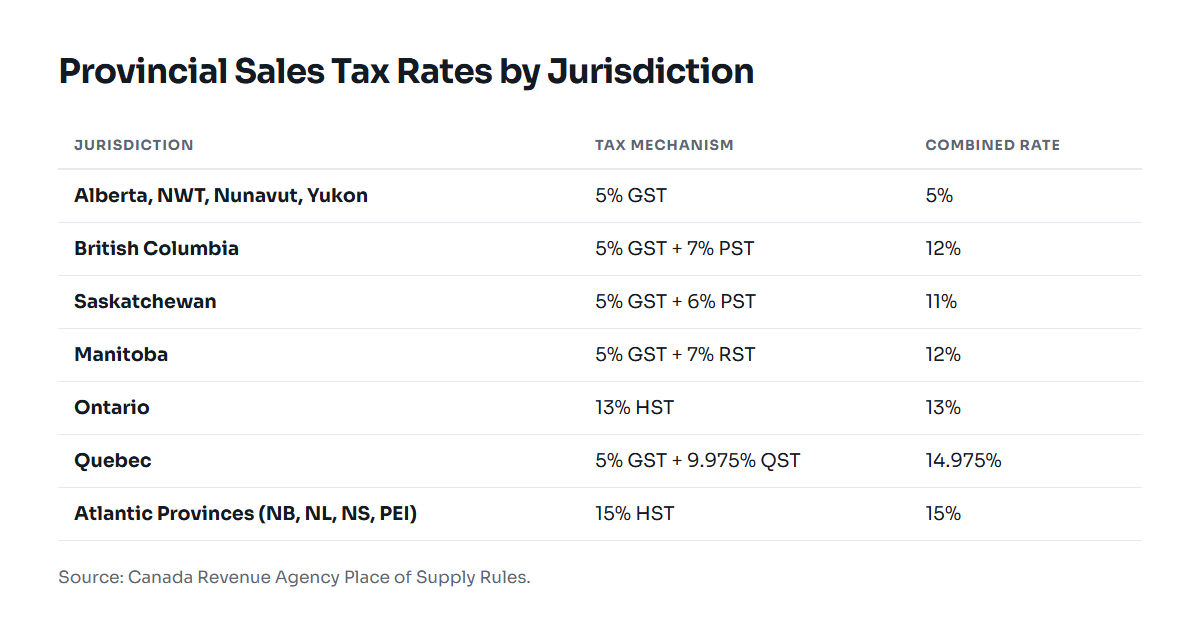
Under the federal Excise Tax Act, businesses with gross taxable revenues exceeding $30,000 across four consecutive calendar quarters must register for a CRA GST/HST account. Small suppliers below this threshold are not required to register, but registered businesses must show their tax numbers and separate tax line items. Tax treatment depends on your client's location, known as the place of supply rule according to the Canada Revenue Agency:
| Province / Territory | Tax Type | Applicable Rate | Tax Breakdown |
|---|---|---|---|
| Alberta, NWT, Nunavut, Yukon | GST | 5% | 5% Federal GST |
| British Columbia | GST + PST | 12% | 5% Federal GST + 7% Provincial Sales Tax |
| Saskatchewan | GST + PST | 11% | 5% Federal GST + 6% Provincial Sales Tax |
| Manitoba | GST + PST | 12% | 5% Federal GST + 7% Retail Sales Tax |
| Ontario | HST | 13% | 13% Harmonized Sales Tax |
| Quebec | GST + QST | 14.975% | 5% Federal GST + 9.975% Quebec Sales Tax |
| New Brunswick, NL, NS, PEI | HST | 15% | 15% Harmonized Sales Tax |
To verify line items quickly across provincial borders, calculate totals using our GST/HST Invoice Calculator. In your quote, always list sales taxes as separate line items rather than embedding them into the base fee. This demonstrates transparent pricing and allows commercial clients to account for their Input Tax Credits.
Prompt Payment and Statutory Holdbacks
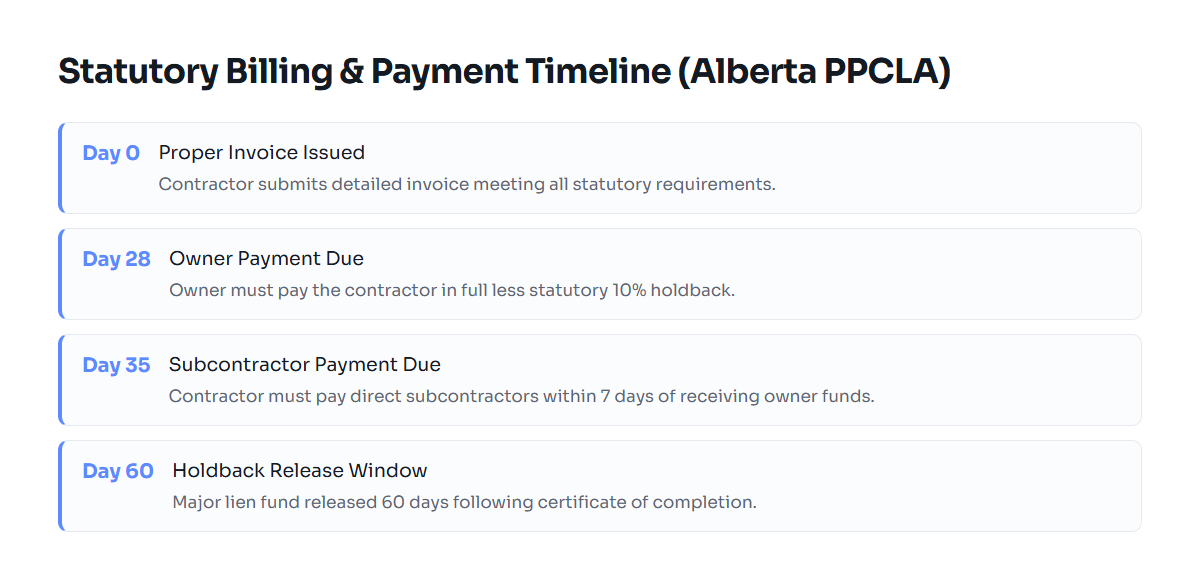
If you perform construction, mechanical, electrical, or trade work, your quote sits under provincial lien legislation. In Alberta, the Prompt Payment and Construction Lien Act (PPCLA) governs commercial billing cycles. Section 18 of the PPCLA establishes a statutory 10% holdback on the value of work completed and materials supplied.
The PPCLA mandates that once a contractor delivers a proper invoice, the owner has 28 calendar days to issue payment. The contractor then has 7 calendar days to pay direct subcontractors. Quoting trade work requires acknowledging statutory holdbacks and detailing how progress billings will occur so your cash flow remains predictable.
CRA Record Retention
Section 230 of the federal Income Tax Act requires businesses to retain books, supporting records, contracts, and accepted quotes for a minimum of six years from the end of the last tax year to which they relate. Keep digital copies of every submitted quote, accepted counter-offer, and signed revision.
Worked Example: Commercial Trade Quote in Alberta
Consider a practical project: an electrical contractor in Calgary quoting a commercial panel upgrade and dedicated sub-circuit installation for a light industrial tenant. The project involves site inspection, city permits, switchgear, branch circuits, and commissioning.
Step 1: Define Explicit Boundaries
Ambiguity causes scope creep. The quote defines the specific panels and feeds included, and excludes unforeseen utility transformer delays, trenching, or patch-and-paint restoration.
Step 2: Calculate Direct Costs and Subtotals
The contractor compiles materials, direct labor hours, equipment allowances, and municipal permits:
- Demolition of existing 100A panel: 4 hours at $110/hour = $440.00
- Supply and install 200A 120/208V 3-phase distribution panel: $2,850.00
- Installation labor: 16 hours at $110/hour = $1,760.00
- Two dedicated 30A 208V machinery drops (materials and labor): $1,450.00
- City of Calgary commercial electrical permit fee (disbursement): $320.00
- Testing and system verification: 2 hours at $110/hour = $220.00
Subtotal: $7,040.00
Step 3: Apply Taxes and Detail Payment Milestones
Because the work occurs in Alberta, only the 5% GST applies. The quote states:
- Subtotal: $7,040.00
- GST (5% on taxable labor and materials of $7,040.00): $352.00
- Total Contract Value: $7,392.00
Payment terms specify a 25% deposit upon contract signing to procure gear ($1,848.00), a 65% progress claim upon substantial completion of rough-in and panel mounting ($4,804.80), and a 10% holdback release ($739.20) payable 60 calendar days following certificate of completion, in alignment with Alberta lien release periods.
How to Write Payment Details on an Invoice: Canada Example
When your quote transitions to an actual bill, how to write payment details on invoice canada example queries center on compliance and clear remittance. A Canadian invoice should match the line items on your quote while stating clear banking and tax identifiers.
Ensure your invoice includes:
- CRA Registration Details: Display your 9-digit Business Number followed by RT0001 (for example, 123456789 RT0001) near the top header.
- Payment Remittance Options: Provide your direct Interac e-Transfer email address, electronic funds transfer (EFT) banking coordinates (3-digit financial institution number, 5-digit transit routing number, and account number), or corporate mailing address for physical cheques.
- Terms of Payment: Net 30 days from invoice date. Specify overdue interest conditions, such as 1.5% per month (18% per annum) on balances remaining unpaid past 30 days.
- Holdback Accounting: For construction claims, state the gross work completed, deduct the 10% statutory holdback on a distinct line, add 5% GST on the net billable amount, and indicate the remaining holdback balance to be billed at project closeout.
Common Quoting Misconceptions
Many independent operators and consultants confuse legal terminology, exposing themselves to unpaid revisions or unexpected liabilities.
Quotes Versus Estimates Versus Tenders
A quote is a firm offer. When you issue a quote for $5,000 and the client signs it, you are committed to delivering the defined scope for $5,000, regardless of whether your actual costs rise. An estimate is an approximation or non-binding assessment. If unpredictable site conditions emerge, an estimate allows for reasonable price adjustments. A tender or formal bid is a binding submission in response to competitive public or institutional procurement rules. Never label a document a quote if you intend to bill variable hourly rates for undefined discovery work; label it an estimate or an hourly services agreement instead.
Omitting Expiry Dates
Leaving an open-ended validity period exposes your business to material inflation. Copper, lumber, steel, and electronic components experience price swings over short intervals. Every quote should state: "This quotation is valid for 30 calendar days from the date of issue. Pricing is subject to renegotiation thereafter."
Burying Exclusions in Fine Print
Failing to list specific exclusions is the primary cause of contractor-client friction. If your quote covers painting walls, explicitly state that drywall patching, skim coating, ceiling repairs, and furniture relocation are excluded. If you offer consulting services, state that attendance at regulatory board hearings or additional design revisions outside the single draft review are billed at standard hourly rates.
Operational Best Practices for Sending Quotes
Establishing a disciplined quote workflow ensures faster client approvals and predictable revenue. Review these operational guidelines before issuing your next proposal:
- Walk the Site or Run Discovery First: Never quote a complex renovation, installation, or corporate consulting mandate without evaluating site conditions or structural documentation. Document existing damage, utility constraints, and software environments before setting a fixed number.
- Itemize Major Milestones: Group project costs by phases (for instance: Phase 1 Preliminary Engineering, Phase 2 Detailed Design, Phase 3 Commissioning). This structure establishes transparent billing intervals for your subsequent progress claims.
- Standardize Your Quote Numbering: Use sequential numbering protocols, such as Q-2024-041, tied directly to your client file. If a client requests scope changes, increment the version number to Q-2024-041-R1 to maintain an audit trail.
- Collect Written Acceptance: Verbal approvals on job sites or brief text messages create legal risk. Require an authorized signature, date, and company purchase order number returned via email or a secure client portal before purchasing materials or scheduling labor.
- Retain Records Systematically: Store your accepted quotations, scope revisions, and related client correspondence together in digital archives for six years to fulfill CRA record-keeping mandates.
Writing an accurate, legally sound quote establishes a professional standard for your project. By itemizing work, isolating provincial sales tax, and enforcing clear payment schedules, you eliminate misunderstandings and protect your operating margins.
Free tools: GST/HST invoice calculator · hourly rate calculator
Common questions
What is the legal difference between a quote and an estimate in Canada?
A quote is a fixed, legally binding offer to deliver defined work for a specific price once accepted. An estimate is a non-binding cost assessment that can change as the scope evolves or unforeseen project conditions arise.
Do I need to charge GST or HST on a quote in Canada?
Yes, if your business gross taxable revenue exceeds $30,000 across four consecutive calendar quarters. You must register with the CRA, show your 9-digit Business Number on documentation, and charge the provincial rate tied to your client's location.
How long should a business quote remain valid?
Standard practice across Canadian trades and consulting industries is 30 calendar days. Setting a clear validity period protects your business against supplier price increases, equipment rental shifts, and material inflation.
What payment terms should I include when writing a quote?
Specify required deposits before work starts, progressive milestone billing dates, invoice payment windows (such as Net 30), accepted payment methods like EFT or Interac e-Transfer, and applicable statutory holdbacks.
How long must I keep records of accepted customer quotes in Canada?
The Canada Revenue Agency requires you to maintain books, accepted proposals, contracts, and financial records for a minimum of six years from the end of the relevant tax year under Section 230 of the Income Tax Act.
Related guides
How to Price a Job: Contractor and Freelance Guide
A step-by-step Canadian guide to pricing service, trade, and freelance jobs with profitable labour, overhead, and margin calculations.
Engineering Fee Proposal Template: Canada Guide
Learn how to structure a Canadian engineering fee proposal with clear scope boundaries, milestone payments, and provincial tax compliance.
Best Quotation Software for Small Engineering Firms
A comparative guide to choosing proposal and quotation software built for Canadian engineering practices, architects, and design consultants.
USA Invoicing Software Guide for Independent Practices
A direct guide to selecting USA invoicing software, handling USD payments, ACH routing, and IRS tax forms without expensive platform overhead.