BoltBill Pro guide
How to Price a Job: Contractor and Freelance Guide
Learn how to price a job accurately in Canada. Calculate true labour rates, overhead, materials, and profit margins to stop underbidding your work.

To price a job accurately, sum your direct labour cost, direct materials and equipment, allocated business overhead, and desired net profit margin. In Canada, profitable trade and contractor quotes generally target a 20% to 35% gross margin, while independent consultants and freelancers price work between 30% and 50% gross margin above their loaded base costs. Never quote direct costs alone, because unpaid administrative time, mandatory payroll taxes, and provincial overhead burdens will immediately eliminate your business profit.
Realistic Pricing Ranges for Service and Trade Jobs
Pricing for contract and service work varies across industries, but billing rates follow distinct structural ranges across Canada. Sole proprietors and small business owners often undercharge because they confuse their take-home hourly wage with a commercial billing rate. Your commercial hourly rate must cover non-billable administration, insurance, tool depreciation, vehicle wear, statutory benefits, and profit.
The table below outlines common commercial hourly rate benchmarks across Canadian markets before sales tax:
| Industry or Service Type | Standard Canadian Billing Range (CAD/hr) | Typical Target Gross Margin | Common Invoicing Model |
|---|---|---|---|
| Residential Trades (Electrician, Plumber, Carpentry) | $85 – $145 | 25% – 35% | Time & Materials or Fixed Quote |
| Commercial Construction & Specialty Trades | $95 – $165 | 20% – 30% | Progress Billing with Holdback |
| Freelance Technical / Creative (Design, Copy, Web) | $65 – $150 | 35% – 50% | Milestone or Flat Project Fee |
| Consulting & Professional Services | $125 – $250+ | 40% – 55% | Retainer, Blended Hourly, or Fixed Fee |
To establish your commercial floor, use our freelance hourly rate calculator to model billable efficiency against annual operating costs. If you bill 1,000 hours per year out of 2,000 working hours, your billable rate must be at least double your basic wage requirement before accounting for overhead and materials.
The Five Cost Drivers That Move Your Price
Every commercial quote rests on five core components. Understanding how these factors shift prevents common estimate shortfalls that leave contractors paying out of pocket.
1. Direct Labour and True Burden
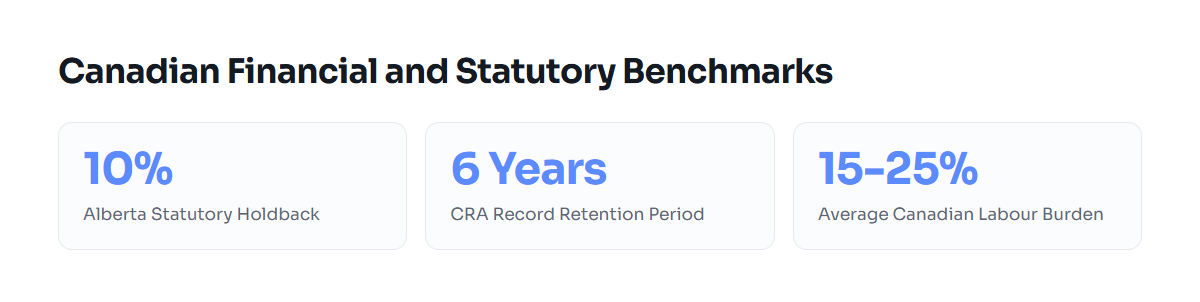
Direct labour is not simply what you pay yourself or an employee per hour. In Canada, an employer must account for the statutory burden: Canada Pension Plan (CPP) contributions, Employment Insurance (EI) premiums, vacation pay (typically 4% to 6%), and provincial workers' compensation premiums such as the Workers' Compensation Board (WCB) in Alberta. For a contractor or freelancer paying self-employed CPP, both employee and employer portions apply. This labour burden typically adds 15% to 25% on top of raw base wages.
2. Materials, Subcontracts, and Handling Markups
Materials carry acquisition costs. Sourcing, handling, warehousing, and delivering parts to a site consumes time and capital. Standard contractor material markups range from 15% to 30%. If you spend $1,000 on specialty plumbing fittings or technical software licenses for a project, billing the client exactly $1,000 means you lose money on transaction fees, procurement time, and liability risk.
3. Fixed and Operating Overhead
Overhead includes the expenses your business pays regardless of whether you have an active project this week. Essential overhead includes commercial general liability (CGL) insurance, vehicle leases, fuel, software subscriptions, mobile phones, accounting fees, and trade licensing. To calculate your overhead recovery, divide your total annual overhead costs by your forecasted billable hours for the year, then add that dollar amount to every billable hour.
4. Scope Risk and Site Conditions
Every project presents variables outside your control. In renovation or trade work, unseen electrical panels or structural framing anomalies demand contingency margins. In consulting, vague client review cycles and ambiguous delivery parameters lead to scope creep. For projects with ambiguous scopes, write an explicit contingency allowance or adjust your quote to a unit-rate or milestone model as explained in our guide to the Engineering Fee Proposal Template: Canada Guide.
5. Statutory Holdbacks and Cash Flow Timing
In Canadian construction contracts, prompt payment legislation and construction lien acts govern billing schedules. For instance, under the Alberta Prompt Payment and Construction Lien Act, owners and general contractors are legally required to retain a 10% statutory holdback on all progress payments. This 10% holdback is not released until the statutory lien period expires (typically 45 or 60 days following major lien events or substantial performance). If your operating margin is only 8%, this statutory holdback means your cash flow remains negative throughout the build phase.
Worked Example: Pricing a Residential Service Upgrade in Calgary
Consider a practical trade scenario: an electrical contractor in Calgary, Alberta pricing a residential 100-amp to 200-amp service panel upgrade. This job requires utility coordination with ENMAX, municipal permits, materials, and two workers on-site for a full day.
Step 1: Calculate Direct Labour Costs
- Lead Electrician (8 hours at $50/hr base + 20% statutory/WCB burden = $60/hr): $480.00
- Apprentice (8 hours at $26/hr base + 20% statutory/WCB burden = $31.20/hr): $249.60
- Total Direct Labour Cost: $729.60
Step 2: Calculate Direct Materials and External Fees
- 200A Breaker Panel, Meter Base, Breakers, and Mast Hardware: $1,150.00
- City of Calgary Electrical Permit Fee: $185.00
- Utility Disconnect/Reconnect Coordination Allowance: $350.00
- Material Handling & Sourcing Markup (20% on $1,150 hardware): $230.00
- Total Direct Materials & Fees: $1,915.00
Step 3: Allocate Business Overhead
The contractor's annual business overhead (van lease, commercial liability, tools, storage, bookkeeping) totals $48,000 across 2,400 billable field hours per year, yielding an overhead recovery rate of $20.00 per direct labour hour.
- 16 combined labour hours × $20.00/hr: $320.00
Step 4: Determine Cost Baseline
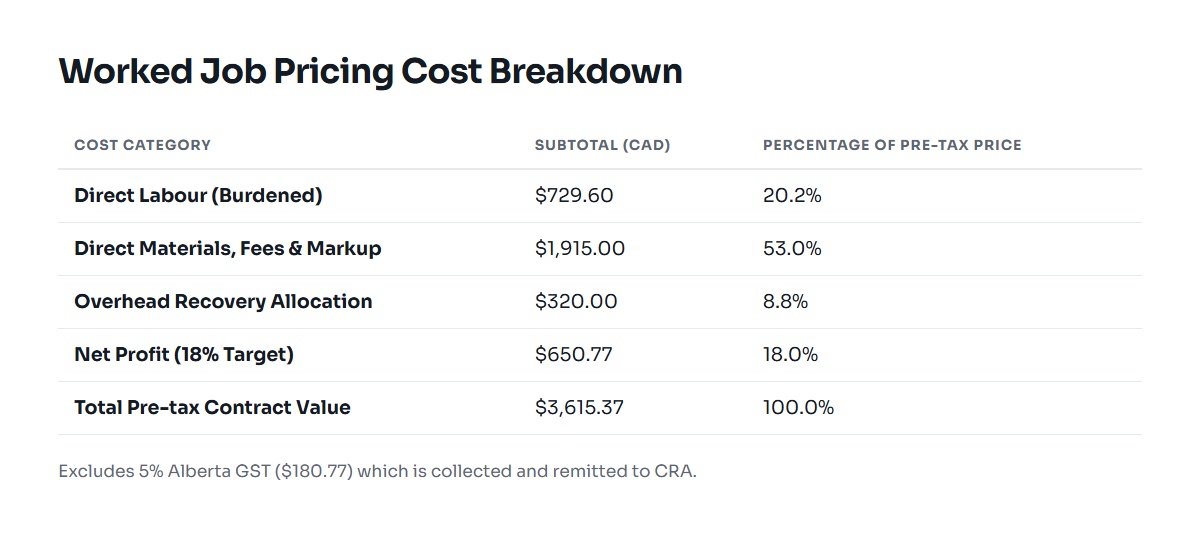
- Direct Labour: $729.60
- Direct Materials, Fees & Markup: $1,915.00
- Allocated Overhead: $320.00
- Total Operating Cost Baseline: $2,964.60
Step 5: Apply Profit Margin
To achieve an 18% net profit margin on the total invoice price (Contract Price = Operating Cost / (1 − 0.18)):
- Pre-tax Proposal Price: $2,964.60 / 0.82 = $3,615.37
- Net Business Profit: $650.77
Step 6: Add Applicable Taxes
Because this project takes place in Alberta, only the 5% federal Goods and Services Tax (GST) applies. If this work were located in Ontario, a 13% Harmonized Sales Tax (HST) would apply instead; in British Columbia, 5% GST applies on real property contractor services, while professional services often face varying tax guidelines depending on delivery. Check your province's rules using our GST/HST Invoice Calculator.
- Pre-tax Total: $3,615.37
- GST (5%): $180.77
- Total Customer Price: $3,796.14
What Is and Is Not Included in Your Quote
Misunderstandings around inclusions generate unpaid bills and client disputes. An airtight quotation must clarify the exact boundary of the agreed work. When preparing quotes with platforms like BoltBill Pro, divide your proposal into clear inclusions, formal exclusions, and unit rates for out-of-scope work.
What Belongs in the Base Price
- Defined scope of work and specified deliverables or tasks.
- Standard commercial materials, consumable items, and necessary trade tools.
- Mandatory municipal safety permits, trade inspections, and utility coordination allowances.
- Travel time within an agreed commercial service radius (e.g., within city limits).
- Statutory warranties on workmanship as required by provincial legislation or contract terms.
What Must Be Explicitly Excluded
- Concealed site defects, hazardous material remediation (e.g., asbestos or vermiculite), and repair of deteriorated structural framing.
- Utility infrastructure replacement charges assessed directly by regional distributors.
- Drywall patching, painting, and architectural refinishing following rough-in work.
- Expedited inspection fees or off-hours overtime requested by the client.
- Changes in scope requested after signing without an executed written change order.
For small businesses handling ongoing bids, selecting dedicated quoting and invoicing software helps standardise these inclusion and exclusion blocks. You can evaluate your workflow options in our review of the Best Quotation Software for Small Engineering Firms.
How to Build an Accurate Estimate Step by Step
Follow this disciplined five-step checklist on every bid to eliminate guesswork and protect your gross margins.
- Perform a Thorough Site Audit or Discovery Intake: Never price a complex job from an informal phone description. Inspect the physical site, check service panels and elevations, or conduct a structured discovery meeting to define technical boundaries before publishing numbers.
- Quantify Direct Quantities (Takeoff): List every unit of material, external permit, equipment rental, and labour hour required. Apply realistic production rates rather than best-case scenarios.
- Apply Fully Burdened Labour Rates: Use a labour rate that incorporates mandatory Canadian payroll burdens (CPP, EI, provincial worker insurance), not just your desired hourly wage.
- Calculate Overhead Recovery Explicitly: Ensure your hourly rate or project markup directly accounts for your unbillable administration, insurance premiums, software, and operational costs.
- Check Statutory Compliance and Documentation: For trade projects subject to provincial lien acts, structure milestone billing schedules that accommodate statutory holdbacks. Ensure your invoicing complies with CRA record-keeping rules, which require registered businesses to maintain original receipts, invoices, and accounting books for at least six years from the end of the last tax year to which they relate.
Review our complete platform pricing options or browse the BoltBill blog to explore further operational workflows for Canadian independent operators and trades.
Free tools: GST/HST invoice calculator · hourly rate calculator
Common questions
How do I calculate my hourly rate for pricing a job?
Add your target annual net income to your annual business overhead, including insurance, software, vehicle, and licensing expenses. Add statutory burdens such as self-employed CPP and provincial workers' compensation premiums. Divide that combined total by your estimated annual billable hours (typically 1,000 to 1,200 hours per year for a solo operator) to find your baseline hourly rate.
What is the difference between markup and margin when pricing work?
Markup is the percentage added directly to your cost baseline to establish a higher price, whereas profit margin is the percentage of the final selling price that represents profit. For example, if a job costs $1,000 and you add a 25% markup, the price is $1,250, resulting in a 20% gross margin ($250 profit divided by $1,250 total price).
How does statutory holdback impact my pricing and cash flow in Alberta?
Under the Alberta Prompt Payment and Construction Lien Act, clients and general contractors retain 10% of each progress payment until the statutory lien period expires. If your bid carries a net margin below 10%, you will finance the project out of pocket until the final holdback funds are released.
Should I price jobs by the hour or by a flat project fee?
Use flat project fees when the scope of work, technical deliverables, and site conditions are fully known and predictable, as fixed fees reward efficiency with higher effective margins. Use hourly or time-and-materials pricing when discovery is ongoing, scope parameters remain unverified, or client review cycles are open-ended.
How long do I need to keep quote and invoice records in Canada?
Under Canada Revenue Agency rules, businesses must keep all books, records, source documents, and sales invoices for a minimum of six years from the end of the latest tax year to which they relate. This applies to sole proprietors, partnerships, and incorporated companies alike.
Related guides
How to Write a Quote: Complete Canadian Guide
A practical guide for Canadian contractors, consultants, and freelancers on how to write a binding quote with clear scope, tax rates, and payment terms.
Engineering Fee Proposal Template: Canada Guide
Learn how to structure a Canadian engineering fee proposal with clear scope boundaries, milestone payments, and provincial tax compliance.
Best Quotation Software for Small Engineering Firms
A comparative guide to choosing proposal and quotation software built for Canadian engineering practices, architects, and design consultants.
USA Invoicing Software Guide for Independent Practices
A direct guide to selecting USA invoicing software, handling USD payments, ACH routing, and IRS tax forms without expensive platform overhead.