BoltBill Pro guide
Milestone Billing vs Hourly: Which Model Fits?
Compare milestone billing vs hourly rates for Canadian contractors, consultants, and freelancers. Learn how each impacts cash flow, margins, and taxes.
Hourly billing charges for actual time spent, making it best for undefined scopes, troubleshooting, and early advisory work where scope creep is unpredictable. Milestone billing charges predetermined dollar amounts tied to verifiable deliverables, making it best for well-scoped projects, trade installations, and fixed packages where speed and efficiency increase your effective profit. Most Canadian businesses should use hourly rates while the scope remains uncertain, then switch to milestone billing once outputs and timelines are measurable.
The Direct Verdict: When to Pick Milestone Over Hourly
Hourly billing sells labour. Milestone billing sells completed outcomes. When you charge by the hour, you take on zero scope risk: if a job takes thirty hours instead of twenty because a client changes their mind or site conditions require extra work, you bill thirty hours. However, hourly billing penalizes operational efficiency. If you invest in specialized software, better tooling, or years of skill that allow you to complete a design or trade installation in half the time, an hourly contract cuts your gross revenue in half.
Milestone billing ties invoicing to verifiable stages of completion. You bill a fixed amount when a specific target is reached, such as receiving a municipal building permit, completing rough-in work, or delivering a final inspection sign-off. If you finish ahead of schedule, your profit margin expands. The risk shifts directly to you: if an installation runs twenty hours over estimate due to your own planning missteps, your invoice total remains identical.
For independent Canadian operators—from electrical sub-trades in Calgary to management consultants in Toronto—the decision often hinges on client expectations and prompt payment legislation. Under Alberta's Prompt Payment and Construction Lien Act (PPCLA), an invoice must qualify as a proper invoice to trigger statutory 28-day payment clocks. Milestone invoices tied to distinct, objective deliverables are far easier to validate and get approved than forty pages of disputed timesheet line items.
The Factors That Actually Decide the Billing Model
Choosing between milestone and hourly billing requires evaluating your project scope, working capital, and administrative burden rather than copying an industry habit.
Scope Clarity and Definition of Done
Can you document the exact criteria required to release payment before work starts? If yes, milestone billing protects your margins. If the client cannot provide technical specifications, existing site drawings, or a clear set of boundary conditions, hourly billing is the only rational approach. Agreeing to a milestone payment tied to client acceptance without objective acceptance criteria invites endless revisions without compensation.
Working Capital and Cash Flow Gaps
Hourly billing usually runs on bi-weekly or monthly cycles. You invoice the hours worked during the prior thirty days, creating predictable cash flow. Milestone billing creates lump-sum payments separated by weeks or months of unbilled effort. If a milestone relies on a third party—such as a municipal development authority issuing a development permit or an owner delivering specialized equipment—your billing clock freezes until that condition is satisfied. You must maintain sufficient operating cash to float labour, materials, and overhead between gates.
Audit Friction and Client Scrutiny
Clients who hire on an hourly basis scrutinize timesheets. They question why a specific task took seven hours instead of four. You spend billable time defending routine activities. Milestone billing removes timesheets from the payment conversation entirely. The client inspects the deliverable, confirms it matches the contract specification, and pays the agreed price.
Tax and Statutory Record Requirements
Both billing models require strict compliance with the Canada Revenue Agency (CRA). Under CRA record-retention requirements, you must keep all books, records, contracts, and supporting documentation for six years from the end of the last tax year to which they relate. For hourly contracts, this means retaining source timesheets, daily logs, and employee punch records. For milestone contracts, you must preserve signed deliverable sign-offs, change orders, and submittal receipts. Review our complete guide to Progress Billing Construction: Rules & Worked Guide to see how deliverable milestones integrate with prompt payment requirements.
Head-to-Head Comparison Across Key Operations
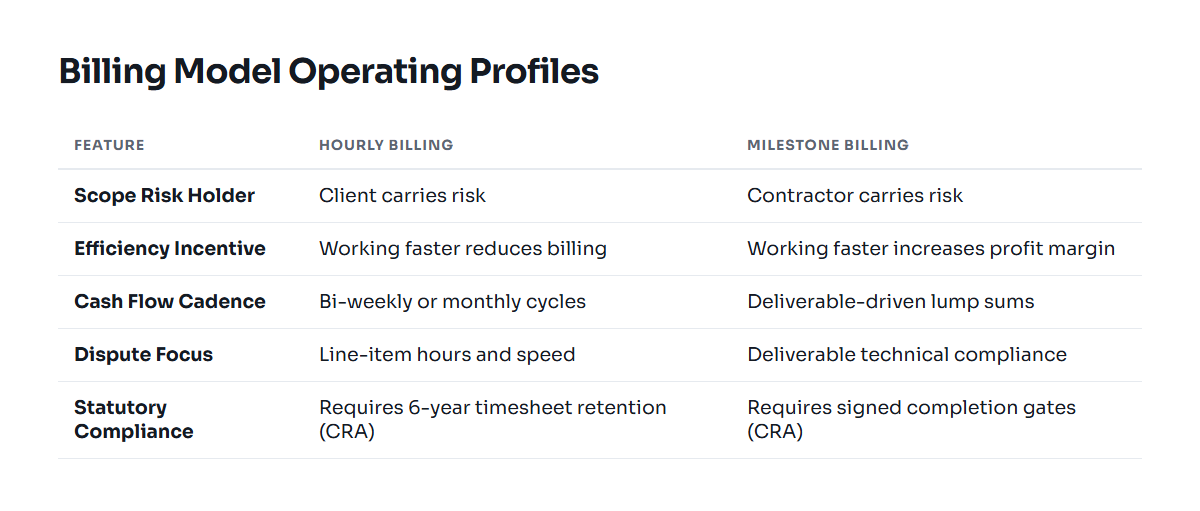
The operational differences between the two methods dictate how you draft contracts, track field work, and manage risk.
| Operational Criterion | Hourly Billing | Milestone Billing |
|---|---|---|
| Scope Risk | Client carries risk. Additional effort translates directly to additional billed hours. | Contractor carries risk. Unplanned effort directly reduces the net margin. |
| Margin Potential | Capped by your hourly rate and the total hours a human can work in a week. | Uncapped. Faster execution and repeatable workflows increase hourly yield. |
| Cash Flow Frequency | Steady, predictable billing on set calendar intervals (e.g., bi-weekly or monthly). | Lumpy. Payments depend on achieving deliverables and third-party approvals. |
| Dispute Trigger | Questioning timesheet efficiency, task durations, and billing increments. | Disagreements over whether a deliverable meets technical specifications. |
| Change Management | Low friction. New client requests simply run on the meter. | High friction. Any change requires a formal, written change order before work starts. |
| Administrative Load | Daily time tracking and task logging for every team member. | Detailed deliverable tracking and contract milestone verification. |
Cash Flow Predictability and Payment Timing
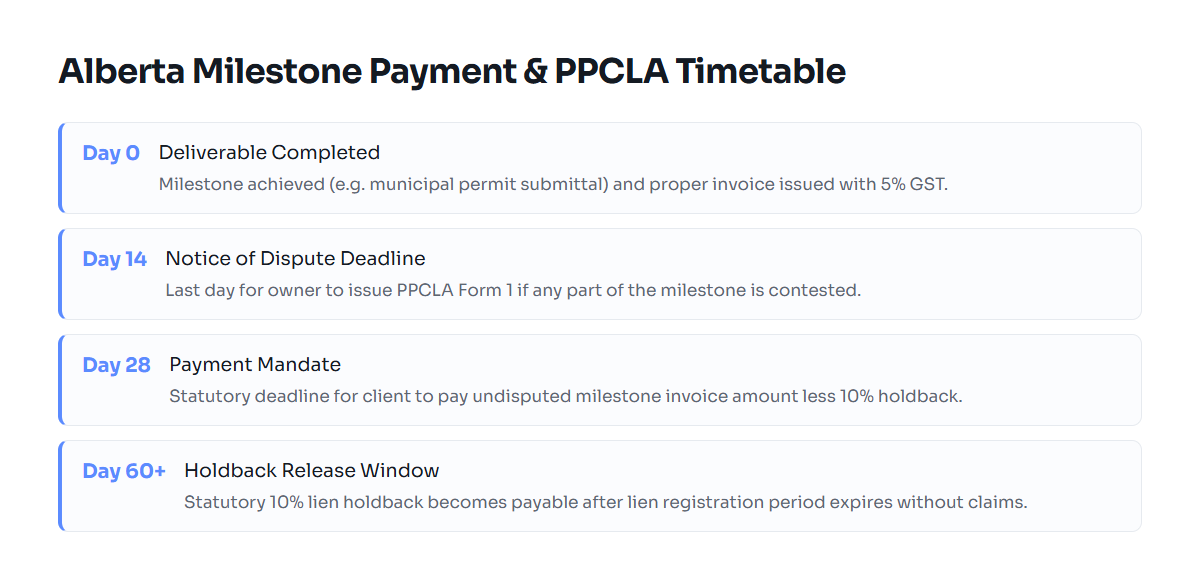
Consider an Alberta trade contractor working under the PPCLA. Once a proper invoice is submitted, an owner has 14 days to issue a Notice of Dispute (Form 1) for any contested amounts, and must pay undisputed amounts within 28 calendar days. When you bill hourly, owners often find line items to dispute, delaying the full invoice balance. When you bill a clearly defined milestone backed by an engineer's field review or an inspection permit, identifying grounds for dispute is far more difficult.
Handling Sales Taxes and Statutory Holdbacks
Sales tax applies to both methods based on the place of supply rules defined by the Excise Tax Act. In Alberta, you collect 5% GST. In Ontario, 13% HST applies. In British Columbia, services generally incur 5% GST, while taxable goods involve 7% PST. In Quebec, billing requires 5% GST and 9.975% QST.
Construction contracts introduce another layer: statutory holdback. Under Alberta's PPCLA, the owner or payer must retain a 10% statutory lien holdback from every progress or milestone payment. If you bill a $10,000 milestone in Edmonton, the client pays $9,000 plus 5% GST on the total work value ($500), withholding $1,000 in the holdback account until the 60-day lien registration period expires. When billing hourly on a construction project, applying holdback across hundreds of small invoices creates an accounting headache. For a detailed breakdown of holdback release schedules, read our article on Holdback Invoicing for Canadian Design Practices.
Worked Canadian Example: The $15,000 Commercial Fit-Out
To see how these mechanics interact, consider a mechanical design consultant hired for a commercial tenant improvement project in Calgary with an agreed scope value of $15,000.
Option A: The Hourly Route
The consultant estimates the project will take 100 hours at $150 per hour ($15,000 total). The team tracks time daily and issues monthly invoices.
- Month 1: 45 hours logged on preliminary site investigation and schematic layout. Invoice: $6,750 + 5% GST ($337.50) = $7,087.50.
- Month 2: 35 hours logged on equipment sizing and duct routing. Invoice: $5,250 + 5% GST ($262.50) = $5,512.50.
- Month 3: The landlord updates the base-building riser schedule. The consultant spends an unexpected 30 hours modifying drawings. Total month: 40 hours. Invoice: $6,000 + 5% GST ($300.00) = $6,300.00.
Total billed: $18,000 across 120 hours. While the consultant was paid for the extra hours, the client felt surprised by the $3,000 cost overrun. The relationship was strained, and the final payment took 60 days to resolve while the client questioned why the base-building coordination took 30 hours.
Option B: The Milestone Route
The consultant structures the exact same $15,000 scope into three milestone gates tied to objective municipal and construction phases:
- Milestone 1: Preliminary Design & Code Review (30% = $4,500 + 5% GST = $4,725). Delivered when preliminary drawings are issued for coordination.
- Milestone 2: Permit Application Submittal (40% = $6,000 + 5% GST = $6,300). Delivered when the stamped mechanical drawings are formally submitted to the City of Calgary planning portal.
- Milestone 3: Issued for Construction (IFC) & Final Review (30% = $4,500 + 5% GST = $4,725). Delivered when contractor tender packages are issued and sign-off is complete.
By using standard CAD libraries and standardized calculation sheets, the consultant completes the entire package in 75 hours instead of 100. The total revenue remains $15,000. The consultant's effective earning rate increases from $150 per hour to $200 per hour ($15,000 / 75 hours). Because each payment was tied to an undeniable submission gate, the client paid each proper invoice within the PPCLA 28-day window without disputing a single timesheet entry.
Who Each Option Is Genuinely Right For
Neither billing model is universally superior. Your business model, client type, and deliverable structure should dictate which one you choose.
Stick with Hourly Billing When:
- You provide troubleshooting, emergency service, or equipment diagnostics where the root cause is unknown.
- You act as a staff augmentation consultant, working under the direct daily supervision of the client's internal managers.
- The project involves expert witness testimony, legal dispute resolution, or litigation support where deliverables depend entirely on court schedules.
- The client cannot provide a defined scope of work and insists on exploring multiple alternative directions concurrently.
Adopt Milestone Billing When:
- You provide fixed-scope professional services, such as permit drawing sets, environmental phase one audits, or standard corporate tax setups.
- You are a trade contractor delivering discrete stages of installation (rough-in, trim, equipment commissioning) subject to municipal inspections.
- You have developed proprietary templates, processes, or automated software that let you complete projects significantly faster than the industry average.
- You work on commercial contracts governed by prompt payment legislation, where clean acceptance gates speed up accounts receivable collections.
Independent operators who want to transition out of manual timesheet verification into structured progress invoicing can track and bill both models using specialized billing tools like BoltBill Pro.
How to Transition from Hourly to Milestone Billing
Moving from hourly rates to deliverable milestones requires disciplined project management and explicit contractual boundaries.
- Audit your historical time logs. Look at your last ten completed projects. Calculate the actual hours spent on specific project phases. Never guess milestone prices; build them from your documented historical delivery data.
- Anchor milestones to external, objective gates. Avoid soft milestones like "draft review completed." Use verifiable events: "City of Edmonton development permit application submitted," "rough-in plumbing inspection tag signed," or "first beta build uploaded to client server." Objective gates prevent clients from holding payments based on subjective feedback.
- Include an explicit out-of-scope clause with hourly backup rates. Every milestone agreement must define what happens when the scope shifts. State clearly: "Any revisions or scope modifications outside the listed deliverables will be billed at our standard rate of $165/hr upon written client approval." This gives you a contractual safety valve.
- Retain proof of completion for CRA and lien compliance. When an objective gate is reached, generate a written completion receipt or milestone sign-off alongside your invoice. Under CRA requirements, store these records alongside your tax filings for six years.
- Use proper invoicing software. Configure your invoicing platform to output clear proper invoices that itemize deliverables, state applicable GST/HST numbers, display statutory holdbacks, and indicate prompt payment due dates. Review BoltBill Pro pricing to choose a billing tier that fits your independent trade or consulting business.
Common questions
Can I combine hourly and milestone billing on the same project?
Yes, many Canadian consultants use a hybrid contract structure. You can bill the discovery or exploratory phase hourly while the project scope is being determined, and then switch to milestone billing for the actual execution once deliverables and timelines are locked down.
How does milestone billing interact with Alberta prompt payment rules?
Under Alberta's Prompt Payment and Construction Lien Act (PPCLA), a proper invoice can be issued upon completing agreed contractual milestones. Once submitted, the payer has 14 days to deliver a formal Notice of Dispute and 28 days to pay the undisputed portion.
Does milestone billing increase the risk of scope creep?
Yes, if milestones are poorly defined. To prevent scope creep, tie every milestone to objective criteria (such as a municipal inspection pass or permit submission) and include a contract clause stating that out-of-scope work is billed at an hourly rate.
How long must I keep records of milestone sign-offs for Canadian tax purposes?
The Canada Revenue Agency requires you to keep all commercial records, receipts, signed contracts, milestone approvals, and invoices for a minimum of six years from the end of the tax year to which they relate.
Do I need to hold back statutory lien funds on hourly invoices?
Yes. If the work falls under provincial construction lien legislation (such as Alberta's PPCLA), the 10% statutory holdback applies to all construction progress billings, regardless of whether you invoice hourly or by milestone.
Related guides
Progress Billing Construction: Rules & Worked Guide
A complete guide to progress billing in Canadian construction, covering statutory holdback, prompt payment timelines, and step-by-step billing math.
Holdback Invoicing for Canadian Design Practices
A practical guide to calculating statutory holdbacks, managing GST/HST deferral, and billing for holdback releases in Canadian design practices.
How to Deal with Late Paying Clients in Canada
A systematic workflow to recover overdue invoices in Canada without torching client relationships.
Reimbursable Expenses Consulting Guide: Rules & Tax
A guide to billing reimbursable expenses in Canadian consulting, covering GST/HST out-of-pocket rules, markups, and CRA record retention.