BoltBill Pro guide
Billing Methods for Consultants, Contractors, and Trades
Master billing methods for consultants, contractors and trades in Canada. Learn hourly, milestone, progress billing, statutory holdbacks, and tax rules.

Independent operators succeed by matching their billing method to project risk: time-and-materials for undefined scopes, milestone billing for deliverable-based consulting, and progress billing with statutory holdbacks for physical construction. Choosing the wrong structure causes cash shortfalls, disputed scope additions, and delayed payments under provincial prompt payment legislation.
The Core Invoicing Methods and Statutory Rules
Billing methods govern how and when you demand payment for labour, equipment, and materials. In Canada, three distinct legal and commercial frameworks shape these invoices: provincial prompt payment statutes, provincial lien acts, and federal tax laws administered by the Canada Revenue Agency (CRA).
Every invoice issued by an independent business falls into one of four primary operational categories:
- Time and Materials (Hourly): You bill for exact hours worked at an agreed rate, plus direct disbursements (materials, travel, permit fees, subcontractor markups). This model protects the contractor when scope cannot be defined up front, such as troubleshooting existing mechanical systems or advisory consulting.
- Fixed-Fee (Lump Sum): You agree to deliver a fully defined scope for an exact total price. The service provider assumes the risk of cost overruns but keeps the margin if the work finishes efficiently.
- Milestone Billing: Payments tie directly to completed deliverables or project stages rather than elapsed calendar periods. For example, an environmental consultant bills upon completion of a Phase I site assessment report, or a graphic designer bills upon delivery of final vector assets. If you want to compare these two models directly, see our guide on Milestone Billing vs Hourly: Which Model Fits?.
- Progress Billing: You bill periodically (usually monthly) based on the percentage of total work completed during that cycle. This structure is universal in commercial construction, large mechanical installations, and multi-month civil work. Learn the detailed accounting mechanics in our guide to Progress Billing Construction: Rules & Worked Guide.
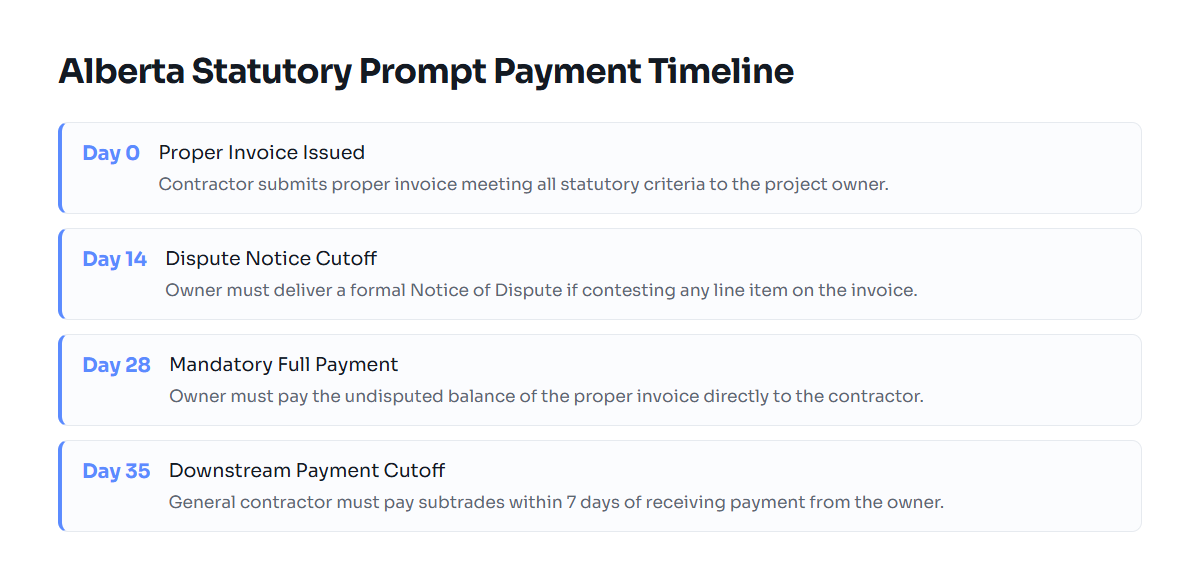
Provincial prompt payment legislation now dictates billing timelines across Canada. In Alberta, the Prompt Payment and Construction Lien Act (PPCLA) governs payments down the contracting chain. Section 32.1(1) requires a contractor to submit a "proper invoice" to the owner at least every 31 days unless the contract provides for testing and commissioning conditions. Once the owner receives that proper invoice, Section 32.2(1) gives them exactly 28 calendar days to pay the full amount or issue a formal Notice of Dispute for contested line items within 14 calendar days.
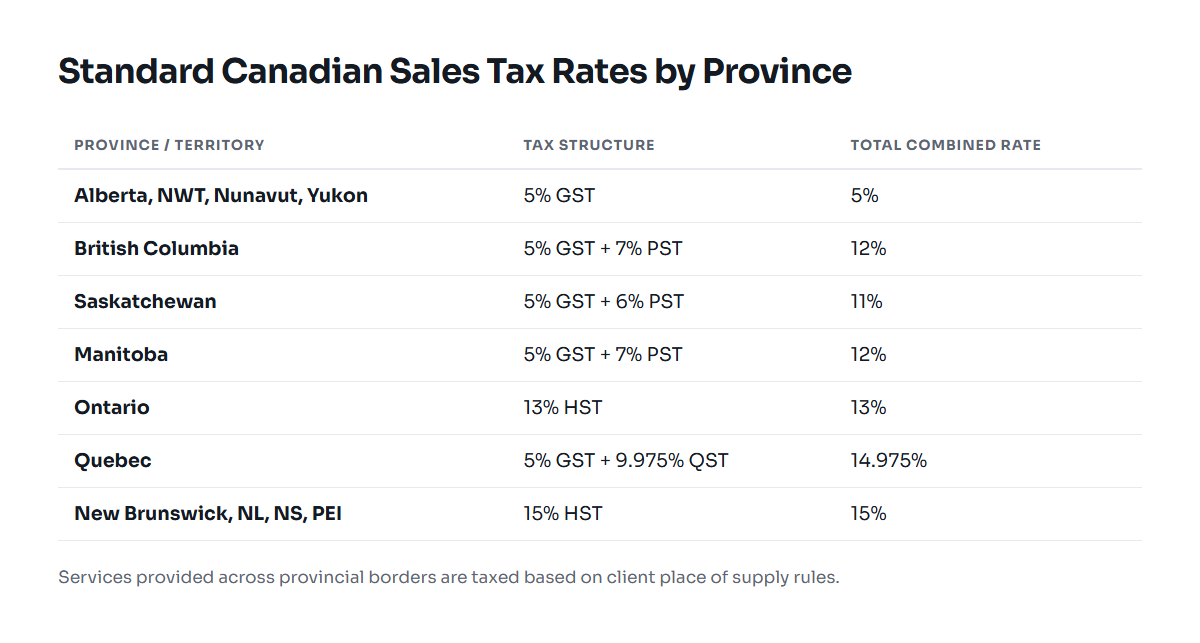
For Canadian sales taxes, the Canada Revenue Agency requires you to collect and remit the 5% Goods and Services Tax (GST) once your worldwide taxable supplies exceed $30,000 in a single calendar quarter or over four consecutive quarters. Depending on your province, you must charge either pure GST (5% in Alberta, British Columbia, Saskatchewan, Manitoba, Northwest Territories, Nunavut, and Yukon), a Harmonized Sales Tax blend (13% in Ontario; 15% in New Brunswick, Newfoundland and Labrador, Nova Scotia, and Prince Edward Island), or GST alongside separate provincial sales tax systems (PST in BC at 7%, Saskatchewan at 6%, Manitoba at 7%; or 9.975% QST in Quebec).
The CRA requires every invoice from a GST/HST registrant to state your nine-digit Business Number with the RT program identifier, the invoice date, total amount payable, and a clear breakdown of tax charged. If an invoice exceeds $100, the CRA mandates that you also state the client's legal name, payment terms, and a formal description of each service or material supplied.
| Billing Method | Best Suited For | Risk Borne By | Prompt Payment Trigger |
|---|---|---|---|
| Hourly / T&M | Repairs, service calls, troubleshooting, advisory consulting | Client absorbs scope expansion; provider absorbs rate cap risk | Monthly calendar cycle or service call completion |
| Fixed-Fee | Well-defined small projects, permit drawings, standard installations | Provider absorbs labour overruns and site delays | Agreed calendar intervals or contract execution stages |
| Milestone | Deliverable-driven engineering, custom fabrication, branding, software | Shared: provider carries cash flow between deliverables | Formal acceptance of the specific milestone deliverable |
| Progress Claim | Commercial trades, construction subcontracts, major renovations | Subcontractor carries working capital subject to statutory holdbacks | Monthly proper invoice submission under provincial statutes |
Provincial Holdback Rules and Tax Compliance Mechanics
When trades and general contractors bill on commercial or residential construction projects, provincial lien legislation alters the gross cash received. In Alberta, Section 18(1) of the Prompt Payment and Construction Lien Act establishes a mandatory 10% statutory holdback. The owner or general contractor must deduct 10% from the value of work and materials actually furnished on every progress payment.
Holdback funds do not belong to the payer; they constitute a statutory trust fund reserved for downstream subcontractors, suppliers, and workers who might file a lien against the project title. In Alberta, the owner retains this 10% reserve until the lien registration period expires: 60 days following contract completion, certificate of substantial performance, or abandonment for standard construction work, and 90 days for work on oil, gas, and mineral well sites.
Design practices and professional engineers face a distinct nuance regarding lien rights and holdbacks. In some Canadian jurisdictions, off-site consulting work does not qualify for lien rights if it does not directly enhance real property value. Read our practical breakdown in Holdback Invoicing for Canadian Design Practices to avoid cash flow dead-ends on consulting retainers.
Sales tax applies to the gross amount of your invoice before deducting the holdback. Under CRA GST/HST Policy Statement P-057R, tax on holdback amounts becomes collectible and remittable either on the day the holdback is actually paid out or on the day the statutory holdback period expires under provincial law, whichever occurs first. Many contractors fail audits by failing to track this tax timing difference on their accounts receivable ledger.
For independent sole proprietors and trade corporations operating across state borders into the United States, cross-border services require careful documentation. Canadian consultants providing cross-border services to US entities generally do not charge GST/HST, treating the service as a zero-rated export under Schedule VI, Part V of the Excise Tax Act, provided the service is entirely consumed outside Canada. When billing USA clients, engineering and technical consulting firms must secure formal IRS W-8BEN or W-8BEN-E forms from their clients to document tax treaty exemptions and prevent automatic 30% US non-resident backup withholding.
How Billing Methods Apply on a Real Project
To see these principles in practice, consider an independent mechanical and electrical trade contractor based in Calgary, Alberta. The contractor secures an commercial tenant improvement subcontract valued at $80,000 before taxes, requiring City of Calgary trade permits, commercial HVAC rough-ins, three-phase subpanel wiring, and final utility inspections with ENMAX.
The project spans three months. The contract specifies monthly progress billing under the Alberta PPCLA, with standard net 28 payment terms following proper invoice submission, subject to a 10% statutory holdback and 5% federal GST.
Worked Billing Example: Month 1 Progress Claim
During the first month, the electrical contractor completes the site mobilization, rough-in of conduits, and 50% of the distribution wiring. The approved Schedule of Values allocates $32,000 of the total $80,000 contract value to this initial phase.
- Value of Work Completed: $32,000.00
- Less 10% Statutory Alberta Holdback: -$3,200.00 (retained in owner trust)
- Net Work Payable: $28,800.00
- GST on Work Completed ($32,000.00 × 5%): $1,600.00
- Total Current Amount Due on Month 1 Proper Invoice: $30,400.00
Under Alberta PPCLA Section 32.2(1), once the general contractor receives this proper invoice, the 28-day countdown begins. The general contractor must pay $30,400.00 within 28 days or issue a formal Notice of Dispute specifying the precise reason and dollar amount withheld. Meanwhile, the $3,200 holdback sits in the statutory reserve, to be released 60 days after substantial performance of the total project.
Billing System Workflows for Consulting and Engineering Practices
If you run an independent engineering or consulting practice instead of a physical trade, managing these layered invoice structures by hand creates balance sheet errors. Practices that try to shoehorn construction progress billing, consulting hourly rates, and variable provincial taxes into basic spreadsheets run into recurring calculation mistakes.
Dedicated platforms like BoltBill Pro automate progress invoicing, milestone tracking, and statutory holdback accounting. Whether you need billing software for engineers managing percentage-of-completion deliverables, trade contractors managing scheduled values, or sole proprietors invoicing out-of-province clients, automated calculations eliminate manual accounting reconciliations. You can evaluate our subscription options directly on our pricing page.
Common Billing Misconceptions
Self-employed operators and small firms frequently run into cash flow bottlenecks because of widespread billing myths. Here are the facts behind common errors:
Myth 1: You can calculate sales tax on the net amount after deducting holdback
Fact: The CRA requires GST/HST calculation on the full value of the work completed. Calculating tax on the net payable amount understates your collected liability and creates immediate exposure during a CRA corporate tax audit.
Myth 2: You cannot submit a bill until the entire project passes final inspection
Fact: Under Alberta PPCLA Section 32.1(1), contractors have a statutory right to submit a proper invoice at least every 31 days unless the written contract explicitly sets testing and commissioning requirements that prevent interim billing. An owner cannot simply refuse interim invoices while waiting for a final municipal occupancy inspection unless the contract explicitly conditions interim acceptance on scheduled commissioning stages.
Myth 3: Fixed-fee invoices do not require detailed documentation
Fact: While you do not need to list individual hours on a fixed-fee billing, the CRA still mandates an unambiguous description of the service delivered, the contract reference, and proof that the contracted milestone was achieved. Omitting these details makes it impossible for an institutional client's accounting department to process the invoice within statutory prompt payment timeframes.
Myth 4: Small side businesses can ignore GST registration until year-end
Fact: The CRA small supplier threshold of $30,000 is a rolling calculation, not an annual calendar tally. The moment your gross revenue exceeds $30,000 within any single quarter, you cease to be a small supplier immediately and must register for GST before issuing your very next invoice.
Related Regulatory and Practice Requirements
Executing your billing method correctly requires tracking overlapping provincial and municipal administration rules:
1. CRA Document Retention Rules
Under Section 286(1) of the Income Tax Act and Section 286(1) of the Excise Tax Act, you must maintain all books, records, and commercial invoices for six years from the end of the last tax year to which they relate. These records must include electronic transaction logs, vendor receipts, permits, subcontracts, and proofs of payment. Invoices stored electronically must remain accessible in a readable format during an audit.
2. Local Permitting and Inspection Verification
In trades and engineering work, municipal inspection pass sheets directly support milestone and progress invoice approvals. In Alberta, work governed by the Safety Codes Act (building, electrical, plumbing, gas, and private sewage) requires permits issued by accredited municipalities or Authorized Accredited Agencies. Submitting the municipal Safety Codes inspection report or utility confirmation along with your proper invoice eliminates standard grounds for owner payment disputes.
3. Standardized Invoice Data for Prompt Payment
Under the Alberta PPCLA, a document does not qualify as a "proper invoice" unless it contains specific required elements: your legal business name, the invoice date, the period during which services or materials were supplied, the contract authority under which work was done, a description of the work and materials, the amount requested with a breakdown of taxes and holdback, and the name and contact information of the recipient. Missing any of these details restarts your 28-day payment clock.
For more analysis on contract administration and cash flow management, browse through our resources on the BoltBill blog.
Common questions
What is the difference between milestone billing and progress billing?
Milestone billing ties invoice issuance directly to the completed delivery and acceptance of a defined project phase, common in engineering design and software. Progress billing invoices periodically, typically every 30 days, based on the percentage of total scheduled contract values completed during that window.
How does statutory holdback affect GST remittances in Canada?
GST applies to the full gross value of work certified on the invoice. However, under CRA Policy Statement P-057R, tax attributable to the holdback itself becomes remittable only when the holdback is paid out or when the statutory lien holdback period expires, whichever is earlier.
When does a Canadian contractor have to register for GST/HST?
You must register for GST/HST as soon as your total taxable worldwide sales exceed $30,000 within a single calendar quarter or over four consecutive calendar quarters. Once you cross this threshold, you can no longer operate as a small supplier.
What constitutes a proper invoice under Alberta prompt payment legislation?
Under the Alberta Prompt Payment and Construction Lien Act, a proper invoice must contain your legal business name, date, invoice period, contract reference, clear work description, total amount payable with holdback and tax breakdowns, and recipient contact information.
How should a Canadian consultant bill clients located in the United States?
Services rendered to US clients are typically zero-rated (0% GST/HST) under the Excise Tax Act if consumed entirely outside Canada. Canadian consultants should also complete an IRS Form W-8BEN to document their foreign status and prevent automatic 30% US backup withholding.
Related guides
Milestone Billing vs Hourly: Which Model Fits?
A direct comparison of milestone billing versus hourly rates for Canadian independent businesses, covering cash flow risks, statutory holdbacks, and prompt payment rules.
Progress Billing Construction: Rules & Worked Guide
A complete guide to progress billing in Canadian construction, covering statutory holdback, prompt payment timelines, and step-by-step billing math.
Holdback Invoicing for Canadian Design Practices
A practical guide to calculating statutory holdbacks, managing GST/HST deferral, and billing for holdback releases in Canadian design practices.
How to Invoice as a Freelancer in Canada
A complete guide to Canadian freelance invoicing, covering CRA mandatory line items, GST/HST registration rules, provincial tax tables, and payment terms.