BoltBill Pro guide
How to Invoice as a Freelancer in Canada
Learn how to invoice as a freelancer in Canada. Understand CRA rules, GST/HST thresholds, place-of-supply tax rates, and proper invoice formatting.

To invoice as a freelancer in Canada, issue a written document stating your legal or business name, invoice date, unique invoice number, a clear description of services, the amount owing, and payment terms. If your worldwide taxable revenues exceed $30,000 in a single calendar quarter or over four consecutive calendar quarters, you must register for a Goods and Services Tax (GST)/Harmonized Sales Tax (HST) account and show your nine-digit Business Number on every invoice alongside the calculated sales tax based on your client's location.
Clear Requirements for Canadian Invoices
Learning how to invoice as a freelancer in Canada comes down to understanding two core requirements: commercial clarity and Canada Revenue Agency (CRA) compliance. An invoice serves as both a formal request for payment and a legally recognized tax document. Whether you are an independent copywriter in Calgary, a solo mechanical designer in Edmonton, or a freelance software developer in Vancouver, the structure of your bill determines how quickly you get paid and whether your clients can claim input tax credits.
A basic invoice for an unregistered freelancer requires your business name, contact information, the client's legal name, a distinct sequential invoice number, the date the invoice was issued, the date the service was delivered, an itemized breakdown of hours or project deliverables, and the total amount payable. If you operate as a sole proprietor under your own personal legal name, your invoice must clearly state that name. If you operate under an operating or trade name, state both your legal name and the registered trade name to avoid banking discrepancies when clients deposit cheques or process electronic fund transfers.
Payment terms must be explicit. Avoid vague statements such as "payable upon receipt." Specify concrete terms such as "Net 30 calendar days from invoice date" or state the exact calendar due date. Include your accepted payment methods, such as Interac e-Transfer email addresses, direct deposit banking instructions (institution number, transit number, and account number), or credit card processing links managed through BoltBill Pro.
The Governing CRA Rules and Sales Tax Thresholds
The Canada Revenue Agency governs commercial transactions through the Excise Tax Act. The pivotal dividing line for any self-employed individual is the small supplier threshold. Under CRA guidelines, you qualify as a small supplier and do not need to register for or charge GST/HST as long as your gross taxable revenues across all businesses do not exceed $30,000 CAD across four consecutive calendar quarters or within a single calendar quarter.
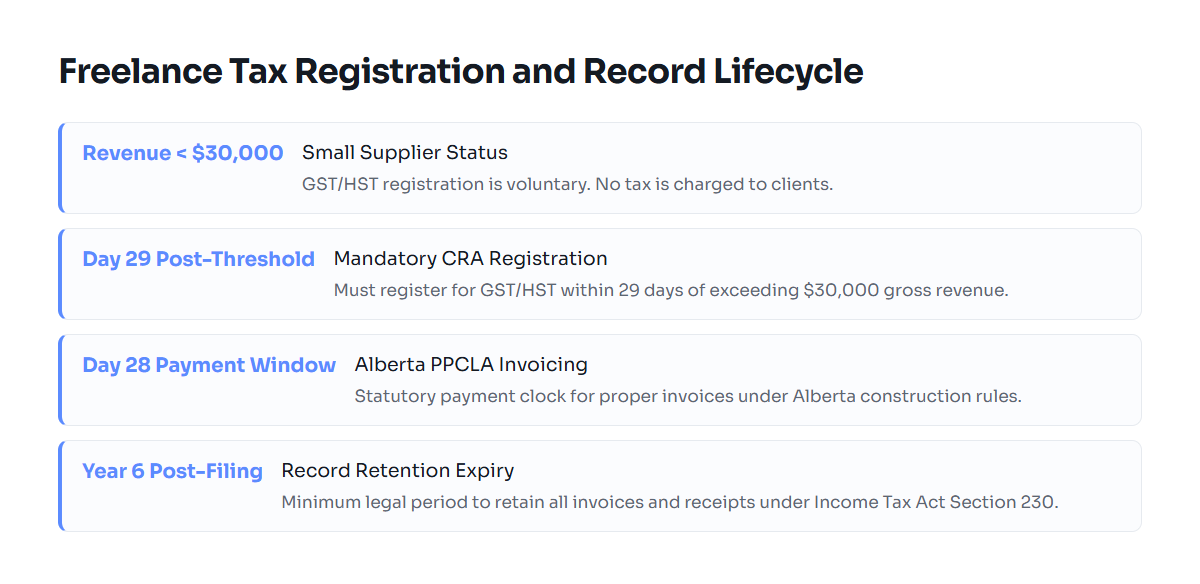
The moment your total gross revenue crosses $30,000, you cease to be a small supplier. You must register for a GST/HST account with the CRA within 29 days of exceeding the threshold. You can also register voluntarily before hitting $30,000. Voluntary registration permits you to claim Input Tax Credits (ITCs) on business expenses, recovering the GST and HST you spend on software, equipment, tools, and office supplies.
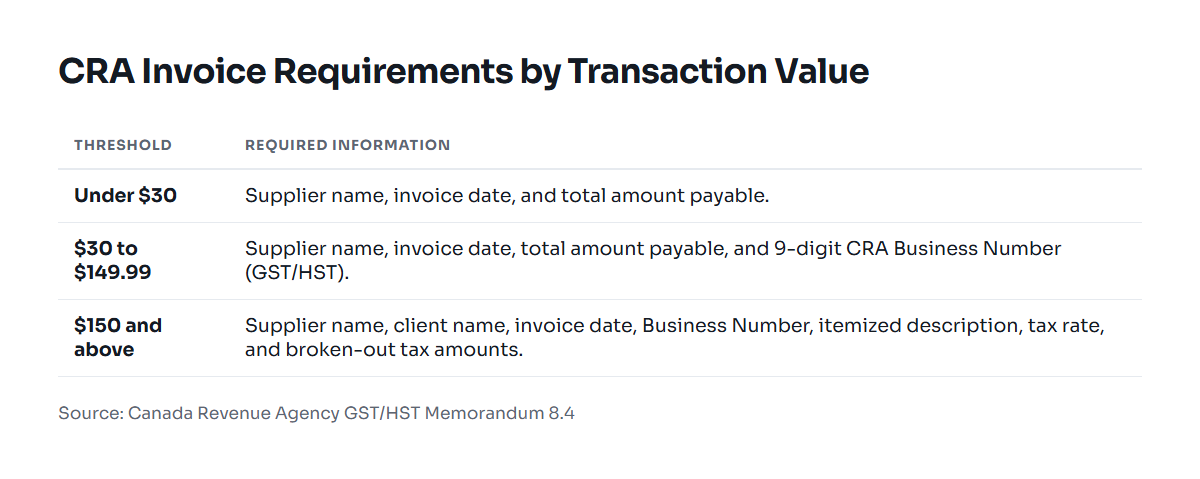
Once registered, every invoice of $30 or more must meet specific CRA disclosure standards. If an invoice totals between $30 and $149.99, it must display your business name, invoice date, total amount paid or payable, and your nine-digit CRA Business Number with the RT program identifier (for example, 123456789 RT 0001). For taxable sales of $150 or more, CRA requires additional data: the client's legal name, a brief description of each service, the applicable tax rate, the exact tax dollar amount broken out per line or aggregated at the bottom, and clear terms of payment.
Sales tax rates are determined by the CRA place-of-supply rules. As outlined in the CRA place-of-supply rules, the tax rate depends on where the client receives or accesses your service, not where your desk sits. If you work from Alberta but deliver a technical report to a client located in Ontario, you must charge 13% Ontario HST. If you deliver that same report to a client in British Columbia, you collect 5% GST.
| Province or Territory | Tax Type | Total Federal + Provincial Rate | Freelancer Billing Treatment |
|---|---|---|---|
| Alberta, NWT, Nunavut, Yukon | GST only | 5% | Charge 5% GST to clients located here. |
| British Columbia | GST + PST | 5% GST (7% PST separate) | Charge 5% GST. PST rarely applies to pure professional services. |
| Saskatchewan | GST + PST | 5% GST (6% PST separate) | Charge 5% GST. PST applies to specific taxable services under provincial rules. |
| Manitoba | GST + RST | 5% GST (7% RST separate) | Charge 5% GST. RST applies to designated services. |
| Ontario | HST | 13% | Charge combined 13% HST. |
| Quebec | GST + QST | 5% GST + 9.975% QST | Charge 5% GST. QST requires separate Revenu Québec registration if thresholds are met. |
| New Brunswick, Newfoundland, Nova Scotia, PEI | HST | 15% | Charge combined 15% HST. |
Keep every invoice, receipt, and bank record for a minimum of six years from the end of the relevant tax year, as mandated by Section 230 of the federal Income Tax Act. If an invoice supports an asset purchase or capital cost allowance deduction, retain those records longer.
Worked Example: Invoicing Across Provincial Lines
Consider an independent technical consultant operating as a sole proprietor in Calgary, Alberta. The consultant is GST-registered with Business Number 849201837 RT 0001. In November, they complete 30 hours of systems integration work for a commercial logistics company based in Mississauga, Ontario, at a contract rate of $120.00 per hour. They also bill $250.00 for reimbursement of specialized software licensing fees purchased specifically for this project.
Because the client is situated in Ontario, the supply is considered made in Ontario under CRA place-of-supply rules. The applicable tax is Ontario's 13% HST, not Alberta's 5% GST. Here is how the numbers calculate on the invoice:
- Line Item 1: Systems Integration Consulting (30.0 hours @ $120.00/hr) = $3,600.00
- Line Item 2: Project Software Access Pass (Flat fee) = $250.00
- Subtotal before tax: $3,850.00
- Harmonized Sales Tax (HST @ 13%): $500.50
- Total Invoice Amount: $4,350.50
The invoice header displays the consultant's full legal name, their trade name ("Apex Technical Services"), their Calgary business address, their phone number, and their GST/HST registration number: 849201837 RT 0001. The document is labeled with invoice number ATS-2024-042 and dated November 30, 2024. The payment terms state: "Net 30 days. Payable by December 30, 2024. Remit via Interac e-Transfer to payments@apextech.example or via direct electronic funds transfer to Transit 10294, Institution 003, Account 1234567."
For contractors and trade specialists operating in Alberta whose work touches physical property, additional statutory rules apply. Under the Alberta Prompt Payment and Construction Lien Act (PPCLA), an invoice meeting the statutory definition of a "proper invoice" triggers a mandatory 28-day payment timeline from the owner or prime contractor. A proper invoice under the PPCLA must include the contractor's name and address, the date of the invoice, the period during which services were rendered, reference to the governing contract or purchase order, a description of work completed, the amount requested, a clear statement identifying it as a proper invoice, and details regarding any statutory holdback (typically 10% under provincial lien legislation).
Where Freelance Billing Fails in Practice
Invoicing errors waste billable hours, delay payments, and draw scrutiny during CRA desk audits. The most frequent errors fall into four areas.
1. Charging GST/HST Without a Registered Business Number
Collecting sales tax without an active CRA GST/HST account is illegal. If you do not have a registered Business Number ending in RT 0001, you cannot collect tax on your invoices. Adding a five percent or thirteen percent charge to your bill without remitting it to the CRA constitutes tax fraud. Conversely, if you are registered and omit your registration number, corporate clients will routinely withhold payment because their accounting teams cannot claim their input tax credits without that number on file.
2. Misapplying Place-of-Supply Rules
Freelancers frequently bill sales tax based on their own home province rather than their client's address. Charging 5% GST to a client in Toronto when you should be charging 13% HST leaves you personally liable for the uncollected 8% difference during a CRA audit. The CRA holds the supplier responsible for calculating, collecting, and remitting the correct provincial tax.
3. Unclear Payment Terms and Missing Interest Clauses
Writing "Due Upon Receipt" creates ambiguity because it sets no enforceable deadline. Specify "Net 15" or "Net 30" and state the calendar date. If your contract allows for late fees, state the exact annual interest rate on the invoice (for example, "Interest of 1.5% per month (19.56% per annum) applied to balances past 30 days"). Without prior agreement in your contract or engagement letter, you cannot retroactively enforce late interest fees.
4. Poor Audit Trails and Document Retention
Sending editable spreadsheets or word processor documents invites numbering mistakes and file loss. When clients ask for replacement copies months later, solo operators often waste hours tracking down what was billed. Using dedicated platforms like the BoltBill blog guides outline, or automated tools like pricing-friendly software, ensures every invoice maintains a permanent PDF snapshot, an immutable issue date, and an organized sequential audit trail that withstands CRA inspection.
The CRA-Compliant Invoicing Checklist
Before emailing an invoice to any Canadian client, review this nine-point compliance check:
- Provider Identity: Your legal name, registered trade name, business mailing address, phone number, and email.
- Client Identity: The client's legal business name, contact person, and billing address.
- Document Metadata: The word "Invoice" prominently displayed, an issuance date, and a distinct, sequential invoice number.
- Tax Registration Details: Your nine-digit CRA Business Number followed by "RT 0001" (if registered). If not registered, ensure no tax line item appears.
- Service Breakdown: Explicit line items describing the project deliverables, hours worked, unit rates, and service dates.
- Tax Line Items: Subtotal before taxes, followed by a separate line showing the applied tax (GST, HST, or QST), the percentage rate, and the exact dollar amount calculated.
- Grand Total: The final amount due, presented clearly in Canadian Dollars (CAD).
- Payment Terms: Clear payment terms (such as "Net 30 calendar days") along with the explicit calendar due date.
- Remittance Details: Exact remittance instructions, including bank account details, e-Transfer address, or online payment link.
Common questions
Do I need to charge GST or HST if I earn under $30,000?
No. If your gross commercial revenues remain below $30,000 across four consecutive calendar quarters, you qualify as a small supplier and do not need to register or charge sales tax. You can choose to register voluntarily to claim Input Tax Credits on your business expenses.
What tax rate do I charge an American or international client?
Services supplied to non-residents who are outside Canada are generally zero-rated under the Excise Tax Act, meaning the tax rate is 0%. You do not charge GST or HST, but you must still report the zero-rated sales on your CRA tax return.
Can I put my personal name on an invoice instead of a business name?
Yes. Sole proprietors operating under their legal personal name can bill directly under that name. If you use a separate brand or trade name, state both your legal name and your trade name on the invoice.
What happens if I forget to put my GST number on an invoice?
Your client's accounting department will likely reject or delay payment because they cannot legally claim an Input Tax Credit without your CRA Business Number. Issue an amended invoice showing the full nine-digit RT number immediately.
How long do I need to keep copies of sent invoices in Canada?
You must retain all sent invoices, billing records, and revenue receipts for at least six years from the end of the last tax year to which they relate, as mandated by Section 230 of the Income Tax Act.
Related guides
How to Invoice as an Electrician in Canada
A complete guide for Canadian electricians on drafting compliant invoices, managing GST, and navigating provincial prompt payment rules.
Invoicing Software Pricing Comparison for Canadians
A transparent look at invoicing software pricing models, hidden fees, and compliance costs for Canadian consultants, trades, and professional firms.
What Has to Be on a Canadian Invoice
A complete guide to the mandatory fields, tax registration numbers, and provincial rules required on Canadian business invoices.
Milestone Billing vs Hourly: Which Model Fits?
A direct comparison of milestone billing versus hourly rates for Canadian independent businesses, covering cash flow risks, statutory holdbacks, and prompt payment rules.