BoltBill Pro guide
How to Invoice Someone as a Freelancer
Learn how to invoice someone as a freelancer in Canada with exact CRA rules, provincial sales tax rates, clear payment terms, and a worked example.

To invoice someone as a freelancer, issue a clear, written bill containing your legal name, an invoice number, the date, an itemized description of work, accepted payment methods, and your tax registration number if you collect GST or HST. Specify exact payment terms such as Net 30, and calculate sales tax based on your client's location. Delivering this complete document immediately upon completing work ensures faster payment and complies with Canadian tax requirements.
The Core Elements of a Freelancer Invoice
Knowing how to invoice someone as a freelancer begins with understanding what turns an informal payment request into a legally binding billing record. Whether you work as a software developer, an independent consultant, a copywriter, or an artisan trade contractor, every professional invoice serves two masters: your client's accounts payable department and the Canada Revenue Agency (CRA).
To satisfy both, every freelancer invoice must contain core identifiers:
- Header Information: Your legal name or registered business name, operating address, phone number, and email.
- Client Information: The client's company name, billing contact, and mailing address.
- Document Identifiers: The word "Invoice" clearly displayed, a unique sequential invoice number (for example, INV-0101), and the invoice issue date.
- Scope Breakdown: Itemized descriptions of hours worked, project milestones achieved, or deliverables completed, accompanied by unit rates and quantities.
- Payment Terms and Due Date: Explicit payment terms (such as "Net 30" or "Due on Receipt") along with the calendar due date.
- Payment Routing Details: Specific instructions for Interac e-Transfer, direct deposit (institution, transit, and account number), or electronic wire.
- Tax Identifiers: Your 9-digit Business Number with the RT program identifier if you are registered to collect sales tax.
If you are drafting your first commercial bill, our guide on issuing your First Invoice as Self Employed: Complete Canadian Guide walks through basic administrative setup. Maintaining sequential invoice numbering prevents duplicate billing disputes and keeps your accounting ledger clean from day one.
The Governing Canadian Rules: CRA Requirements and Provincial Sales Tax
Freelancers in Canada cannot arbitrarily charge or omit tax. The Canada Revenue Agency administers federal tax rules that dictate how to invoice someone as a freelancer once your earnings reach certain milestones.
The $30,000 Small Supplier Threshold
Under CRA guidelines, you must register for and collect the Goods and Services Tax (GST) or Harmonized Sales Tax (HST) if your worldwide taxable commercial supplies exceed $30,000 over a single calendar quarter or four consecutive quarters. If your gross revenue stays at or below $30,000 across four consecutive calendar quarters, you qualify as a small supplier and do not need to register or charge GST/HST. However, once you cross that threshold, registration is mandatory, and you must display your valid registration number on every commercial invoice exceeding $30.
The Place of Supply Rule
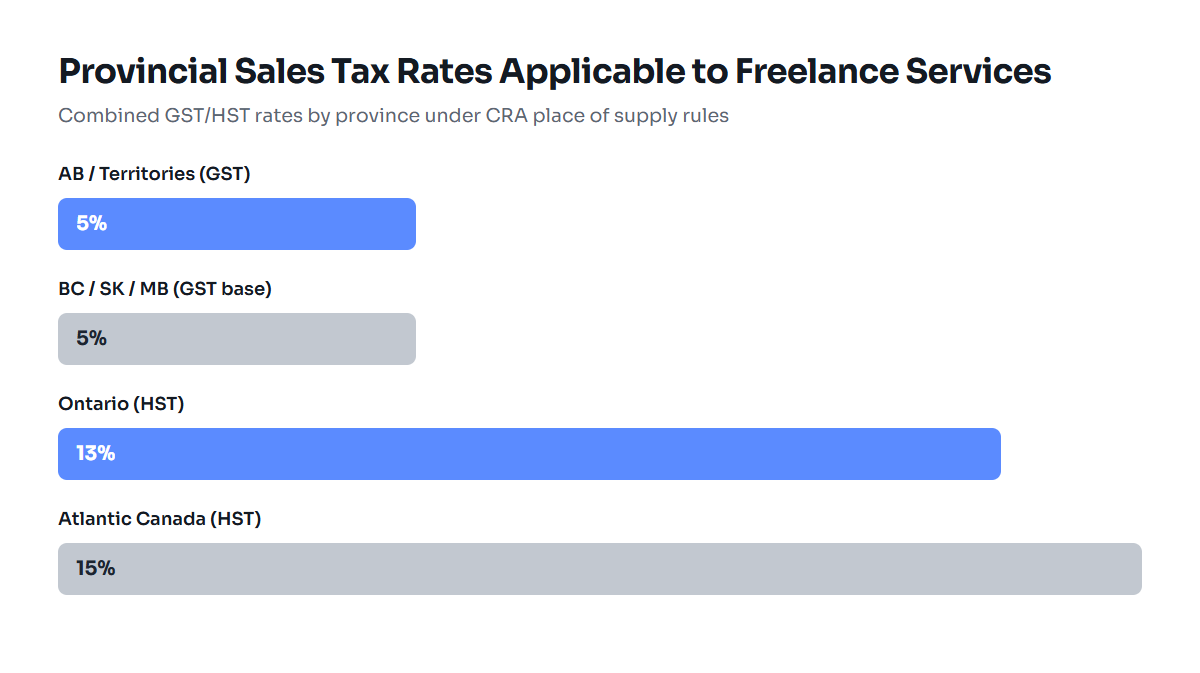
A frequent point of confusion is determining which tax rate applies. Canadian tax policy follows the "place of supply" rule. You charge the sales tax rate of the province or territory where your customer receives your service or goods, not the province where you sit.
For example, if you operate out of Calgary, Alberta, where there is no provincial sales tax and only 5% GST applies, but your client is in Ontario, you must charge Ontario's 13% HST on the taxable service. If your client is in British Columbia, you charge 5% GST on the service (and determine if provincial sales tax applies to tangible goods or software under provincial rules). For clients in Quebec, you charge 5% GST alongside the Quebec Sales Tax (QST) of 9.975% if registered.
| Province / Territory | Tax Type | Total Rate Charged to Client |
|---|---|---|
| Alberta, Northwest Territories, Nunavut, Yukon | GST | 5% |
| British Columbia | GST (+ PST if applicable) | 5% GST (plus 7% PST where applicable) |
| Saskatchewan | GST (+ PST if applicable) | 5% GST (plus 6% PST where applicable) |
| Manitoba | GST (+ RST if applicable) | 5% GST (plus 7% RST where applicable) |
| Ontario | HST | 13% |
| New Brunswick, Newfoundland and Labrador, Nova Scotia, Prince Edward Island | HST | 15% |
| Quebec | GST + QST | 5% GST + 9.975% QST |
To quickly verify your line-item calculations before sending a bill to an out-of-province customer, you can calculate the exact amounts using our GST/HST Invoice Calculator.
CRA Record Retention
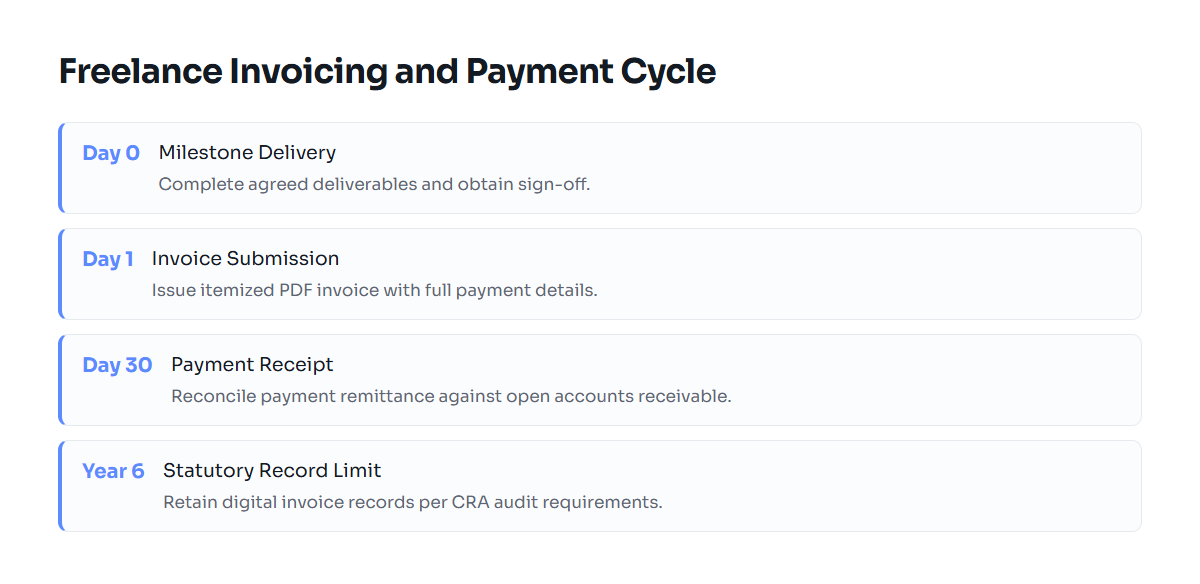
The CRA requires self-employed individuals and commercial contractors to retain all books, records, bank statements, and issued invoices for a minimum of six years from the end of the tax year to which they relate. Storing digital copies in cloud storage or specialized invoicing software ensures compliance if an audit occurs.
Worked Example: Real Numbers for a Canadian Freelance Invoice
To see how to invoice someone as a freelancer with real figures, consider an independent mechanical drafting contractor based in Edmonton, Alberta, billing a commercial engineering firm located in Toronto, Ontario. The drafting consultant completed 32 hours of 3D modeling and preparation work at an agreed rate of $85 per hour.
Because the client is located in Ontario, the applicable tax under the place of supply rules is 13% HST. The contractor is GST/HST registered under Business Number 123456789 RT0001.
- Subtotal: 32 hours × $85.00/hour = $2,720.00
- Harmonized Sales Tax (Ontario 13% HST): $2,720.00 × 0.13 = $353.60
- Invoice Total Due: $3,073.60
The contractor structures the payment details section of the invoice with unambiguous routing data:
Payment Due: November 30, 2024 (Net 30)
Payment Methods:
1. Interac e-Transfer: billing@contractoroffice.ca (auto-deposit enabled)
2. Direct Deposit / EFT:
Bank Name: Alberta Treasury Branches (ATB Financial)
Institution Number: 219
Transit Number: 07329
Account Number: 1029384756
Please reference invoice number INV-2024-088 on all remittances.
Providing the 3-digit institution code, 5-digit transit number, and account number directly on the document prevents payment delays caused by corporate finance departments waiting for external vendor direct deposit paperwork.
Where Invoicing Goes Wrong in Practice
Even seasoned independent operators stumble over avoidable billing pitfalls. Knowing how to invoice someone as a freelancer involves dodging several common traps:
1. Ambiguous Payment Terms
Writing "Due Upon Receipt" sounds urgent, but in standard accounting practice it creates confusion. Corporate finance desks batch their vendor pay runs on the 15th and 30th of each month. State an exact calendar due date alongside terms such as "Net 30 days." In provinces like Alberta, construction-related billing falls under the Prompt Payment and Construction Lien Act, which mandates explicit timelines: owners must pay proper invoices within 28 calendar days of receipt. While general freelance work is governed by contract law rather than construction lien acts, setting firm 14-day or 30-day payment dates provides a clear timeline for sending late payment notices.
2. Charging GST Without a Valid Business Number
It is illegal to collect GST or HST from a customer without an active CRA registration number. If you are unregistered because your revenue is under $30,000, your invoice subtotal equals your final total. If you add 5% without an RT registration number, corporate clients will reject the invoice or report the error to avoid losing their own input tax credits.
3. Unclear Expense Reimbursements
When billing a client for out-of-pocket project costs—such as site parking, printing materials, or specialized testing fees—freelancers often submit a flat dollar amount without supporting receipts. Always list reimbursable disbursements as distinct line items and attach copies of original receipts to prevent accounting disputes.
For further breakdown on structural differences across industries, consult our detailed walkthrough on How to Invoice as a Freelancer in Canada.
Freelancer Invoicing Checklist
Before emailing your PDF invoice to any client, verify each item on this operational checklist:
- Document Title and Number: Ensure the word "Invoice" is distinct, with a unique sequential numbering sequence.
- Dates: The invoice creation date and the explicit payment due date are visible at the top.
- Your Details: Correct legal name, operating address, and business email.
- Client Details: Company legal name, billing contact, and company physical or postal address.
- Clear Line Items: Units, hourly rates, dates of service, and concise descriptions for each deliverable.
- Sales Tax Compliance: The correct provincial sales tax rate based on your client's location, alongside your 9-digit CRA Business Number (if registered).
- Financial Accuracy: Subtotal, tax dollar calculation, and final total balance verified.
- Payment Instructions: Complete e-Transfer email or bank routing numbers (institution, transit, account) printed directly on the page.
- Backup Documentation: Signed work approvals, timesheet logs, or expense receipts attached as an appendix.
Implementing these standard practices guarantees your invoices move smoothly through client approval pipelines while maintaining bulletproof financial records for annual tax filings.
Free tools: GST/HST invoice calculator · hourly rate calculator
Common questions
Can I invoice someone as a freelancer without a registered business name?
Yes. If you operate as a sole proprietor under your own legal name, you can issue invoices using your personal first and last name. You only need a formal registered trade name if you operate under a separate brand identity.
Do I charge GST or HST if my freelance business makes under $30,000?
No. If your gross commercial revenue remains at or below $30,000 across four consecutive calendar quarters, you qualify as a small supplier under CRA rules. You do not register for, charge, or remit GST/HST until you exceed that threshold.
What payment terms should a Canadian freelancer put on an invoice?
The most standard term is Net 30, which requires payment within 30 calendar days from the invoice date. Freelancers often negotiate Net 14 or Net 15 for faster turnaround, especially on smaller project milestones.
How do I determine which provincial tax rate to charge a remote client?
Canadian tax law uses the place of supply rule, meaning you charge the tax rate of the province where your client receives the service. For example, an Alberta freelancer billing an Ontario client charges 13% HST.
What banking information should I include for Canadian direct deposit?
Include your full legal or business name, the financial institution code (3 digits), the branch transit number (5 digits), and your account number (7 to 12 digits), which can be found on a void cheque.
Related guides
First Invoice as Self Employed: Complete Canadian Guide
A complete guide to sending your first invoice as a self-employed Canadian, covering CRA tax rules, payment terms, and practical billing steps.
How to Invoice as a Freelancer in Canada
A complete guide to Canadian freelance invoicing, covering CRA mandatory line items, GST/HST registration rules, provincial tax tables, and payment terms.
How to Write a Quote: Complete Canadian Guide
A practical guide for Canadian contractors, consultants, and freelancers on how to write a binding quote with clear scope, tax rates, and payment terms.
USA Invoicing Software Guide for Independent Practices
A direct guide to selecting USA invoicing software, handling USD payments, ACH routing, and IRS tax forms without expensive platform overhead.