BoltBill Pro guide
First Invoice as Self Employed: Complete Canadian Guide
Send your first invoice as self employed in Canada. Learn mandatory CRA requirements, GST/HST thresholds, payment terms, and view a full worked example.
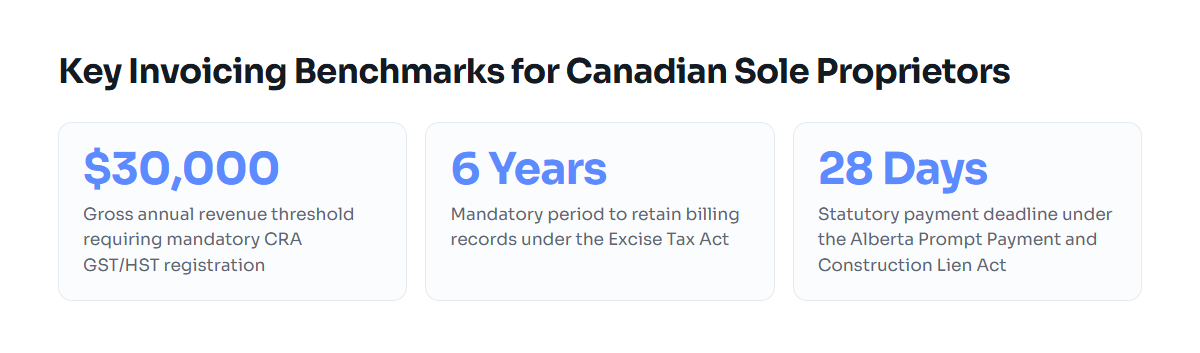
To send your first invoice as self employed in Canada, issue a written document containing your legal or business name, client details, an itemized scope of work, an invoice date, a unique identifier, and defined payment terms. You must charge GST or HST only if you have registered for a Canada Revenue Agency business number, which becomes mandatory once your worldwide taxable revenues exceed $30,000 across four consecutive calendar quarters.
The Core Elements of Your First Invoice
Your first invoice serves two distinct purposes: it prompts your client to pay you on time, and it acts as an official accounting record for both parties under federal tax law. Missing details will delay your payment or cause deductions during a Canada Revenue Agency (CRA) review.
Every standard invoice you send must state the following details clearly on a single page:
- Header and Business Information: Your full legal name (and registered trade name if operating as a sole proprietorship), business mailing address, phone number, and professional email address.
- Client Information: The client's legal business name, contact person, billing address, and department or purchase order number if they supplied one.
- Tracking Metadata: A distinct invoice number and the date of issue. Avoid starting with "1"; use an alphanumeric format such as "INV-2025-001" to keep accounting logs organized.
- Description of Supply: Specific line items describing each deliverable, service rendered, or milestone achieved, including hourly rates or fixed fees and unit counts.
- Financial Summary: The subtotal before tax, any applicable provincial or federal sales taxes calculated on separate lines, and the grand total due.
- Payment Terms: The exact payment window (for example, "Net 30 calendar days from invoice date"), accepted payment methods (Interac e-Transfer address, EFT direct deposit details, or wire instructions), and any agreed late payment interest rate.
For individuals stepping into independent work, adopting dedicated BoltBill Pro tools early prevents bookkeeping errors, especially when handling varying project agreements across provincial boundaries.
The Governing Rules: CRA Standards and Provincial Sales Tax
The Canada Revenue Agency enforces strict documentation rules for taxable supplies under the Excise Tax Act. The threshold determining whether you must collect sales tax is known as the Small Supplier rule.
The $30,000 Small Supplier Threshold
Under CRA regulations, you are categorized as a small supplier if your total taxable revenues from all business activities do not exceed $30,000 over a single calendar quarter or across the previous four consecutive calendar quarters. Once your gross billings exceed $30,000 within that window, you cease to be a small supplier immediately or at the end of the month following the quarter in which you crossed the limit. You must register for a CRA GST/HST account and begin charging tax.
If you bill before registering, you cannot legally add GST or HST to your invoice. If you are registered, your nine-digit CRA Business Number followed by the program identifier "RT0001" must be displayed on every invoice you issue.
Provincial Tax Variations
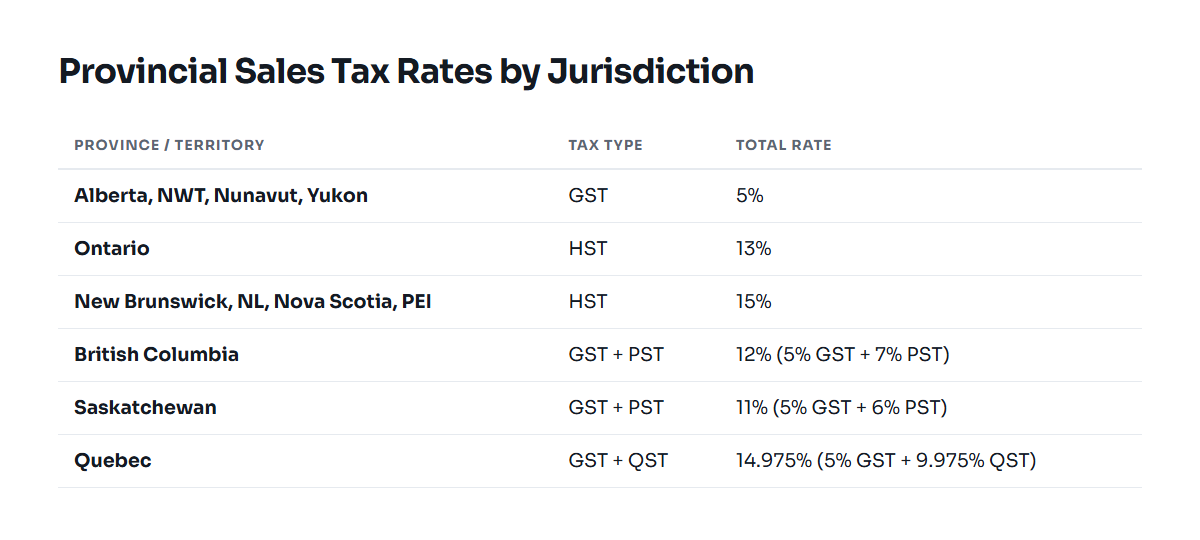
The sales tax you apply depends on the province where the supply is received under CRA place-of-supply rules, not necessarily where your desk is located:
- Alberta, Northwest Territories, Nunavut, Yukon: 5% GST. Alberta does not levy a provincial sales tax.
- Ontario: 13% HST.
- New Brunswick, Newfoundland and Labrador, Nova Scotia, Prince Edward Island: 15% HST.
- British Columbia: 5% GST plus 7% PST (administered separately through the BC Ministry of Finance).
- Saskatchewan: 5% GST plus 6% PST (administered separately through the Saskatchewan Ministry of Finance).
- Quebec: 5% GST plus 9.975% QST (administered by Revenu Québec).
If you are based in Calgary and perform consulting work remotely for a client in Toronto, you apply Ontario's 13% HST to that invoice, provided the service is delivered to Ontario under place-of-supply rules.
Statutory Invoicing Data Requirements
CRA document requirements depend on the total dollar value of the invoice:
| Invoice Total Value | Mandatory Business Details | Mandatory Tax & Line Details |
|---|---|---|
| Under $30.00 | Supplier name, invoice date | Total amount payable |
| $30.00 to $149.99 | Supplier name, invoice date, CRA GST/HST registration number | Total amount paid/payable, indication of which items are taxable, tax rate applied |
| $150.00 and above | Supplier name, recipient name, invoice date, CRA GST/HST registration number | Itemized description of each supply, terms of payment, subtotal, tax amount separated by rate, grand total |
Record Retention and Statutory Timelines
Section 286 of the Income Tax Act and Section 98 of the Excise Tax Act require you to retain all issued invoices, receipts, and supporting transaction logs for six years from the end of the last tax year to which they relate. If you operate in the construction sector or supply trade services in Alberta, the Prompt Payment and Construction Lien Act (PPCLA) governs your billing timelines. A proper invoice issued under the PPCLA triggers a statutory requirement for the owner or general contractor to pay within 28 calendar days unless a formal notice of dispute is issued within 14 calendar days.
Worked Example: An Alberta Service Contract with Real Numbers
Consider an independent specialist living in Edmonton, Alberta, who completes a technical consulting assignment for a commercial facility manager in Calgary. The agreed contract includes a fixed project fee of $2,000 for site evaluation, 8 hours of follow-up reporting at $100 per hour, and $150 in direct disbursements for municipal document retrieval.
Because the consultant is registered for GST with the CRA, the invoice breakdown looks like this:
- Item 1: Facility Condition Assessment (Fixed Fee milestone) = $2,000.00
- Item 2: Data Compilation and Client Presentation (8 hours @ $100.00/hr) = $800.00
- Item 3: Municipal Land Title and Permit Searches (Disbursements at cost) = $150.00
- Subtotal: $2,950.00
- GST (5% applied to $2,950.00): $147.50
- Total Amount Due: $3,097.50
The invoice header displays the business name, contact information, and "CRA GST/HST Registration Number: 123456789 RT0001". Below the total, the payment block states: "Payment Due: October 30, 2025 (Net 30 days). Please remit payment via direct deposit to Institution 003, Transit 12345, Account 9876543, or via Interac e-Transfer to payments@exampleconsulting.ca."
For additional details on structuring contracts across various industries, see our guide on How to Invoice as a Freelancer in Canada.
Where First-Time Invoicing Fails in Practice
First-time self-employed operators frequently run into administrative friction by repeating several predictable errors:
1. Charging Sales Tax Without a Registration Number
Collecting GST or HST without an active CRA registration number is illegal. Clients will refuse payment if an invoice displays a tax charge without the required 9-digit RT0001 account number. If you are unregistered under the $30,000 threshold, you must charge only your agreed fee with zero sales tax applied.
2. Vague Line Item Descriptions
Writing "Consulting work completed - $3,000" creates payment delays. Accounts payable clerks require verifiable task summaries to reconcile invoices against contracts. Always write clear descriptions: specify dates worked, deliverables handed over, or milestones reached.
3. Omitting Clear Due Dates
Writing "Payment due upon receipt" creates friction because standard enterprise accounts payable systems run on set bi-weekly or monthly payment cycles. Specify an unambiguous calendar date, such as "Due Date: November 15, 2025 (Net 14 Days)."
4. Misapplying Destination Tax Rates
When billing a client outside your home province, charging your local tax rate rather than the recipient's provincial rate causes accounting headaches for your client. An Alberta business supplying design services to a Vancouver office must charge 5% GST, whereas billing a Halifax office requires 15% HST under CRA place-of-supply rules.
The Pre-Flight Invoicing Checklist
Review these steps before emailing your invoice to a client:
- Confirm Client Billing Protocols: Check whether the client requires an internal Purchase Order (PO) number or a specific accounts payable email address listed on the document.
- Assign a Sequential Invoice Number: Ensure the number has not been used previously in your bookkeeping records.
- Include Complete Contact Records: List your legal trade name, direct email, phone number, and physical mailing address.
- Itemize Every Charge: Separate hourly labor, milestone payments, and reimbursed project expenses on distinct lines.
- Verify Tax Status: If registered, verify that your 9-digit CRA Business Number is clearly legible. If unregistered, confirm that no sales tax is added.
- State Definite Payment Terms: Provide the due date and bank transfer details (institution, transit, and account number).
- Archive an Immutable Copy: Save the invoice as a finalized PDF in your tax archives, ready to meet the CRA six-year retention standard.
Common questions
Can I bill a client before registering for GST or HST in Canada?
Yes. If your gross worldwide taxable revenues remain below $30,000 over four consecutive calendar quarters, you qualify as a small supplier. You can invoice clients for your services, but you must not add GST or HST to the subtotal.
What happens if I forget to put my CRA business number on an invoice?
If you charge GST or HST without displaying your business number, business clients cannot claim input tax credits for the tax paid. Most accounts payable departments will reject the invoice and withhold payment until you supply a corrected copy.
What payment terms should I state on my first invoice?
Net 30 days is the standard commercial term across Canada, meaning payment is due within 30 calendar days of the invoice date. Independent contractors often negotiate Net 14 or Net 15 days to maintain predictable cash flow.
Do I charge Alberta GST or Ontario HST when billing an Ontario client?
Under Canada Revenue Agency place-of-supply rules, services are generally taxed at the rate of the province where the client receives the benefit. A supplier in Alberta billing an Ontario client must charge Ontario's 13% HST.
How long must self-employed workers keep copies of sent invoices?
The Canada Revenue Agency requires you to keep all issued invoices, incoming expense receipts, and bank statements for at least six years from the end of the relevant tax year.
Related guides
How to Invoice as a Freelancer in Canada
A complete guide to Canadian freelance invoicing, covering CRA mandatory line items, GST/HST registration rules, provincial tax tables, and payment terms.
QuickBooks Alternative for Small Business Canada
A practical comparison of Canadian invoicing alternatives to QuickBooks for contractors, freelancers, and small operations.
Contractor Invoice Template for Canada: CRA Rules
A compliant Canadian contractor invoice template meeting CRA GST/HST rules, provincial sales taxes, and Alberta Prompt Payment requirements.
Billing Methods for Consultants, Contractors, and Trades
A complete guide to hourly, fixed-fee, milestone, and progress billing methods for Canadian independent contractors, trades, and consultants.