BoltBill Pro guide
Separating Business and Personal Expenses in Canada
Learn how to separate business and personal expenses in Canada. Avoid CRA audit flags, claim valid GST/HST credits, and streamline your small business bookkeeping.
Separating business and personal expenses requires opening a dedicated commercial bank account, using a dedicated credit card exclusively for commercial purchases, and paying yourself through documented owner draws or wage transfers. In Canada, this clean split ensures you preserve legitimate income tax deductions, claim eligible Input Tax Credits (ITCs) for GST/HST, and comply with Canada Revenue Agency recordkeeping rules without co-mingling funds.
The Core Reason to Isolate Business Cash Flow
When you operate as a sole proprietor, independent contractor, or corporation, the Canada Revenue Agency (CRA) does not prohibit paying for a commercial supply using personal funds. However, running personal groceries and client project supplies through the same account creates administrative friction that costs billable hours and invites scrutiny during an audit.
Co-mingling funds obscures your actual operational overhead. For trades running jobs in Alberta, an independent consultant billing hourly, or a freelance copywriter, commingled accounts turn simple bookkeeping into an evidentiary battle. If the CRA reviews your filings under the Income Tax Act, the burden of proof rests entirely on you to demonstrate that an expense was incurred for the purpose of gaining or producing income.
Clean separation establishes an immediate paper trail. You can connect your dedicated business operating account directly to your invoicing workflow, capture client payments, pay subtrades or suppliers, and maintain the clean ledger required for sound Bookkeeping Basics for Small Business Canada: Practical Guide.
The Governing Rules: CRA Recordkeeping and Deductibility
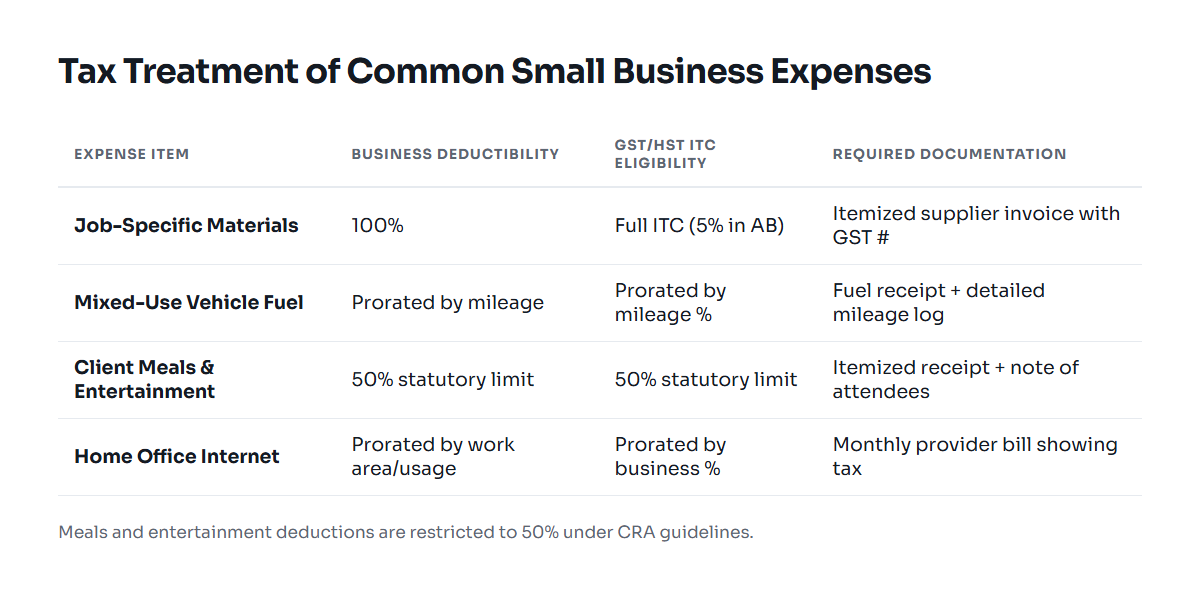
The CRA outlines strict guidelines under the Income Tax Act (Section 230) and the Excise Tax Act regarding books and records. You must retain supporting documents for six years from the end of the last tax year to which they relate. A credit card statement alone is insufficient proof of an expense; you must retain the source invoice or receipt showing the vendor name, date, specific goods purchased, and the tax paid.
The rules governing expense deductibility rest on several operational baselines:
- Business Purpose Test: Under paragraph 18(1)(a) of the Income Tax Act, an expense is deductible only to the extent it was made or incurred to earn business or professional income. Personal or living expenses are expressly denied under paragraph 18(1)(h).
- Input Tax Credits (ITCs): Under the Excise Tax Act, registered businesses can recover the 5% GST (or applicable HST/QST) paid on commercial inputs. In Alberta, you track the 5% federal GST; in Ontario, 13% HST; in British Columbia, 5% GST alongside non-recoverable 7% PST. To claim an ITC, your records must show the supplier's business name, registration number, and the amount of tax billed.
- Capital Cost Allowance (CCA) and Mixed-Use Assets: Assets used for both business and personal reasons—such as a passenger vehicle or home office—must be prorated. You cannot deduct 100% of fuel or home internet costs if you also use them privately. You must maintain a continuous logbook of commercial use versus personal use.
| Province / Territory | Sales Tax Regime | Tax Deductibility Mechanism | ITC Claimability |
|---|---|---|---|
| Alberta | 5% GST | Net business expense deducted from income | Full 5% GST on commercial inputs |
| British Columbia | 5% GST + 7% PST | GST deducted net; PST added to expense cost | 5% GST recoverable; 7% PST non-recoverable |
| Ontario | 13% HST | Net business expense deducted from income | Full 13% HST on commercial inputs |
| Quebec | 5% GST + 9.975% QST | Net business expense deducted from income | Recoverable via ITR (Revenu Québec) |
Worked Example: Mixed-Use Vehicle and Tool Purchases in Alberta
Consider an electrical contractor based in Calgary, Alberta, registered for GST. During a standard quarter, the contractor spends personal and operational funds across multiple categories.
Scenario Details
- Work van maintenance: $1,200.00 + $60.00 GST = $1,260.00 total. The logbook shows the vehicle was driven 16,000 km in the year, with 12,000 km dedicated to job sites, material pickups, and permit inspections at City of Calgary Planning & Development. Business use is 75%.
- Job materials at an electrical supply house: $3,400.00 + $170.00 GST = $3,570.00. Business use is 100%.
- Hardware store run: $400.00 total, consisting of $300.00 for conduit and junction boxes (commercial) and $100.00 for home lawn supplies (personal), plus $20.00 GST.
The Financial Breakdown
If this contractor uses a single personal account, identifying what can be deducted requires manually auditing receipts line by line. Here is the mathematically correct treatment using separated accounts:
- Job Materials: 100% deductible. The full $3,400.00 is an operating expense. The $170.00 GST is claimed as an Input Tax Credit on line 108 of the CRA GST return.
- Van Maintenance: 75% business use applied. Deductible business expense is $900.00 ($1,200.00 × 0.75). The claimable ITC is $45.00 ($60.00 GST × 0.75). The remaining $315.00 ($300.00 + $15.00 GST) is personal draw.
- Split Hardware Purchase: The commercial portion is $300.00. The claimable ITC is $15.00 ($300.00 × 0.05). The $105.00 spent on personal supplies is recorded as a shareholder or owner withdrawal, not an operational expense.
Total legitimate tax deductions: $4,300.00. Total claimable GST credits: $230.00. By paying the supply house and van maintenance through a dedicated business account, only the split hardware receipt requires manual line-item allocation.
Where Expense Separation Fails in Practice
Separating expenses breaks down most frequently at convenience touchpoints. A contractor filling up at the pump grabs lunch and pays with the business debit card. A freelance consultant renews personal streaming subscriptions on the corporate card because it was saved in their browser.
These actions trigger specific problems:
- The Commingling Cascade: When personal expenses pass through a commercial bank account, your bookkeeper or accountant must spend billable hours categorizing them to an owner draw account. You pay accounting fees to sort your personal life.
- Lost Input Tax Credits: When business purchases are paid with personal pocket cash without retaining the itemized receipt, the GST or HST paid is permanently lost. Credit card summaries do not satisfy CRA documentation requirements for ITCs.
- Piercing the Corporate Veil: For incorporated businesses, treating the corporate account like a personal ATM creates shareholder loan issues under subsection 15(2) of the Income Tax Act. If an owner withdraws funds without reporting them as salary or dividends within one year from the end of the corporation's tax year, the CRA can tax the withdrawn money as personal income.
- Audit Vulnerability on Mixed-Use Assets: The CRA frequently challenges cell phone and home internet claims. Claiming 100% business use for a home internet connection or a single family vehicle without a mileage log routinely results in adjustments and back taxes.
Tools that simplify invoice delivery and milestone progress claims, like BoltBill Pro, help keep receivables clean so you are never tempted to deposit business revenue directly into personal checking accounts.
Checklist for Clean Expense Separation
Follow this checklist to establish and protect your financial boundary:
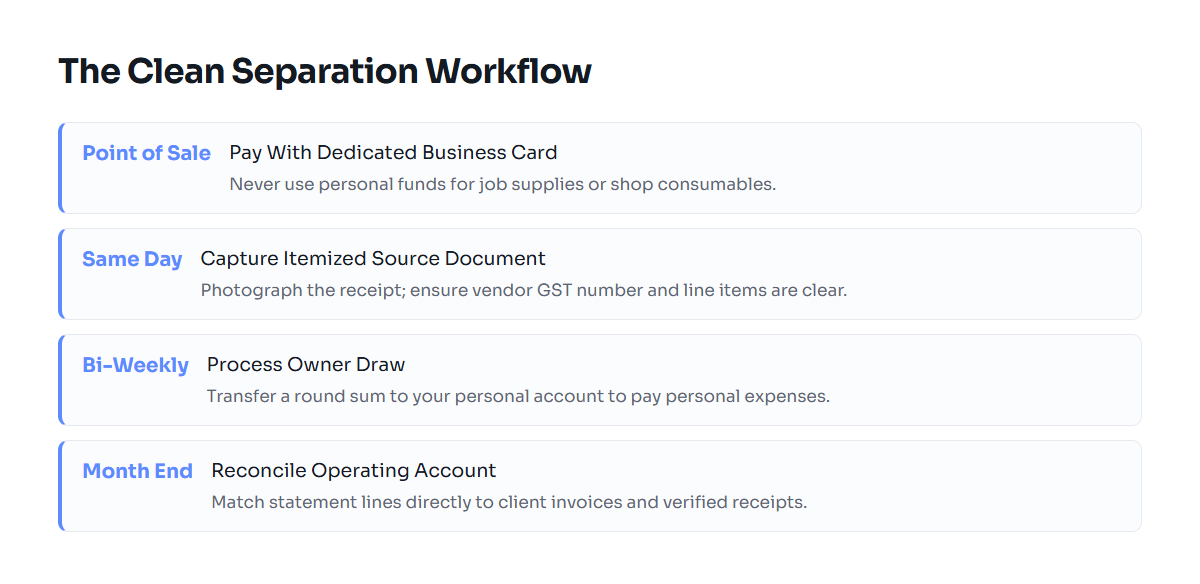
- Open a Dedicated Commercial Checking Account: Even if you operate under your legal name as a sole proprietor, do not run client billings or vendor payments through your everyday personal account.
- Get a Dedicated Business Payment Card: Use a separate credit card solely for trade supplies, subscriptions, software, and tools.
- Establish a Consistent Owner Draw Rhythm: Rather than paying personal bills directly from your business balance, transfer a set round sum to your personal account bi-weekly or monthly. Treat personal spending as personal, funded by deliberate transfers.
- Digitize Source Receipts Immediately: CRA allows electronic copies of source documents provided they are clear, complete, and stored systematically. Snap photos of paper receipts from suppliers before the thermal ink fades.
- Maintain an Active Mileage Log: Record date, destination, client or supplier visited, and kilometers driven. A bare estimate at tax time will be rejected during a review.
- Retain Records for Six Years: Store all receipts, bank records, and GST/HST filings in line with the CRA recordkeeping requirements.
Free tools: GST/HST invoice calculator · hourly rate calculator
Common questions
Can I use a personal credit card for business expenses?
Yes, but you should reserve that specific card exclusively for business purchases. Commingling personal and business transactions on the same card forces manual reconciliation and increases the risk of missed deductions or lost Input Tax Credits.
What happens if I accidentally pay a personal bill with my business account?
You must record the transaction in your bookkeeping system as an owner draw or shareholder withdrawal, not an operating expense. For incorporated businesses, ensure these amounts are settled or declared as income within corporate tax year limits to prevent CRA shareholder loan issues.
Does the CRA accept digital photos of receipts?
Yes. The CRA accepts electronic images of receipts provided they are legible, accurately represent the original paper receipt, and are backed up securely. You do not need to keep the fading paper copy if your digital record meets these standards.
How do I split my cell phone bill between business and personal use?
Establish a reasonable percentage of commercial use based on actual call logs or data utility over a representative period. Deduct only that percentage from your net business income, and claim the corresponding proportion of GST/HST.
Why is a bank statement not enough proof for a CRA tax deduction?
A bank statement shows only the date, vendor name, and dollar amount. It does not break down the specific items purchased, whether personal goods were included, or the exact GST/HST paid, which is mandatory to substantiate business deductions.
Related guides
Bookkeeping Basics for Small Business Canada: Practical Guide
A straightforward guide to Canadian bookkeeping basics covering CRA invoice rules, tax registration thresholds, holdback accounting, and monthly routines.
How to Write a Quote: Complete Canadian Guide
A practical guide for Canadian contractors, consultants, and freelancers on how to write a binding quote with clear scope, tax rates, and payment terms.
USA Invoicing Software Guide for Independent Practices
A direct guide to selecting USA invoicing software, handling USD payments, ACH routing, and IRS tax forms without expensive platform overhead.
Holdback Invoicing: Rules, Math, and Workflows
A straightforward guide to Canadian statutory holdback invoicing, covering the 10% deduction, GST handling, and release schedules.