BoltBill Pro guide
Bookkeeping Basics for Small Business Canada: Practical Guide
Master bookkeeping basics for small business in Canada. Learn CRA invoice rules, the $30,000 GST threshold, record retention, and holdback accounting.

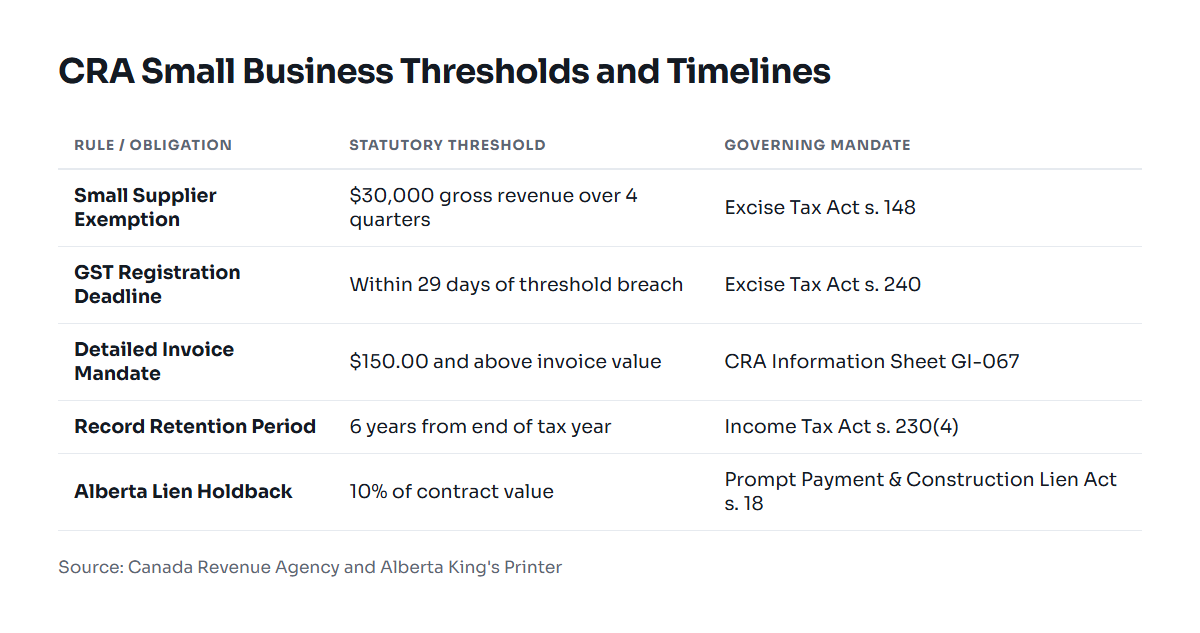
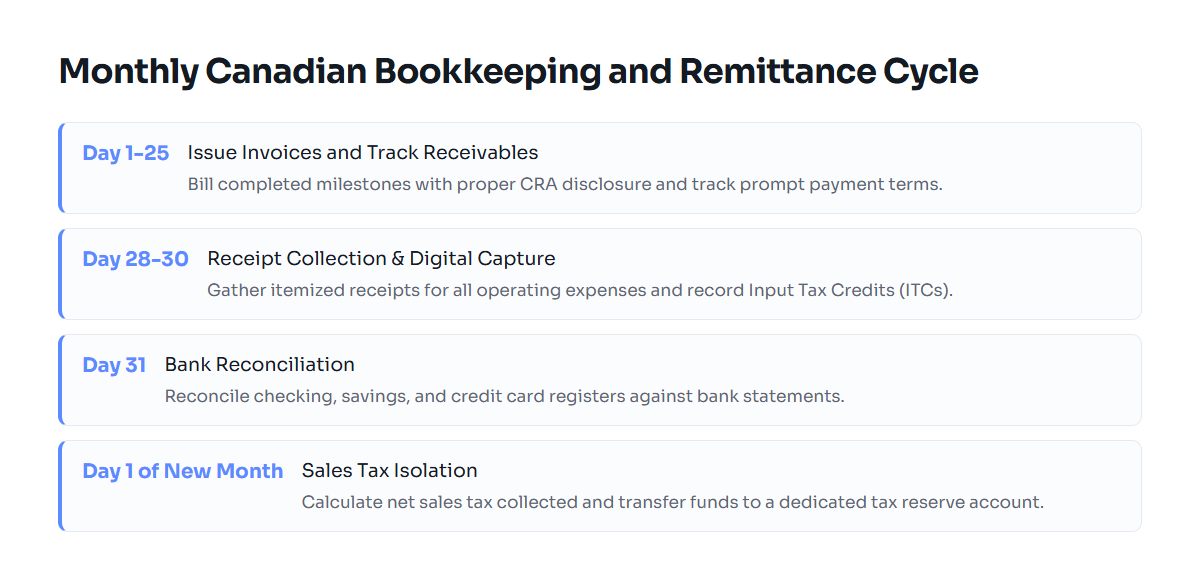
Bookkeeping basics for small business Canada boil down to five core operations: separating personal and commercial banking, logging every transaction with its source document, collecting and remitting GST/HST once your gross worldwide revenue exceeds $30,000, retaining financial records for six years, and tracking your accounts receivable against formal payment terms. Mastering these steps keeps your business solvent, protects you in a Canada Revenue Agency audit, and ensures you get paid on time.
The Core Operations of Canadian Small Business Bookkeeping
Every commercial operation in Canada, whether an independent tradesperson in Edmonton, an engineering consultant in Calgary, or a freelance copywriter in Toronto, runs on the same bookkeeping cycle. You sell a service or product, issue a compliant invoice, collect money, pay suppliers, and preserve paper or digital proof of the transaction.
Bookkeeping is not the same as filing your year-end corporate tax return or T2125 statement of business activities. Bookkeeping is the day-to-day and week-to-week recording of financial events. If your daily bookkeeping is accurate, your year-end tax preparation with a Chartered Professional Accountant takes hours instead of weeks.
To establish a solid bookkeeping workflow, you must understand cash-basis versus accrual-basis accounting:
- Cash-basis bookkeeping: You record income only when the cash hits your bank account, and you record an expense only when the money leaves. While simpler, the CRA generally requires businesses (other than farmers and fishers) to use accrual accounting for tax reporting.
- Accrual-basis bookkeeping: You record income when you issue the invoice (when the work is earned), and you record expenses when you receive a vendor bill (when the liability is incurred). This method provides an accurate picture of profitability and matches revenues with the expenses incurred to earn them.
The Governing Rules: CRA Invoicing, GST Thresholds, and Record Retention
Small business bookkeeping in Canada is governed by federal legislation under the Canada Revenue Agency (CRA) and the Income Tax Act, alongside provincial sales tax acts where applicable.
1. The $30,000 GST/HST Small Supplier Rule
Under CRA regulations, you are considered a "small supplier" and do not have to register for or charge Goods and Services Tax (GST) or Harmonized Sales Tax (HST) if your gross taxable revenues across all your businesses remain at or below $30,000 in a single calendar quarter and over the last four consecutive calendar quarters. The moment your gross revenue crosses $30,000 within these periods, you lose small supplier status. You must register for a CRA Business Number with a GST/HST program account (an RT account) within 29 days of the transaction that pushed you over the limit.
2. CRA Invoice Disclosure Requirements
If you charge GST or HST, your invoices must follow strict CRA disclosure thresholds under the Excise Tax Act. The required details depend on the value of the invoice:
| Invoice Total | Mandatory Information Required by CRA |
|---|---|
| Under $30.00 | Name of the business, date of invoice, and total amount payable. |
| $30.00 to $149.99 | Business name, date, total amount, explicit indication of the GST/HST charged (either broken out or stated as included with the tax rate), and your 9-digit CRA Business Number. |
| $150.00 and above | All of the above, plus the client’s legal name, a brief description of goods or services, terms of payment, and the specific breakdown showing the net subtotal and tax amounts. |
Failing to include your 9-digit CRA Business Number with the "RT0001" suffix prevents your commercial clients from claiming their Input Tax Credits (ITCs). Without a valid invoice, corporate clients will hold your payment.
3. Provincial Sales Tax Obligations
Depending on where your customer takes delivery of your work, you must charge the tax rate of their province, not your own home province. Here is how standard rates compare across Canadian jurisdictions:
| Province / Territory | Tax Type | Total Rate | Notes |
|---|---|---|---|
| Alberta, NWT, Nunavut, Yukon | GST only | 5% | No provincial sales tax. |
| Ontario | HST | 13% | Single harmonized federal and provincial levy. |
| Nova Scotia, New Brunswick, PEI, NL | HST | 15% | Single harmonized federal and provincial levy. |
| British Columbia | GST + PST | 12% | 5% federal GST plus 7% provincial PST (separate filings). |
| Saskatchewan | GST + PST | 11% | 5% federal GST plus 6% provincial PST (separate filings). |
| Quebec | GST + QST | 14.975% | 5% federal GST plus 9.975% provincial QST (administered by Revenu Québec). |
4. Record Retention Rules
Section 230(4) of the federal Income Tax Act mandates that you keep all financial records, source receipts, bank statements, client invoices, and ledgers for a minimum of six years from the end of the last tax year to which they relate. If you submit a late return, the six-year retention clock starts on the date the return was filed, not the end of the tax year. Digital copies are completely acceptable to the CRA, provided they are legible, accessible, and backed up.
Worked Example: Commercial Trade and Consulting Invoice with Holdback
To see how bookkeeping mechanics work in practice, consider an independent mechanical commissioning contractor in Calgary, Alberta. They are completing a commercial ventilation balance and control inspection under the Alberta Prompt Payment and Construction Lien Act.
The contract details are:
- Labor and professional testing fees: $5,000.00
- Pass-through materials and calibration consumables: $1,200.00
- Total scope price: $6,200.00
- Applicable tax: 5% Alberta GST
- Statutory lien holdback under Alberta law: 10% on services and materials
Under the Alberta Prompt Payment and Construction Lien Act, commercial construction projects require owners and general contractors to retain a 10% statutory holdback from every progress payment. This holdback protects downstream suppliers and subcontractors. It is released only after the lien period expires (typically 60 days following contract completion or certificate of substantial performance).
Here is how the numbers break down on the invoice:
| Line Item | Calculation | Amount |
|---|---|---|
| Professional Labor / Service | Base fee | $5,000.00 |
| Testing Materials Pass-Through | Reimbursable expenses | $1,200.00 |
| Taxable Subtotal | $5,000.00 + $1,200.00 | $6,200.00 |
| GST (5%) | 5% of $6,200.00 | $310.00 |
| Gross Invoice Total | $6,200.00 + $310.00 | $6,510.00 |
| Less: Statutory Holdback (10%) | 10% of $6,200.00 | -$620.00 |
| Net Cash Amount Due Now | $6,510.00 - $620.00 | $5,890.00 |
The Double-Entry Bookkeeping Ledger
In your accounting system, you do not simply book $5,890.00 as income. Doing so would understate your revenue and miscalculate your sales taxes. You enter the full transaction as follows:
- Debit: Accounts Receivable: $5,890.00 (Current asset to be collected within invoice terms, e.g., 28 days under Alberta prompt payment rules)
- Debit: Holdback Receivable: $620.00 (Long-term or retained asset held until the lien period lapses)
- Credit: Professional Fee Revenue: $5,000.00 (Income statement)
- Credit: Materials Revenue: $1,200.00 (Income statement)
- Credit: GST Payable: $310.00 (Current liability owed to the CRA on your next GST return)
Notice that the full $310.00 GST liability is recognized immediately upon billing. Even though the client withholds $620.00 of your principal fee under provincial lien legislation, the CRA requires GST to be calculated on the full value of the services rendered during that billing period. Proper tools simplify this process; check our the BoltBill blog for comparisons on workflow strategies and software configurations.
Where Bookkeeping Goes Wrong in Practice
Even conscientious business owners run into cash flow traps and tax penalties when basic processes are neglected. Here are four common friction points:
1. Treating GST/HST as Business Revenue
When a client pays an invoice of $6,510.00, $310.00 of that deposit does not belong to you. It is collected in trust for the Receiver General of Canada. Small business owners who leave tax funds in their general operating account frequently spend that cash on overhead, finding themselves short when their annual or quarterly CRA remittance is due. Open a separate high-interest savings account named "Tax Reserve" and transfer collected sales taxes into it weekly.
2. Commingling Personal and Business Funds
Using a personal credit card for business equipment or paying for personal groceries with an operating debit card destroys your audit trail. When the CRA conducts an audit or review, mingled accounts force the auditor to review every personal transaction, raising red flags and triggering disallowances for legitimate expenses. Maintain separate commercial checking and credit card accounts from day one.
3. Neglecting Input Tax Credits (ITCs)
When you spend money on business expenses, you pay GST or HST. You are entitled to recover 100% of that sales tax through Input Tax Credits (ITCs) against the GST/HST you collect from clients. If you buy a $1,000 diagnostic tool in Alberta, you pay $50 in GST. If you do not record that $50 in your bookkeeping ledger as an ITC, you forfeit that refund and pay more tax than required to the CRA.
4. Missing Source Documentation for Small Cash Purchases
Bank statements and credit card line items alone do not qualify as CRA-compliant expense proof. A bank statement shows that you spent $42.15 at a hardware supplier or gas station, but it does not show what was purchased. Without an itemized receipt showing the date, vendor name, item description, and tax breakout, the CRA will routinely reject the expense deduction during an audit. Using dedicated BoltBill Pro software helps keep clean records and compliant billing trails without administrative clutter.
The Monthly Bookkeeping Checklist for Canadian Operators
Follow this actionable, step-by-step checklist at the end of every calendar month to keep your books balanced and ready for tax filing:
- Capture and Attach All Source Receipts: Collect every paper receipt, digital PDF, and utility bill. Ensure each document shows the supplier’s business name, date, items purchased, and sales tax broken out.
- Reconcile Operating and Credit Card Accounts: Match every single debit and credit on your bank and credit card statements against your accounting entries. The reconciled balance in your bookkeeping software must match your physical bank statement to the cent.
- Review Outstanding Accounts Receivable: Identify invoices that have exceeded your payment terms (e.g., net 30 days). Send polite reminder statements to overdue accounts. Under the Alberta Prompt Payment framework, ensure your regular monthly invoices were issued on proper billing dates to preserve statutory dispute timelines.
- Audit the Holdback Ledger: Check on completed projects to see if the statutory 60-day lien period has expired. If conditions are met, issue an invoice or formal request for the release of the 10% holdback.
- Calculate and Transfer Tax Reserves: Total the net GST/HST collected during the month (GST collected on sales minus ITCs paid on expenses). Move this balance directly to your dedicated tax reserve account so your remittance is fully funded.
- Back Up Your Records: Ensure your digital receipts and accounting files are stored securely in the cloud or on an encrypted off-site drive to satisfy the CRA’s six-year retention mandate.
Common questions
When do I legally have to register for GST/HST in Canada?
You must register for GST/HST once your gross worldwide taxable sales exceed $30,000 in a single calendar quarter or across four consecutive calendar quarters. If you remain under this threshold, you are a small supplier and registration is voluntary, though registering early allows you to claim Input Tax Credits on your business expenses.
What is the difference between GST, HST, and PST for invoicing?
GST (5%) is the federal goods and services tax charged in provinces without provincial tax like Alberta. HST is a combined federal and provincial rate charged in Ontario (13%) and Atlantic Canada (15%). Provinces like British Columbia and Saskatchewan charge separate GST and PST, requiring distinct registrations and remittances.
How long does the CRA require me to keep my bookkeeping records?
Under Section 230(4) of the Income Tax Act, you must retain all source documents, invoices, receipts, and bank statements for six years from the end of the tax year they relate to. If you file a return late, keep the records for six years from the actual date the return was filed.
Can I use credit card statements instead of receipts for CRA expense claims?
No, a credit card or bank statement only shows that a payment occurred, not what you purchased or how much tax was paid. The CRA requires an itemized receipt or invoice displaying the vendor name, date, description of items, and sales tax breakdown to support tax deductions and Input Tax Credits.
How does holdback work on an invoice in Alberta?
Under the Alberta Prompt Payment and Construction Lien Act, 10% of the value of work and materials is held back by the client on each progress billing. You bill for the full work and calculate 5% GST on the entire amount, but deduct the 10% holdback from the immediate cash total due until the statutory lien period expires.
Related guides
First Invoice as Self Employed: Complete Canadian Guide
A complete guide to sending your first invoice as a self-employed Canadian, covering CRA tax rules, payment terms, and practical billing steps.
QuickBooks Alternative for Small Business Canada
A practical comparison of Canadian invoicing alternatives to QuickBooks for contractors, freelancers, and small operations.
Contractor Invoice Template for Canada: CRA Rules
A compliant Canadian contractor invoice template meeting CRA GST/HST rules, provincial sales taxes, and Alberta Prompt Payment requirements.
Billing Methods for Consultants, Contractors, and Trades
A complete guide to hourly, fixed-fee, milestone, and progress billing methods for Canadian independent contractors, trades, and consultants.