BoltBill Pro guide
What Has to Be on a Canadian Invoice
Learn what has to be on a Canadian invoice under CRA rules and provincial prompt payment laws, including GST numbers, line items, and holdback rules.

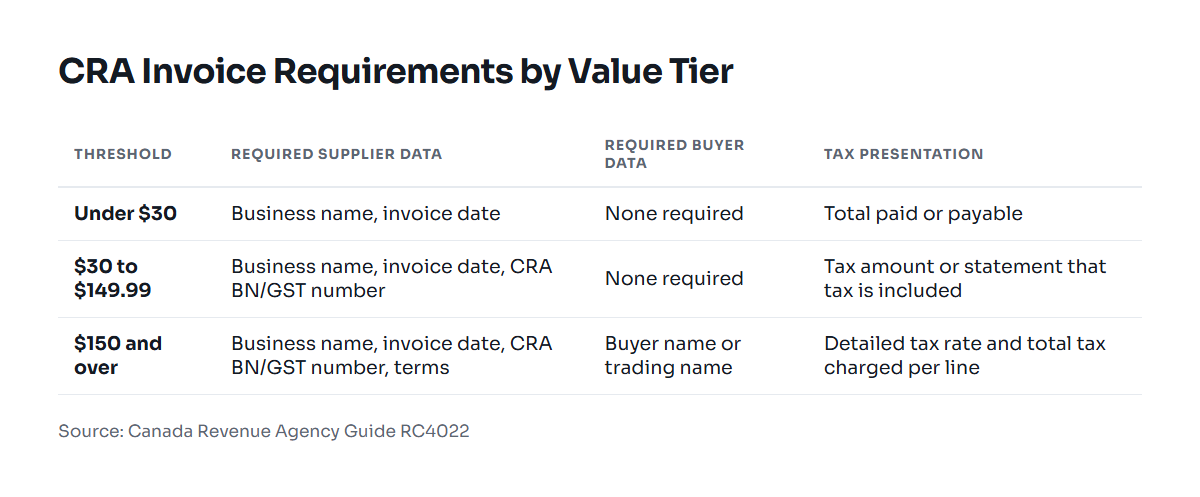
A valid Canadian invoice must show your legal or operating business name, the invoice date, an itemized description of goods or services provided, the total amount payable, and a clear breakdown of applicable taxes. For sales of $150 or more where you collect sales tax, the Canada Revenue Agency also mandates the buyer's name and your nine-digit CRA Business Number with its tax program identifier.
Mandatory Fields on a Canadian Invoice
The exact information your bill requires depends on your business structure, your customer, and whether you collect sales tax. When you bill clients in Canada, you generate a legal accounting document. This document supports your revenue reporting and serves as the official proof your client needs to claim business expense deductions or Input Tax Credits (ITCs).
Every standard invoice issued by a sole proprietor, independent contractor, or incorporated business must display basic transaction details:
- Your business name or legal trading name, along with current contact details (mailing address, email address, or phone number).
- Your client's legal name or trade name.
- A unique invoice tracking number.
- The date the invoice was issued and the date goods or services were delivered.
- A clear, line-by-line description of the work completed, materials supplied, or milestone achieved.
- The net payable total, showing quantity, unit price, or hourly rate where applicable.
- Payment terms specifying when the funds are due (for example, Net 30 days).
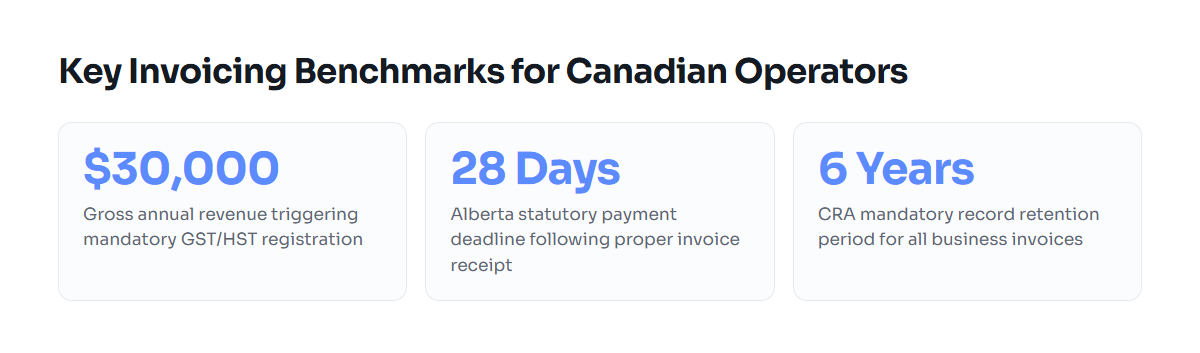
If you bill more than $30,000 in worldwide gross revenues over four consecutive calendar quarters, you must register for and collect the Goods and Services Tax (GST) or Harmonized Sales Tax (HST). Once registered, your invoice obligations expand immediately.
CRA Invoicing Rules by Transaction Value
Under the Excise Tax Act, the Canada Revenue Agency establishes tiered documentation requirements. These tiers dictate what information must appear on an invoice so your commercial client can claim an Input Tax Credit to recover the tax paid. Failing to include these details does not invalidate your debt, but it prevents your client from recovering the sales tax, which damages client relationships and triggers payment disputes.
| Invoice Total (CAD) | Mandatory CRA Invoicing Fields | Input Tax Credit Eligibility |
|---|---|---|
| Under $30.00 | Supplier name, invoice date, total amount paid or payable. | Client can claim full ITC with basic receipt details. |
| $30.00 to $149.99 | Supplier name, invoice date, total amount, CRA Business Number (GST/HST account), indication of tax charged or tax-inclusive statement. | Client can claim ITC if the registration number and tax rate are recorded. |
| $150.00 and above | All fields above, plus buyer name, clear description of each service or item, terms of payment, and explicit tax breakdown by jurisdiction. | Client requires all fields, including formal purchaser identification, to support an ITC audit. |
The CRA Business Number format for GST/HST accounts consists of nine digits followed by the program code RT and a four-digit account number (such as 123456789 RT 0001). Never hide this number in small footer text. Place it prominently alongside your contact details. For comprehensive provincial rules on place of supply and retail sales taxes, consult our guide to GST HST Invoicing Canada: Professional Practice Guide.
Applying the Rules to a Canadian Commercial Project
To see how these rules come together in practice, consider an electrical contractor in Edmonton, Alberta, invoicing a commercial general contractor for rough-in work on a light industrial bay. The agreed progress billing milestone is $12,500.00 before tax.
Because the project is located in Alberta, the governing sales tax is 5% federal GST. Alberta does not levy a provincial sales tax (PST). The trade contractor operates in the construction sector, which means the bill must also comply with the Alberta Prompt Payment and Construction Lien Act (PPCLA). Under Section 32.1 of this Act, submitting a "proper invoice" starts a mandatory 28-day countdown for the project owner to remit payment.
Example Progress Billing Calculation
- Milestone: Substation Feeder Conduit and Panel Rough-in = $12,500.00
- Statutory Construction Holdback (10% under PPCLA Section 18) = -$1,250.00
- Net Work Value Subject to Payment = $11,250.00
- 5% GST on Work Performed ($12,500.00 × 0.05) = $625.00
- Total Amount Currently Due = $11,875.00
- Cumulative Holdback Retained to Date = $1,250.00
Under the PPCLA, the invoice must also state the authority under which the work was performed (such as Subcontract Agreement #2024-04), the period during which the work was executed, and contact information for the person receiving payment inquiries. If the contractor omits the contract reference or fails to identify the submission as a proper invoice, the statutory 28-day payment clock does not start.
Contractors and technical consultants using BoltBill Pro can set up automated holdback schedules and proper invoice markers directly on their billing templates so provincial compliance requirements are satisfied on every draft.
Common Invoicing Misconceptions
Many independent operators and small businesses make fundamental assumptions about Canadian invoices that lead to audits or payment delays.
Misconception 1: You can charge GST or HST before receiving your CRA registration number.
You cannot collect sales tax without an active GST/HST account. Collecting tax without a registration number is illegal under the Excise Tax Act. If you have applied for a number but the CRA has not issued it, notify your client in writing. You can either issue an invoice without tax and retroactively bill the tax once your account is active, or wait until the CRA issues your nine-digit identifier.
Misconception 2: All Canadian invoices use the supplier's home province tax rate.
Tax rates follow the "place of supply" rules set by the CRA, not where your desk sits. If an engineering consultant based in Calgary completes design drawings for a mining facility in Sudbury, Ontario, the service is supplied in Ontario. The invoice must charge 13% Ontario HST, not 5% Alberta GST. If the work is performed for a client in Vancouver, British Columbia, the invoice carries 5% GST, while provincial sales tax depends on the specific service classification under BC provincial legislation.
Misconception 3: Writing "Tax Included" without details is acceptable on invoices over $150.
While point-of-sale cash registers frequently print "tax included" on retail receipts, business-to-business invoices above $149.99 require clarity. If you bundle tax into your line items, the invoice must state the applicable rate (for example, "Prices include 5% GST") or list the tax dollar figure separately. Auditors routinely reject input tax credits when the line-item tax calculation is ambiguous.
Statutory Requirements and Record Retention
Issuing the invoice is only the first half of your legal requirement. Under Section 286 of the Excise Tax Act and Section 230 of the federal Income Tax Act, you must maintain all issued and received invoices for a minimum of six years from the end of the latest tax year to which they relate.
Your records must be kept in Canada, in either English or French. Digital copies are legally acceptable provided they are stored in an electronically readable format that CRA auditors can inspect upon request. If you maintain paper copies, ensure receipts printed on thermal paper are scanned or duplicated, as thermal paper degrades well before the six-year statutory limit expires.
For independent trades and consultants tracking invoices across multiple provinces, review our complete pricing options to automate record-keeping and multi-jurisdiction tax management.
Common questions
Do I need a GST number to send an invoice in Canada?
You only need a GST/HST number on your invoice if your business is registered with the Canada Revenue Agency. Registration is mandatory once your worldwide gross taxable revenue exceeds $30,000 across four consecutive calendar quarters. If you are under this threshold, you are considered a small supplier and do not charge or display a GST number.
What happens if an invoice is missing the CRA Business Number?
If an invoice total is $30 or higher and lacks your valid CRA Business Number, your commercial client cannot legally claim an Input Tax Credit for the tax paid. The client's accounting department will often reject the invoice and hold payment until you issue a corrected document.
What is required on an Alberta construction proper invoice?
Under Alberta's Prompt Payment and Construction Lien Act, a proper invoice must include the contractor's name and address, invoice date, period of supply, reference to the governing contract, description of work, amount payable, payment terms, and a designated contact person. Submitting these fields starts the mandatory 28-day owner payment deadline.
How long must Canadian businesses keep copies of their invoices?
The Canada Revenue Agency requires businesses to retain all sales invoices, expense receipts, and supporting records for six years from the end of the tax year to which they apply. Digital storage is permitted if files remain accessible and verifiable.
Which provincial tax rate do I charge on an out-of-province invoice?
You charge the sales tax applicable to the province where the service is performed or where the client receives the benefit, known as the place of supply. For example, an Alberta business providing services to an Ontario client generally charges 13% Ontario HST rather than 5% Alberta GST.
Related guides
GST HST Invoicing Canada: Professional Practice Guide
A practical guide to CRA-compliant GST and HST invoicing for Canadian engineering, architecture, and consulting practices.
Milestone Billing vs Hourly: Which Model Fits?
A direct comparison of milestone billing versus hourly rates for Canadian independent businesses, covering cash flow risks, statutory holdbacks, and prompt payment rules.
How to Deal with Late Paying Clients in Canada
A systematic workflow to recover overdue invoices in Canada without torching client relationships.
Reimbursable Expenses Consulting Guide: Rules & Tax
A guide to billing reimbursable expenses in Canadian consulting, covering GST/HST out-of-pocket rules, markups, and CRA record retention.