BoltBill Pro guide
GST, HST and PST on Canadian Invoices: Complete Guide
Learn how to charge GST, HST, and PST on Canadian invoices. Understand place-of-supply rules, provincial rates, CRA requirements, and exemptions.

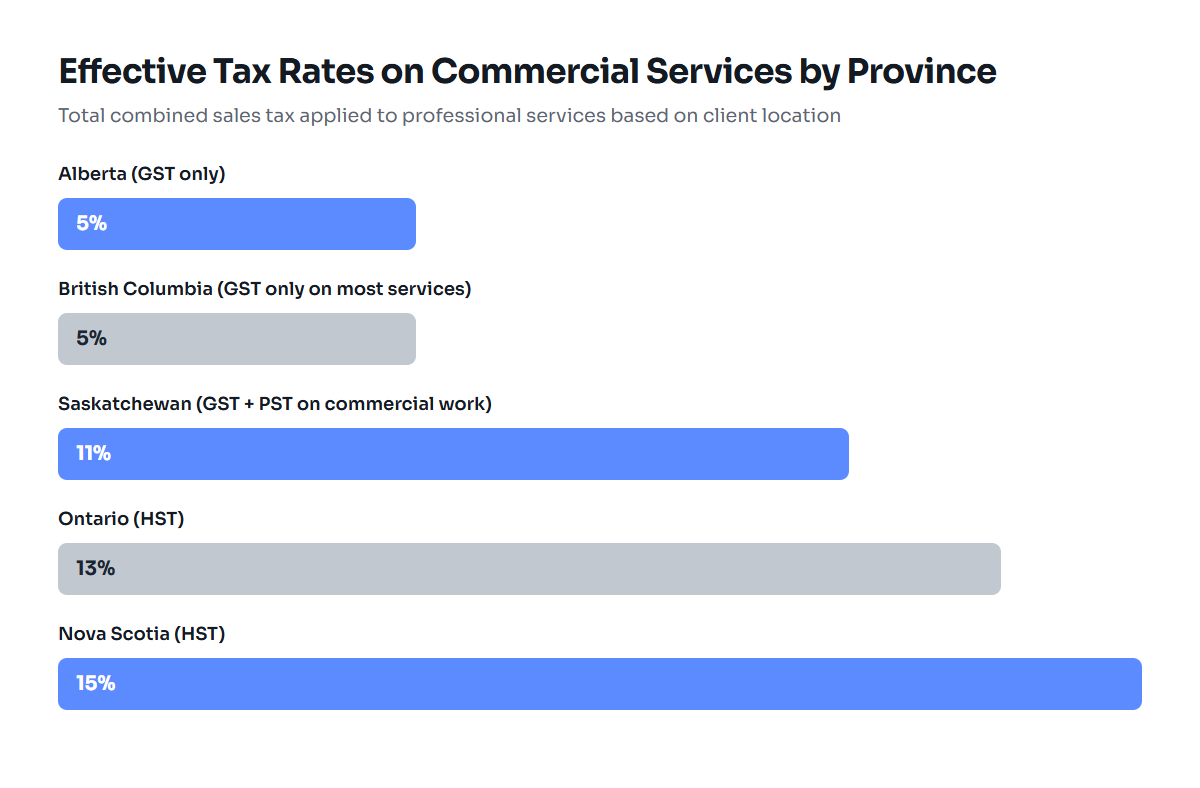
On Canadian invoices, you charge sales tax based on the customer's location, known as the place of supply, not your own office location. If your worldwide taxable revenue exceeds $30,000 across four consecutive calendar quarters, you must register with the Canada Revenue Agency and collect 5% GST, 13% to 15% HST, or GST alongside provincial sales taxes (PST or QST) depending on where your client receives your work.
The Rules Governing Canadian Sales Tax on Invoices
The Canada Revenue Agency (CRA) administers sales tax across Canada under Part IX of the Excise Tax Act. While the federal government levies the Goods and Services Tax (GST) at a baseline rate of 5%, several provinces combine federal and provincial sales taxes into a single Harmonized Sales Tax (HST). Other provinces maintain independent provincial sales tax systems that require separate provincial registration and separate tax line items.
To determine what tax to charge, you must establish the place of supply. For services and digital deliverables, the place of supply is generally the address of the customer obtained in the normal course of business. For physical goods, freight, or site-specific construction services, the place of supply is the physical location where the property is delivered or where the real property work takes place.
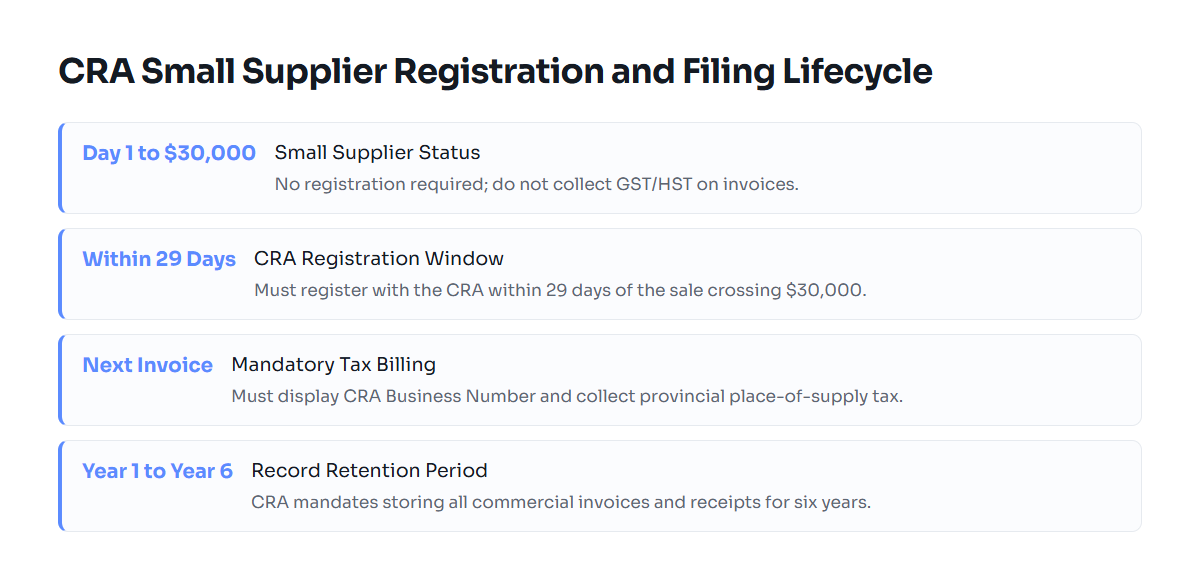
Under CRA regulations, businesses whose gross taxable revenues fall below $30,000 across any single calendar quarter or four consecutive calendar quarters qualify as small suppliers. Small suppliers are not required to register for or charge GST/HST, though voluntary registration allows businesses to recover the sales tax paid on business expenses through Input Tax Credits (ITCs). Once you cross the $30,000 threshold, you must register within 29 days of the sale that puts you over the limit.
| Province / Territory | Tax Type | Federal Rate | Provincial Rate | Total Invoice Tax Rate |
|---|---|---|---|---|
| Alberta | GST | 5% | 0% | 5% |
| British Columbia | GST + PST | 5% | 7% | 5% GST (PST depends on service) |
| Manitoba | GST + RST | 5% | 7% | 5% GST (RST applies to select items) |
| New Brunswick | HST | 5% | 10% | 15% |
| Newfoundland and Labrador | HST | 5% | 10% | 15% |
| Northwest Territories | GST | 5% | 0% | 5% |
| Nova Scotia | HST | 5% | 10% | 15% |
| Nunavut | GST | 5% | 0% | 5% |
| Ontario | HST | 5% | 8% | 13% |
| Prince Edward Island | HST | 5% | 10% | 15% |
| Quebec | GST + QST | 5% | 9.975% | 14.975% |
| Saskatchewan | GST + PST | 5% | 6% | 5% GST + 6% PST |
| Yukon | GST | 5% | 0% | 5% |
For independent operators, reading our breakdown on how to charge GST on invoices provides detailed operational steps for setting up your billing system.
How Tax Calculations Apply on a Real Commercial Project
Consider a practical engineering and field-testing project based out of Calgary, Alberta. An independent electrical consultant signs a contract with a client headquartered in Toronto, Ontario, to perform analysis and review drawings for a commercial facility located in Edmonton, Alberta.
Because the real property is situated in Alberta, the service relates directly to Canadian real property under section 136.1 of the Excise Tax Act. The place of supply is Alberta, meaning the invoice carries 5% GST, not Ontario's 13% HST. If the work instead consisted of general business consulting without a direct attachment to physical Alberta real property, the place of supply would be the client's head office in Ontario, requiring 13% HST.
Here is how the numbers work on a typical progress billing for this commercial contract under the Alberta Prompt Payment and Construction Lien Act (PPCLA), including a standard 10% statutory lien holdback:
- Base Professional Fee: $10,000.00
- Reimbursable Mileage and Printing: $450.00
- Subtotal Subject to Tax: $10,450.00
- GST (5% applied to full subtotal): $522.50
- Gross Invoice Amount: $10,972.50
- Statutory Lien Holdback (10% of $10,000 work subtotal): -$1,000.00
- Net Amount Payable Now: $9,972.50
Under CRA rules, GST applies to the full value of the work before deducting the statutory construction holdback. However, the client pays the net amount now, retaining the $1,000 holdback until the statutory 60-day lien period expires under Alberta law without any registered liens. For more detail on structural line items, review our guide to what has to be on a Canadian invoice.
Billing Out-of-Province Clients for Services
Freelancers and technical specialists regularly bill clients across multiple jurisdictions. The following scenario illustrates how the exact same $2,500 drafting service changes based on client location:
- Client located in Vancouver, British Columbia: You charge 5% GST ($125.00). In British Columbia, most professional consulting and digital services are exempt from BC PST, meaning you do not charge the 7% provincial portion unless providing taxable software or legal services.
- Client located in Ottawa, Ontario: You charge 13% HST ($325.00). Ontario collapses both portions into one tax rate, paid directly to your single CRA GST/HST account.
- Client located in Halifax, Nova Scotia: You charge 15% HST ($375.00).
- Client located in Dallas, Texas (United States): Services provided to non-residents are generally zero-rated (taxed at 0%) under the Excise Tax Act, provided the service is not performed directly on tangible personal property or real property in Canada. You collect $0.00 in tax but report the gross revenue on line 101 of your CRA GST/HST return.
Common Misconceptions About Canadian Invoice Taxes
Several persistent misunderstandings create compliance audits and unrecoverable back-taxes for Canadian contractors, consultants, and sole proprietors.
1. Believing You Bill Tax Based on Your Home Province
Sole proprietors frequently assume that an Alberta-registered business always charges 5% GST regardless of where the deliverable goes. This assumption is incorrect. If your company operates in Calgary and provides technical reports or marketing services to a corporation located in New Brunswick, you must charge 15% HST. Failing to collect HST leaves you personally liable to the CRA for the 10% provincial variance during an audit.
2. Collecting Tax Before Receiving a Registration Number
It is unlawful to write a line item for GST or HST on an invoice if you do not possess an active Business Number (BN) with an RT program identifier from the CRA. Collecting money labelled as tax without a registration number constitutes tax fraud. If you have crossed the $30,000 threshold and applied for a number that has not yet arrived, inform your client that an adjusted invoice containing the tax and your official number will follow once approved.
3. Passing Out-of-Pocket Expenses Through Without Tax
When you incur business expenses such as hotel rooms, fuel, or municipal permit fees and rebill them to a client, they cease to be direct government fees and become consideration for your service. Even if an Alberta city building permit carries no GST on the original municipality receipt, adding that expense to your commercial consulting invoice makes it taxable under CRA rules. You must charge the applicable GST or HST on the total rebilled amount.
4. Confusing the $30,000 Rule With an Annual Calendar Year Cap
The small supplier threshold operates across four consecutive calendar quarters, not individual calendar years starting every January 1. If your business earns $12,000 in Q3, $10,000 in Q4, and $9,000 in Q1 of the following year, your trailing twelve-month revenue totals $31,000. You have exceeded the threshold in March, not the following December. For full regulatory procedures, see our resource on GST HST invoicing in Canada.
Related Requirements and Record Retention Rules
Charging sales tax triggers mandatory formatting and archival duties established by federal and provincial legislation.
Mandatory CRA Invoice Information
Under Canada Revenue Agency guidelines, commercial invoices exceeding $100 must contain specific elements to enable your clients to claim their Input Tax Credits:
- Your registered business name or operating name.
- The invoice issue date.
- Your 9-digit CRA Business Number followed by the RT program code (e.g., 123456789RT0001).
- The customer's legal or operating name.
- A distinct description of each service rendered or good supplied.
- The total amount charged, indicating whether tax is separated or bundled into the price.
- The exact rate of GST, HST, or PST charged on each item.
Statutory Record Retention
The CRA mandates that businesses retain all books, electronic records, source receipts, bank statements, and invoices for a minimum of six years from the end of the last tax year to which they relate. If you file your 2024 tax return in June 2025, you must preserve those 2024 billing records through the end of December 2031. Electronic invoices must remain accessible, intelligible, and verifiable upon CRA audit request.
Prompt Payment Requirements in Alberta
For trades and technical contractors operating under the Alberta PPCLA, submitting a "proper invoice" triggers statutory payment clocks. The owner must pay within 28 calendar days of receiving a compliant invoice. To qualify as a proper invoice under Section 32.1 of the PPCLA, your document must include the vendor name, date, period during which work was executed, description of services, contract authority, total amount requested, breakdown of sales taxes, and statement identifying the document as a proper invoice under the Act.
Using automated tools like BoltBill Pro ensures that every invoice you generate automatically applies the correct provincial tax rate, embeds mandatory CRA identification numbers, and satisfies statutory prompt payment line items.
Common questions
How do I calculate GST on Canadian invoices?
To calculate GST on a Canadian invoice, multiply your taxable subtotal by 0.05. If your client is located in an HST province like Ontario, multiply by the HST rate of 0.13 instead. Add this calculated tax amount as a separate line item to your subtotal to arrive at the total invoice balance.
Do I have to charge sales tax to clients outside Canada?
Services delivered to clients located outside Canada are generally zero-rated, meaning they carry a 0% tax rate under CRA rules. You do not collect GST or HST from the foreign client, but you must report the export revenue on your regular GST/HST filing.
What happens if I forget to charge GST to a client?
If you are registered for GST/HST and forget to charge it, the CRA still holds you liable for remitting the tax that should have been collected. You can issue a revised invoice to the client requesting the tax payment, as registered businesses can typically recover this amount via input tax credits.
Can I charge PST if I am only registered for GST?
No, you cannot charge provincial sales tax (PST or QST) unless you have registered with the specific provincial revenue authority in provinces like British Columbia, Saskatchewan, Manitoba, or Quebec. Charging provincial taxes without a provincial registration account is illegal.
Does the 10% construction holdback apply before or after GST?
In Canadian construction billing, sales tax is calculated on the full pre-holdback value of the work performed. The 10% statutory holdback is then deducted from the gross invoice total (or calculated against the pre-tax labor and materials) to determine the net payment due immediately.
Related guides
How to Charge GST on Invoices: Canadian Guide
A straightforward guide on how to calculate, display, and remit GST on Canadian invoices without running afoul of CRA rules.
What Has to Be on a Canadian Invoice
A complete guide to the mandatory fields, tax registration numbers, and provincial rules required on Canadian business invoices.
GST HST Invoicing Canada: Professional Practice Guide
A practical guide to CRA-compliant GST and HST invoicing for Canadian engineering, architecture, and consulting practices.
Invoicing and Quoting for Trades and Contractors
A complete Canadian guide to quoting, proper invoices, provincial holdbacks, and prompt payment compliance for contractors, trades, and consulting engineers.