BoltBill Pro guide
How to Charge GST on Invoices: Canadian Guide
Learn how to charge GST on invoices in Canada correctly. Clear steps for small businesses, contractors, and consultants, with real worked examples.

To charge GST on an invoice in Canada, register for a GST/HST account with the Canada Revenue Agency (CRA), add your nine-digit Business Number with its RT program identifier to your header, calculate 5% on taxable goods and services, and list that tax amount on a dedicated subtotal line before the final total payable. You must never collect GST before your registration date takes effect.
The Governing Rules for Billing GST in Canada
The legal framework for charging the Goods and Services Tax rests on the federal Excise Tax Act administered by the CRA. Before you add a single dollar of sales tax to an invoice, you must determine whether you are legally required or eligible to register.
The threshold sits at $30,000 in gross taxable sales over any single calendar quarter or across four consecutive calendar quarters. This total includes worldwide revenues and sales from all associated businesses, not just profit or net income. If your revenue stays below this threshold, the CRA classifies you as a small supplier. Small suppliers do not charge GST, cannot collect it, and do not show an RT registration number on their billing documents.
Once your sales cross $30,000, registration stops being optional. You cross the threshold in one of two ways:
- Over four consecutive quarters: You exceed $30,000 across a rolling 12-month period. You remain a small supplier for the month following the quarter where you crossed the limit. You must register and begin charging GST on sales made after that transitional month.
- In a single calendar quarter: You cross the $30,000 mark within three consecutive months. You cease to be a small supplier immediately on the specific sale that pushed you over the limit. You must charge GST on that transaction and all subsequent invoices.
Voluntary registration is allowed before hitting the threshold. Independent operators often register immediately to recover input tax credits (ITCs) on business expenses like equipment purchases, software subscriptions, and vehicle operating costs. Once registered, you must collect and remit the tax regardless of your sales volume.
For a detailed breakdown of mandatory billing fields, review our guide on What Has to Be on a Canadian Invoice.
Place of Supply Determines the Tax Rate
Charging sales tax requires identifying where the supply takes place, known as the place-of-supply rule. You charge tax based on where your customer receives your product or service, not where your desk or shop sits.
For physical goods, the rate applies according to the delivery destination. If an Alberta fabricator ships equipment to an operator in Calgary, the rate is 5% GST. If that same fabricator ships parts to an outfit in Halifax, Nova Scotia, the place of supply is Nova Scotia, requiring the 15% Harmonized Sales Tax (HST).
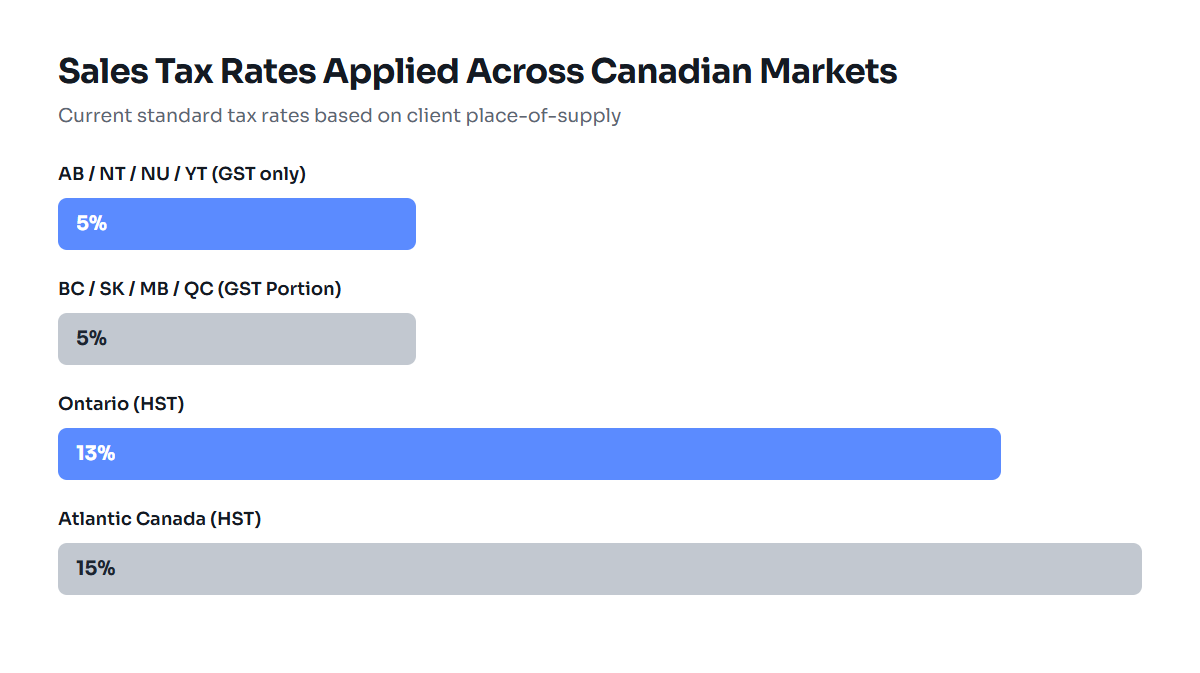
For professional services, consulting, and digital work, the place of supply generally defaults to the client's home or business address that you obtain in the normal course of business. The table below lists the current sales tax rates across Canadian jurisdictions.
| Province or Territory | Tax Type | Total Tax Rate Applied |
|---|---|---|
| Alberta, Northwest Territories, Nunavut, Yukon | GST only | 5% |
| British Columbia | GST (5%) + PST (7%) | 5% GST on invoice (PST billed separately) |
| Saskatchewan | GST (5%) + PST (6%) | 5% GST on invoice (PST billed separately) |
| Manitoba | GST (5%) + RST (7%) | 5% GST on invoice (RST billed separately) |
| Ontario | HST | 13% |
| Quebec | GST (5%) + QST (9.975%) | 5% GST (QST calculated on base price) |
| New Brunswick, Newfoundland, Nova Scotia, PEI | HST | 15% |
To understand multi-provincial contracts across non-participating and participating provinces, see our deep dive on GST HST Invoicing Canada: Professional Practice Guide.
Worked Example with Real Numbers: Alberta Trade Contractor
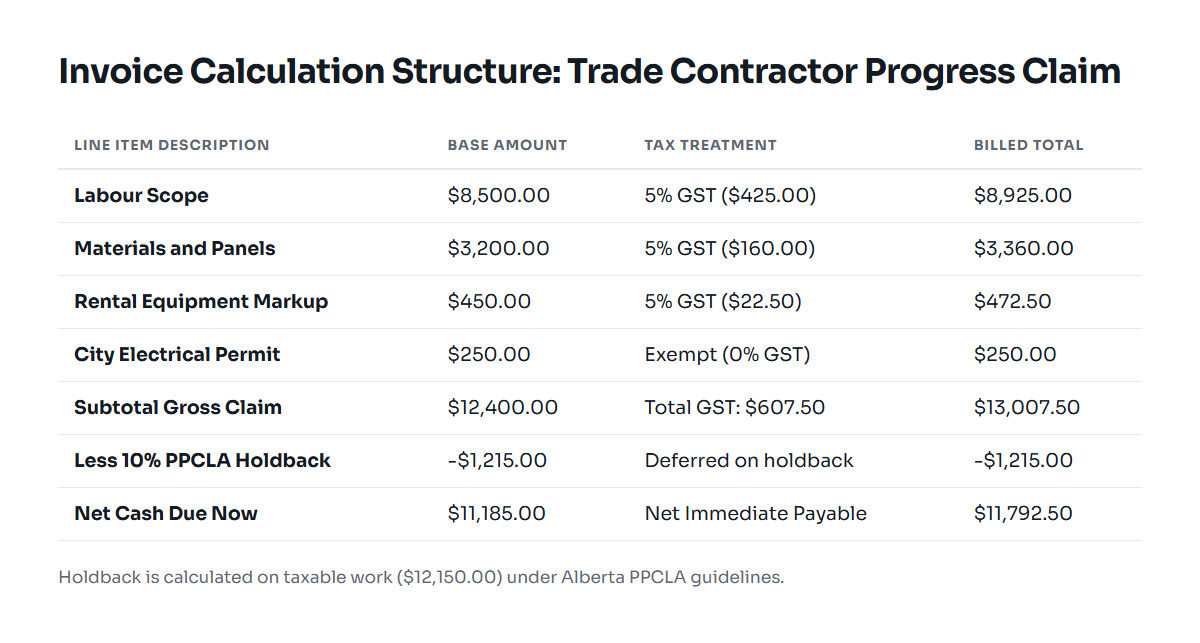
Consider an independent electrical contractor based in Red Deer, Alberta, performing an upgrade for a commercial warehouse facility. The scope includes labour, commercial panel components, permit fees, and reimbursable travel. The project also falls under the Prompt Payment and Construction Lien Act (PPCLA), which establishes a mandatory 10% statutory lien holdback on all value delivered.
Understanding how GST applies to disbursements, permits, and holdbacks prevents severe accounting reconciliation errors. Here is how each line item behaves:
- Labour: Fully taxable at 5% GST.
- Materials and equipment: Fully taxable at 5% GST.
- City electrical permit: Municipal permits issued directly by local authorities are typically exempt from GST under Schedule V of the Excise Tax Act. If the contractor pays the city directly and passes the fee through at true cost as an agent disbursement, no GST applies on the reimbursement. If the contractor marks up the permit fee, the entire line item becomes a taxable service.
- Statutory holdback: In Alberta, the owner holds back 10% of the contract value until lien periods lapse. Under CRA rules (Section 168(4) of the Excise Tax Act), GST on holdback amounts becomes payable on the earlier of the day the holdback is actually paid out or the day the holdback period expires. You can bill GST on the net progressive amount or calculate it on the gross milestone while clearly tracking the deferred tax component. Most trade practices calculate GST on the progress billing gross subtotal so that contract balances reconcile cleanly.
Sample Calculation
The electrical contractor bills milestone work consisting of $8,500.00 in professional labour, $3,200.00 in panels and wiring, a $250.00 pass-through municipal inspection permit (exempt), and an agreed equipment rental markup of $450.00.
Total taxable base: $8,500.00 + $3,200.00 + $450.00 = $12,150.00.
GST at 5%: $12,150.00 × 0.05 = $607.50.
Municipal permit reimbursement: $250.00 (exempt from GST).
Gross progress billing: $12,150.00 + $607.50 + $250.00 = $13,007.50.
Statutory 10% Holdback on work performed: 10% of $12,150.00 = $1,215.00.
Current amount payable by the client: $13,007.50 − $1,215.00 = $11,792.50.
Using software like BoltBill Pro lets you automate progress claims, track statutory holdbacks, and generate clean CRA-compliant line items automatically.
Where It Goes Wrong in Practice
Collecting sales taxes creates fiduciary duties. You act as an agent collecting public revenue on behalf of the Crown. Several recurring traps cause audit penalties and lost revenue for self-employed operators.
1. Invoicing GST Prior to Registration Date
If you bill a customer 5% GST before your effective date of registration with the CRA, you commit a serious infraction. You cannot retain that money, nor can you remit it against your own input tax credits through an unassigned account. If your application is pending, hold the sales tax line off the bill until the CRA assigns your RT0001 account number, or bill the work base price and issue a revised adjustment once the registration date takes effect.
2. Blending Out-of-Pocket Expenses with Disallowable Markup
Contractors and consultants frequently incur direct expenses such as mileage, blueprint printing, or safety supplies. When you pass these costs to a client, the GST treatment changes based on how the contract frames them. If you recharge $100.00 of travel expenses as part of your overall professional service, that reimbursement is taxable consideration for your services. You must charge 5% GST on the $100.00 recharge, even if you paid provincial sales tax or GST on the original receipt. Only pure agent disbursements—where you had legal authority to act on the client's behalf to pay an expense in their name—pass through tax-neutral.
3. Omitting the Nine-Digit Business Number
Under CRA GST/HST memorandum guidelines, any taxable transaction exceeding $100.00 must show your business name, date, total amount, and your specific GST registration number. Invoices over $500.00 require the recipient's name, payment terms, and clear identification of items taxed at 0% versus 5%. If your invoice lacks your registration number, your commercial clients cannot claim their Input Tax Credits. Corporate accounting departments will routinely reject your payment request until you reissue an amended invoice with valid tax registration credentials.
4. Misapplying Rates for Out-of-Province Remote Work
A software designer or structural engineer working from an office in Edmonton often assumes all their billings carry 5% Alberta GST. When that engineer accepts an assignment for a commercial property or client located in Ottawa, the supply is considered rendered in Ontario. The correct tax to bill is 13% HST. Failing to collect the Ontario rate leaves the engineer personally liable to the CRA for the missing 8% difference out of their own pocket during an assessment.
Pre-Billing Checklist for GST Invoices
Run through this operational checklist before transmitting any billing document to a customer:
- Registration status confirmed: Confirm your CRA RT account number is active and that the invoice issue date is on or after your official registration effective date.
- Complete billing header: Display your corporate or trade operating name alongside your full business identifier (for example: 123456789 RT 0001).
- Accurate place-of-supply rate: Verify the client's physical location or shipping endpoint to pick the exact tax rate (5% GST, 13% HST, or 15% HST).
- Disbursements separated: Split pure agency expenses from ordinary expense allowances or marked-up reimbursements.
- Itemized taxable base: Clearly state the subtotal of zero-rated or exempt items apart from fully taxable components.
- Holdback deductions itemized: On construction accounts, apply your statutory 10% deduction against contract work value rather than the raw gross tax amount.
- Six-year retention filed: Store digital copies of issued billings, receipts, and associated bank deposits in accordance with CRA seven-year and six-year audit retention rules outlined in the federal Excise Tax Act.
Common questions
Can I charge GST before my CRA registration is approved?
No. You cannot charge or collect GST without an active CRA business registration number. If you have applied but have not yet received your RT account number, you cannot add the tax to customer invoices until the effective date established by the CRA.
What happens if I forget to charge GST on an invoice?
You remain legally liable to remit the GST amount to the CRA regardless of whether you collected it from your client. You can issue a revised invoice or an adjustment note to your client requesting payment for the uncollected tax.
Do I charge GST on provincial travel reimbursements and meals?
Yes. When you bill a client for operational disbursements like meals, travel, or lodging, the CRA treats these as additional consideration for your services. You must apply GST to the total reimbursement charge.
Do small suppliers under the $30,000 threshold ever need to charge GST?
Small suppliers do not charge GST unless they voluntarily register with the CRA. Once voluntarily registered, you must charge, collect, and remit GST on all taxable sales immediately, even if your total annual revenue remains below $30,000.
How does statutory holdback impact GST on an Alberta construction invoice?
GST on holdbacks under the Prompt Payment and Construction Lien Act becomes payable when the holdback is released or when the lien period expires. Most billings calculate the total GST on the gross work completed while subtracting the 10% holdback from the immediate cash total due.
Related guides
What Has to Be on a Canadian Invoice
A complete guide to the mandatory fields, tax registration numbers, and provincial rules required on Canadian business invoices.
GST HST Invoicing Canada: Professional Practice Guide
A practical guide to CRA-compliant GST and HST invoicing for Canadian engineering, architecture, and consulting practices.
Progress Draw Payments in Canadian Construction
A complete guide to progress draw payments, statutory holdbacks, and prompt payment rules for Canadian contractors and trades.
Bookkeeping Basics for Small Business Canada: Practical Guide
A straightforward guide to Canadian bookkeeping basics covering CRA invoice rules, tax registration thresholds, holdback accounting, and monthly routines.