BoltBill Pro guide
Invoicing and Quoting for Trades and Contractors
Master invoicing and quoting for trades and contractors in Canada. Learn prompt payment timelines, statutory holdbacks, CRA tax rules, and worked billing models.

Invoicing and quoting for trades and contractors in Canada is the commercial process of pricing, contracting, and requesting statutory payment for labour and materials under provincial construction lien legislation and Canada Revenue Agency (CRA) rules. A quote becomes a legally binding contract sum upon client acceptance, while a proper invoice triggers statutory prompt-payment clocks and mandatory provincial holdback deductions. Managing both correctly protects your lien rights and preserves cash flow.
The Fundamentals of Contractor Quotes and Proper Invoices
Pricing and billing construction work requires distinguishing between four distinct documents: estimates, quotes, progress claims, and invoices. Confusing these terms leads to unpaid change orders, delayed draws, and protracted disputes with owners and general contractors.
- Estimate: A non-binding forecast of project costs based on preliminary drawings or early site visits. In provinces like Ontario and Alberta, consumer protection legislation limits final invoice variance on consumer estimates unless scope changes are formally documented.
- Quote (or Bid): A formal, binding commercial offer to perform a defined scope of work for a fixed price or specific unit rates. Once signed or accepted in writing, the quote forms the commercial baseline of the contract.
- Progress Claim: A detailed billing application submitted at agreed project milestones or month-end intervals. It details the percentage of work completed to date, materials stored on-site, previous billings, and statutory holdbacks.
- Proper Invoice: A formal payment demand that meets all statutory criteria set out under provincial prompt payment laws, triggering the client's mandatory legal countdown to pay or dispute.
Whether you work as a sole proprietor electrician or run an electrical or civil engineering consultancy, commercial clients demand systematic billing. Sole proprietors often start with basic spreadsheets, but scaling past simple jobs requires specialized tools. If you manage trade-specific billing, review our guide on How to Invoice as an Electrician in Canada for detailed labour-and-material breakdowns.
Statutory Rules: Prompt Payment, Holdbacks, and CRA Tax Requirements
Billing construction or professional engineering services in Canada operates under strict provincial and federal statutes. You cannot structure your billing purely on personal preference; your contracts and payment requests must comply with the governing legislation of the province where the project site is located.
1. Provincial Prompt Payment Legislation
Alberta replaced its legacy Builders' Lien Act with the Prompt Payment and Construction Lien Act (PPCLA), establishing clear statutory rules for billing. Under the PPCLA:
- Invoice Frequency: Contractors must submit a proper invoice to the project owner at least every 31 days unless the contract specifies a testing and commissioning milestone structure.
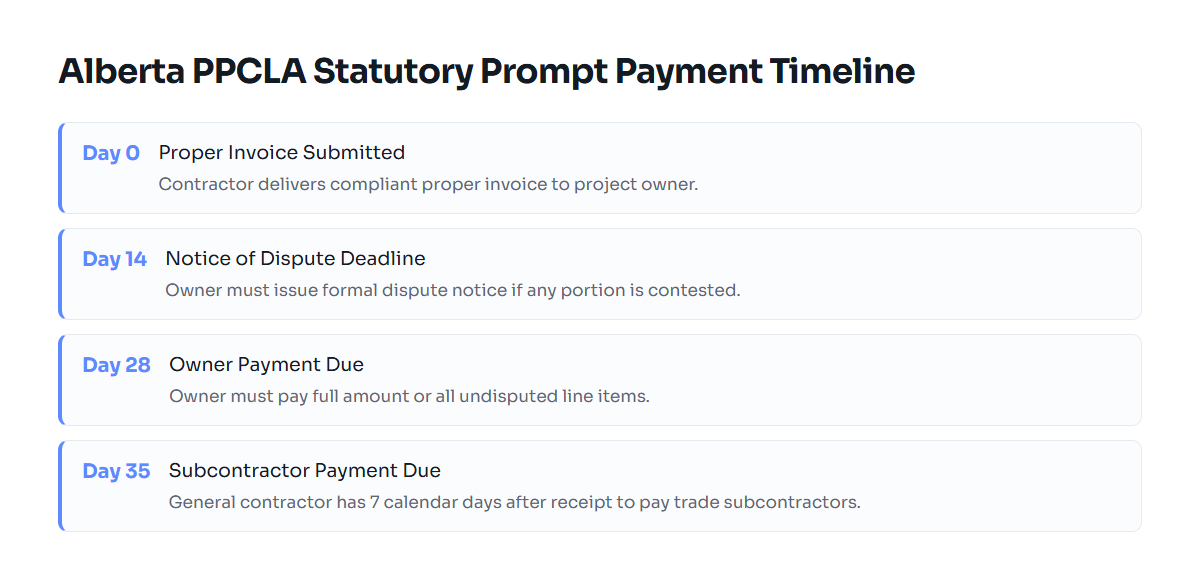
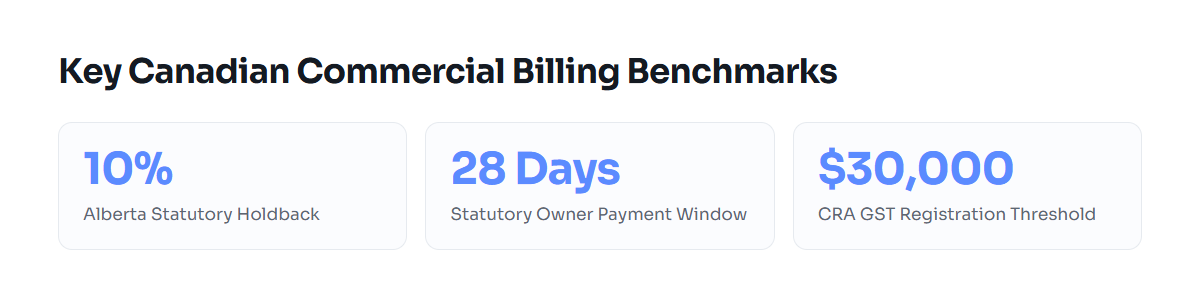
- Owner Payment Period: The owner must pay the contractor within 28 calendar days of receiving a proper invoice.
- Contractor Payment to Subcontractors: Upon receiving payment, the general contractor has 7 calendar days to pay subcontractors. Subcontractors then have 7 calendar days to pay their sub-subcontractors.
- Dispute Notices: An owner disputing all or part of an invoice must issue a formal Notice of Dispute within 14 calendar days of receipt. A contractor who receives a notice of dispute must notify subcontractors within 7 days.
Ontario enforces comparable rules under the Construction Act (28-day owner payment, 14-day notice of non-payment). Other provinces, including Saskatchewan and British Columbia, continue moving forward with similar prompt-payment regimes.
2. Mandatory Statutory Holdback
Every Canadian province mandates a statutory holdback to create a security fund for subcontractors and suppliers down the contractual chain. In Alberta, Section 18 of the PPCLA mandates a 10% holdback on the value of work or materials provided. This money is withheld from every progress draw.
The owner or general contractor retains this 10% fund until the lien registration period expires: 60 days in Alberta for standard construction (or 90 days for oil, gas, and concrete improvements) following substantial performance or project completion. In Ontario, the holdback is also 10%, retained for 60 days following the publication of the Certificate of Substantial Performance. In British Columbia, the holdback is 10% retained for 55 days under the Builders Lien Act.
3. Canada Revenue Agency (CRA) Invoicing Mandates
If your worldwide taxable sales exceed $30,000 across four consecutive calendar quarters, you must register for a CRA Business Number and collect Goods and Services Tax (GST) or Harmonized Sales Tax (HST). Under the Excise Tax Act, every invoice for amounts over $100 must include:
- The business or operating name of the supplier.
- The 9-digit CRA Business Number (GST/HST account number).
- The invoice date and a unique invoice serial number.
- The customer's legal name or trade name.
- A clear description of the goods or services supplied.
- The total price charged, indicating whether taxes are included or itemized.
- The rate of tax applied and the total GST/HST charged.
Provincial sales tax treatments vary significantly across Canada:
| Province | Tax Structure | Total Rate | Application on Trade Invoices |
|---|---|---|---|
| Alberta, NWT, Nunavut, Yukon | GST only | 5% | Collected on total contract services and billable materials. |
| Ontario | HST | 13% | Single combined tax rate applied to labour, services, and materials. |
| British Columbia | GST + PST | 5% GST + 7% PST | Contractors generally pay PST on materials purchased; bill 5% GST to clients. |
| Saskatchewan | GST + PST | 5% GST + 6% PST | PST applies to taxable commercial construction labour and services. |
| Quebec | GST + QST | 5% GST + 9.975% QST | Separate registration with Revenu Québec; both taxes displayed. |
| Atlantic Provinces (NB, NL, NS, PE) | HST | 15% | Single combined harmonized sales tax on all taxable supplies. |
Under CRA policy (CRA GST/HST Memorandum 19.3), tax on statutory construction holdbacks is payable on the earlier of the day the holdback is actually released or the day the holdback period expires under governing provincial lien legislation. For complete document formatting rules, read our breakdown on the Contractor Invoice Template for Canada: CRA Rules.
How It Applies on a Real Project: Step-by-Step Worked Example
Consider an Alberta mechanical contractor completing a commercial HVAC retrofit in Calgary. The agreed contract price is $60,000 plus 5% GST. The contractor issues monthly progress billings based on verified site inspections, leading up to City of Calgary safety inspection sign-offs.
Phase 1: Progress Billing Calculation (Month 1)
During Month 1, the contractor completes demolition, rough-in ductwork, and equipment delivery, representing 40% of the total contract value ($24,000).
- Total Work Completed to Date: $24,000.00
- Less Previous Billings: $0.00
- Current Work Billed: $24,000.00
- Less 10% Alberta Statutory Holdback: -$2,400.00
- Net Work Payable (Current Draw): $21,600.00
- 5% GST on Net Work Payable ($21,600 × 0.05): $1,080.00
- Total Amount Payable on Draw 1: $22,680.00
- Accumulated Holdback Held by Owner: $2,400.00
(Note: Many contractors bill GST on the gross work completed of $24,000 [$1,200 GST] and net out the holdback before tax. Both methods appear in commercial practice, but calculating GST on the current payable amount and charging GST on the holdback upon its release aligns directly with Section 168(4) of the Excise Tax Act.)
Phase 2: Submitting a PPCLA-Compliant Proper Invoice
The contractor delivers the invoice electronically on October 1st. To satisfy Section 32.1 of the PPCLA, the invoice document includes:
- The contractor's full legal name and office address.
- The date of the proper invoice and the period covered (September 1 to September 30).
- Reference to the written contract (Purchase Order #2024-088).
- A description of work completed (HVAC rough-in, RTU installation, permit ref #CAL-2024-MECH-441).
- The gross amount billed ($24,000), the 10% holdback retained ($2,400), and the net amount payable ($22,680 including GST).
- The name, title, and contact details of the contractor's billing representative.
- A statement confirming that the invoice is intended to constitute a proper invoice under the PPCLA.
Phase 3: The Statutory Payment Timeline
The statutory clock runs from the invoice submission date:
- Day 0 (October 1): Proper invoice received by client.
- Day 14 (October 15): Deadline for the client to serve a formal Notice of Dispute (Form LTS-1) if they reject any line item. Because the mechanical work passed the municipal rough-in inspection, no dispute is filed.
- Day 28 (October 29): Statutory deadline for the client to transfer $22,680.00 into the contractor's account.
- Day 35 (November 5): Contractor's mandatory deadline to pay sheet-metal fabricators and controls suppliers.
To see how multi-stage milestones work on commercial builds, consult our detailed guide on Progress Draw Payments in Canadian Construction.
Common Misconceptions in Contractor and Trade Billing
Misunderstanding legal and accounting requirements creates significant liabilities for small business owners and independent tradespeople.
Misconception 1: "Estimates and Quotes Are Interchangeable"
An estimate is an educated guess. If you issue an estimate for $10,000 and run into unexpected underground rock requiring $14,000 of excavation, the estimate offers flexibility. A quote, however, fixes the price. If the client signs a quote for $10,000, you are legally bound to deliver that exact scope for $10,000 unless a written change order is executed before performing the extra work.
Misconception 2: "Holdbacks Only Apply to Large Commercial Contractors"
Section 18 of the Alberta PPCLA applies to all improvements to land unless explicitly exempted (such as public highways or federal undertakings). If a homeowner hires a general contractor to build an addition, or a commercial tenant hires an electrical firm, the 10% holdback applies by law. Failing to track holdback balances across projects risks liability to unpaid lower-tier trades.
Misconception 3: "Consulting Engineers and Designers Do Not Fall Under Prompt Payment"
Under modernized lien legislation in both Alberta and Ontario, regulated professionals who provide consulting, design, or field reviews contributing to an actual improvement fall within the definition of a contractor or consultant. Engineering firms issuing milestone or hourly invoices can enforce statutory 28-day prompt payment deadlines and file liens if their invoices go unpaid.
Misconception 4: "Verbal Approvals for Extra Work Are Enforceable on Invoices"
Trade contractors frequently lose dispute adjudications because they proceed with site changes based on an oral agreement with a site superintendent. If a change modifies the contract price, it must be documented in a written Change Order or Change Directive before appearing on a proper invoice. If the client refuses to sign, document the scope, hours, and materials in an email immediately to preserve an evidentiary audit trail.
Related Workflow and Software Requirements
Managing trade billing, holdback tracking, and tax collection by hand becomes cumbersome once a company manages three or four active job sites simultaneously.
1. Integration With Municipal Inspections and Utilities
For plumbing, electrical, and gas trades, payment milestones should tie directly to regulatory inspections. Never issue a final invoice or release holdbacks without the following documentation attached to your payment application:
- Safety Codes Council permit inspection reports (rough-in, service connection, and final).
- Utility connection energization agreements or gas meter turn-on authorizations.
- Completed electrical test logs, mechanical balancing reports, or structural field inspection notices.
2. CRA Record Retention Rules
The CRA requires businesses to retain all sales records, purchase receipts, bank statements, subcontracts, and change orders for a minimum of six years from the end of the relevant tax year. Storing paper work orders in a van cab violates basic audit readiness standards. Digital invoices with verifiable timestamps, attached delivery slips, and logged customer approvals satisfy CRA auditors and legal adjudicators alike.
3. Choosing the Right Invoicing Infrastructure
Generic accounting software handles simple single-line invoices, but it frequently fails to track 10% statutory construction holdbacks, cumulative progress draws, and prompt payment deadlines. Whether you are an independent trade contractor or an expanding engineering consultancy, using dedicated platforms simplifies your operations.
At BoltBill Pro, we designed our platform specifically to eliminate billing friction for trade contractors, independent consultants, and technical service providers. Check our transparent pricing to select a plan that fits your business, or explore the BoltBill blog for practical guides on Canadian trade compliance, contract administration, and project accounting.
Common questions
What makes an invoice a 'proper invoice' under Canadian prompt payment rules?
A proper invoice must include the contractor's name and address, invoice date, period covered, contract or purchase order reference, detailed description of work or materials supplied, payment terms, and contact details for queries. In provinces like Alberta, it must also state that it is intended as a proper invoice under the governing Act.
How does statutory holdback work on contractor invoices?
The client withholds exactly 10% from the pre-tax value of all work completed on each progress draw. This money sits in a holdback account until the statutory lien expiry period passes (typically 55 to 60 days after project completion or substantial performance), at which point it is released if no liens are filed.
Do I have to charge GST on my construction quotes and invoices?
Yes, if your worldwide gross taxable revenue exceeds $30,000 across four consecutive calendar quarters, you must register for a CRA Business Number and charge 5% GST (or applicable HST in participating provinces) on all taxable construction labour and materials.
What happens if a client disputes a contractor's proper invoice?
Under Alberta's PPCLA, the client must deliver a formal Notice of Dispute (Form LTS-1) within 14 calendar days of receiving the proper invoice, specifying the exact items and dollar amounts contested. Any undisputed portion of the invoice must still be paid within the mandatory 28-day window.
Can engineering consultants file liens and use prompt payment rules?
Yes. Regulated professionals, including consulting engineers and architects who provide design, planning, or field review services for an improvement to real property, have full statutory lien rights and can enforce prompt payment deadlines under updated provincial construction legislation.
Related guides
Progress Draw Payments in Canadian Construction
A complete guide to progress draw payments, statutory holdbacks, and prompt payment rules for Canadian contractors and trades.
Contractor Invoice Template for Canada: CRA Rules
A compliant Canadian contractor invoice template meeting CRA GST/HST rules, provincial sales taxes, and Alberta Prompt Payment requirements.
How to Invoice as an Electrician in Canada
A complete guide for Canadian electricians on drafting compliant invoices, managing GST, and navigating provincial prompt payment rules.
Zoho Invoice Alternative for Canadian Small Business
Zoho Invoice is free, but Canadian tax handling, provincial sales taxes, and statutory holdbacks often demand a software alternative built for Canadian rules.