BoltBill Pro guide
Progress Draw Payments in Canadian Construction
Learn how progress draw payments work in Canadian construction, including statutory holdbacks, prompt payment rules, and CRA tax requirements.

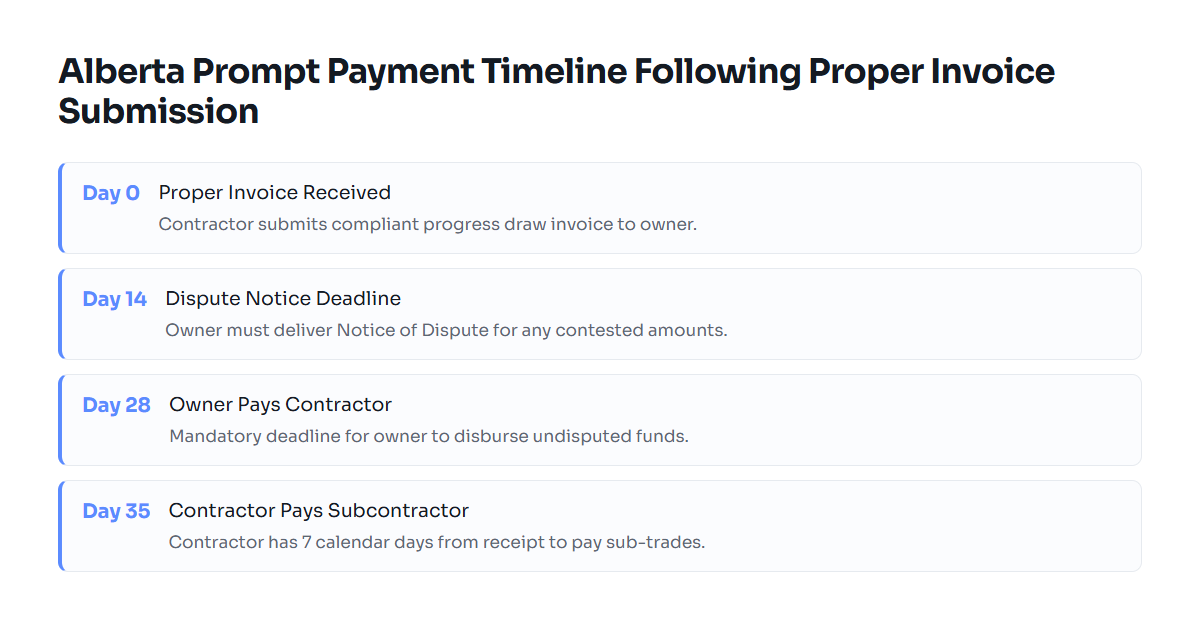
A progress draw payment in Canadian construction is a scheduled partial disbursement released to a contractor or trade as specific project milestones or percentages of completion are verified. In provinces like Alberta under the Prompt Payment and Construction Lien Act, each approved draw triggers a mandatory 10% statutory holdback deduction, with the owner legally required to issue payment within 28 calendar days of receiving a proper invoice.
The Structure of a Progress Draw Payment
General contractors, trade subcontractors, and commercial project owners use progress billing to maintain cash flow throughout long projects. Instead of billing upon full project completion or relying on arbitrary deposit requests, parties establish a Schedule of Values before starting site work. The Schedule of Values allocates the total contract sum across distinct scopes of work, trades, or project phases.
When an invoice period closes—typically monthly—the contractor submits a progress claim reflecting the cumulative percentage of work completed to date for each line item. The project consultant, engineer, or prime contractor reviews the site conditions, reviews delivered equipment, and certifies the claimed percentage before approving the payout.
To maintain clarity and audit readiness, every progress claim must document the financial position of the contract. A standard progress draw invoice states:
- Original contract value and any approved change orders
- Total revised contract value
- Cumulative dollar value of work completed to date
- Dollar value of materials delivered and securely stored on site
- Total value of previous claims paid
- Gross amount earned in the current billing period
- Statutory holdback deduction for the period
- Net amount payable for the period
- Applicable federal and provincial sales taxes calculated on the net or gross taxable basis
For independent trades transitioning from small residential jobs to commercial work, standardizing this format is critical. You can review standard formatting rules in our guide to the Contractor Invoice Template for Canada: CRA Rules.
Statutory Holdback and Prompt Payment Legislation in Canada
Construction lien statutes in Canadian provinces govern how progress draws operate. These statutes protect workers, suppliers, and lower-tier subcontractors down the payment chain by mandating that payers retain a percentage of every payment in a statutory holdback fund.
In Alberta, the governing statute is the Prompt Payment and Construction Lien Act (PPCLA). Section 18 of the PPCLA establishes a mandatory 10% statutory holdback on the value of work or materials provided. The act also establishes strict payment clocks initiated by the delivery of a proper invoice:
- Day 0: Subcontractor delivers a proper invoice to the prime contractor (or contractor to project owner).
- Day 14: The payer must issue a Notice of Dispute (Form PP1 or equivalent) if they dispute any portion of the invoice, specifying the reasons for non-payment.
- Day 28: The owner must pay the undisputed amount of the proper invoice to the general contractor.
- Day 35: Within 7 calendar days of receiving payment from the owner, the contractor must pay its subcontractors.
- Day 42: Subcontractors must pay their secondary subcontractors within 7 days of receiving payment.
| Province | Governing Legislation | Mandatory Holdback | Owner Payment Deadline |
|---|---|---|---|
| Alberta | Prompt Payment and Construction Lien Act | 10% | 28 calendar days from proper invoice |
| Ontario | Construction Act | 10% | 28 calendar days from proper invoice |
| British Columbia | Builders Lien Act | 10% | Contract-governed (Holdback held 55 days) |
| Saskatchewan | The Builders' Lien Act | 10% | 28 calendar days from proper invoice |
| Manitoba | The Builders' Liens Act | 7.5% | Contract-governed |
British Columbia operates under the Builders Lien Act with a 10% holdback retained for 55 days following the issuance of a certificate of completion. Ontario enforces a 10% basic holdback under the Construction Act with prompt payment timelines mirroring Alberta. Manitoba sets its holdback rate lower, at 7.5%.
Worked Example: Commercial Electrical Progress Draw in Alberta
To see how the accounting works on a real project, consider a licensed electrical contractor completing a commercial tenant fit-out in Calgary. The base subcontract value is $100,000.00 plus 5% GST. During the second month on site, the contractor completes the rough-in stage, reaching 40% cumulative completion.
In the first month, the contractor had billed 10% ($10,000.00 gross). Here is the exact calculation for Progress Draw 2:
- Total Subcontract Value: $100,000.00
- Cumulative Work Completed (40%): $40,000.00
- Less Previously Invoiced Gross Amount: $10,000.00
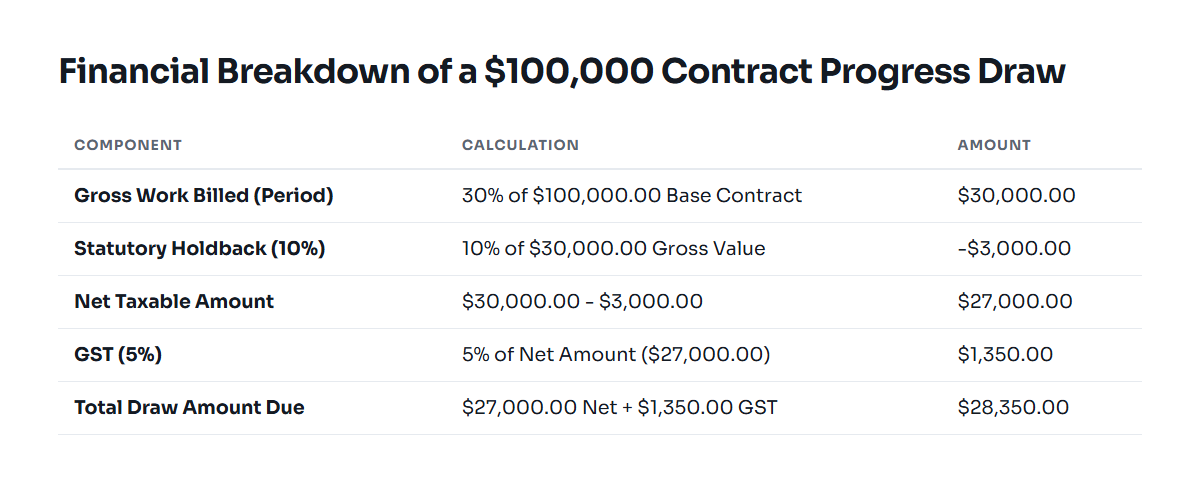
- Current Billing Period Gross Value: $30,000.00
- Statutory Holdback Deduction (10% of $30,000.00): -$3,000.00
- Current Net Amount Payable: $27,000.00
The sales tax calculation requires careful application of the federal Excise Tax Act. Under subsection 168(2) of the Excise Tax Act, GST or HST on holdbacks is not collectible until the holdback amount actually becomes payable under the contract or statutory release period, or when the holdback is actually paid. Contractors may invoice GST on only the net amount payable ($27,000.00 × 5% = $1,350.00) or invoice the full GST on the gross value ($30,000.00 × 5% = $1,500.00) depending on project terms. The standard commercial practice is to bill tax on the current payable amount and invoice the holdback tax upon release.
Assuming tax is billed on current net payable amounts:
- Net Subtotal: $27,000.00
- GST (5% of $27,000.00): $1,350.00
- Total Draw 2 Due: $28,350.00
- Cumulative Holdback Retained to Date: $4,000.00
Trade contractors tracking multi-stage installations can see detailed industry billing workflows in our breakdown of How to Invoice as an Electrician in Canada. Small operations often run into accounting errors when spreadsheets fail to separate the holdback tracking from accounts receivable, which is why trades use dedicated systems like BoltBill Pro to track cumulative claims automatically.
Common Pitfalls with Canadian Construction Progress Claims
Payment delays usually stem from clerical omissions rather than financial insolvency. Avoid these four common traps:
First, treating the 10% holdback as a discount or an optional buffer is illegal. Provincial lien statutes make statutory holdback retention mandatory for all owners and contractors. Failing to withhold these funds exposes the payer to personal liability if a lower-tier supplier or labourer files a lien against the title of the property.
Second, contractors often issue invoices that fail to qualify as a proper invoice under provincial prompt payment rules. Under Alberta PPCLA Section 32.1, a proper invoice must include the contractor's legal name and business address, the date of the invoice and the period covered, reference to the governing contract, a detailed description of services or materials provided, the amount requested with a breakdown of work, and the payment terms. If an invoice lacks these data points, the 28-day statutory payment clock never begins to run.
Third, trades frequently confuse provincial sales tax rules when working across provincial borders. While Alberta charges only the 5% federal GST, projects in British Columbia require 5% GST plus 7% provincial sales tax (PST) on materials unless specific production exemptions apply. Projects in Ontario incur 13% harmonized sales tax (HST), while Quebec requires 5% GST alongside 9.975% Quebec sales tax (QST). Applying the wrong rate or omitting your CRA business registration number invalidates the invoice.
Fourth, disputes often arise over unapproved change orders. Subcontractors sometimes include completed extra work in their progress percentage before obtaining a fully executed Change Order. Project consultants routinely reject the entire draw if unauthorized line items appear on the Schedule of Values.
Supporting Documentation and Release Requirements
A Canadian progress draw invoice rarely travels alone. To satisfy lender requirements and protect owners from hidden liabilities, contractors must submit mandatory supporting documentation with each claim:
1. Statutory Declarations: Prime contractors submit CCDC 9A declarations, while subcontractors submit CCDC 9B forms. These sworn affidavits declare under oath that all sub-trades, suppliers, and labourers from the preceding billing period have been paid in full.
2. Workers' Compensation Board (WCB) Clearances: Payers require a current WCB clearance letter (such as from WCB Alberta) confirming that the contractor maintains active coverage and has no outstanding assessment balances. Paying an unregistered contractor can transfer their outstanding compensation liabilities directly to the project owner.
3. Inspection Approvals: For mechanical, electrical, and structural scopes, payments tied to rough-in or service connection milestones depend on municipal safety codes inspections. In Calgary, for example, rough-in progress claims require an approved inspection report from City of Calgary Safety Codes officers before the project consultant signs off on the draw.
Once substantial performance is achieved and registered, the statutory holdback period begins—running for 60 calendar days in Alberta or 45 days in Ontario. During this period, the payer runs land title searches to verify that no builders' liens have been registered against the property. If the title remains clear, the accumulated holdback is released as the final progress draw, closing the contract account.
Common questions
What is the difference between milestone billing and percentage-of-completion billing?
Milestone billing ties payment directly to specific completed phases, such as foundation pour or service energization. Percentage-of-completion billing measures cumulative work completed against a detailed Schedule of Values at regular calendar intervals, such as monthly progress claims.
When is the 10% statutory holdback released to the contractor?
The holdback is released after the statutory lien registration period expires following substantial performance of the contract. In Alberta, this period is 60 calendar days (90 days for oil and gas sites) provided no builders' liens have been registered against the property title.
Do you charge GST on the statutory holdback in Canada?
Under Section 168(2) of the Excise Tax Act, GST/HST on a holdback amount is not payable until the holdback actually becomes payable or is paid out. Most contractors calculate GST solely on the net invoice amount, billing the holdback tax upon final release.
What happens if an owner disputes a progress claim in Alberta?
Under the Prompt Payment and Construction Lien Act, an owner must deliver a formal Notice of Dispute (Form PP1) within 14 calendar days of receiving a proper invoice. The notice must specify the disputed amount and the reasons for non-payment, while paying the undisputed remainder within 28 days.
Can a subcontractor file a lien if a progress draw is delayed?
Yes. Subcontractors have statutory rights to file a builders' lien against the project property if payment is wrongfully withheld. In Alberta, a lien must be registered within 60 calendar days of the last date work or materials were provided to the site.
Related guides
Contractor Invoice Template for Canada: CRA Rules
A compliant Canadian contractor invoice template meeting CRA GST/HST rules, provincial sales taxes, and Alberta Prompt Payment requirements.
How to Invoice as an Electrician in Canada
A complete guide for Canadian electricians on drafting compliant invoices, managing GST, and navigating provincial prompt payment rules.
Bookkeeping Basics for Small Business Canada: Practical Guide
A straightforward guide to Canadian bookkeeping basics covering CRA invoice rules, tax registration thresholds, holdback accounting, and monthly routines.
First Invoice as Self Employed: Complete Canadian Guide
A complete guide to sending your first invoice as a self-employed Canadian, covering CRA tax rules, payment terms, and practical billing steps.