BoltBill Pro guide
Invoicing Software Pricing Comparison for Canadians
Compare invoicing software pricing models in Canada. See real costs for contractors, freelancers, and engineering firms from bid to final payment.

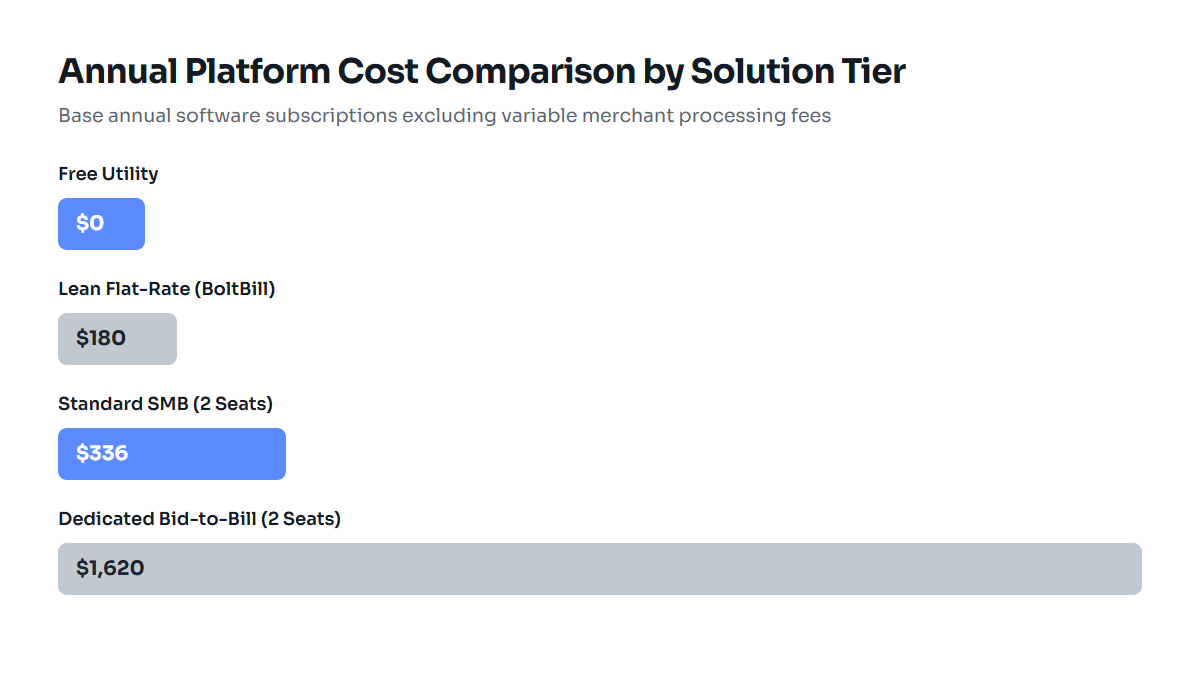
Invoicing software for Canadian sole proprietors and service firms generally costs between $0 and $60 per month for basic to mid-tier plans, while multi-user platforms supporting bid-to-bill workflows and project accounting range from $40 to over $250 per user monthly. Payment processing fees add an unavoidable 2.4% to 3.5% plus $0.30 per transaction for credit cards, making total annual costs heavily dependent on your transaction volume and team size.
The Real Cost Spectrum: From Free Tools to Enterprise Systems
Software vendors structure billing tools into four general tiers. Understanding where your operation sits prevents you from overpaying for unused features or adopting a platform that fails statutory compliance.
| Tier Level | Monthly Cost (CAD) | Target Business Profile | Core Capabilities |
|---|---|---|---|
| Free / Micro | $0 | Side businesses, solo freelancers (under 5 clients) | Manual invoice generation, basic PDF exports, no automated reminders. |
| Solo Professional | $15 – $30 | Independent consultants, trades, solo practitioners | Automated recurring billing, expense tracking, client portals, single-currency tax tracking. |
| Growing Team | $40 – $90 | Specialty contractors, design practices, small agencies | Multi-user seats (2 to 5), project time tracking, milestone billing, multi-rate sales tax (GST/PST). |
| Bid-to-Bill / Enterprise | $120 – $300+ per user | Engineering firms, general contractors, multi-discipline practices | Job costing, subconsultant tracking, progress claims, statutory holdback tracking, ERP sync. |
For independent operators, staying in the $15 to $30 range provides core compliance: generating itemized bills, applying provincial sales taxes, and logging payments. However, firms requiring specialized engineering billing software or bid to bill software for engineering firms quickly jump to per-user pricing. These systems do not just create invoices; they track project phases, subconsultant expenses, and unbilled work-in-progress (WIP).
What Drives the Subscription Price Up or Down
The sticker price of invoicing software rarely reflects your total cost of ownership. Several operational factors alter the monthly expense:
- Seat Licenses: Basic systems charge a flat rate for a single user and bill $5 to $15 monthly for each additional collaborator. Professional engineering billing software frequently charges full license fees ($50 to $150) for any project manager who must review timesheets or issue draft invoices.
- Payment Processing Take Rates: Accepting online payments simplifies cash flow, but credit card interchange and gateway fees take 2.9% plus $0.30 per transaction on standard platforms. On a $10,000 progress invoice, processing fees consume $290.30. Platforms offering integrated Canadian EFT (Electronic Funds Transfer) or Interac e-Transfer alternatives often charge flat fees ($0.50 to $2.00 per transfer), saving thousands annually.
- Multi-Provincial Tax Rules: Operating across provincial lines requires handling varying sales tax structures. Software must accurately track 5% GST in Alberta, 13% HST in Ontario, 15% HST in the Atlantic provinces, and separate PST (7% in British Columbia, 6% in Saskatchewan) or QST (9.975% in Quebec). Systems that lack native Canadian place-of-supply rules force manual entry, increasing your administrative overhead.
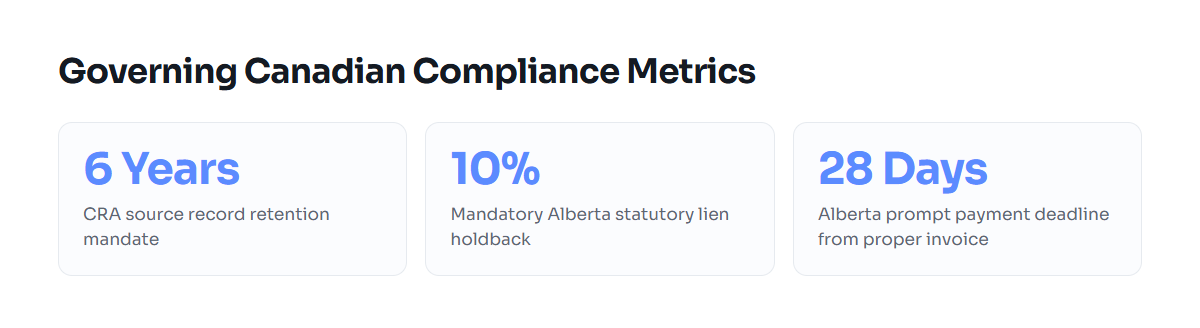
- Contract Accounting Requirements: Invoicing software for engineers and construction trades must accommodate contract retainage. Under the Alberta Prompt Payment and Construction Lien Act, a 10% statutory holdback must be retained on contract billings. If your tool cannot automatically calculate and isolate a 10% holdback line item, your billing workflow breaks.
For a deeper review of how platforms handle these requirements, consult the BoltBill blog for specific workflow breakdowns.
Worked Example: Real Annual Costs for an Independent Practice
Consider a consulting civil engineer based in Calgary, operating as an incorporated sole practitioner with one part-time field technician. The practice bills $220,000 annually across commercial site grading reviews and residential approvals. The billing profile consists of 60 invoices per year, with 20 invoices paid via credit card ($40,000 total volume) and the remaining $180,000 settled by direct bank deposit or EFT.
Here is how three distinct technology approaches compare over a twelve-month operating cycle:
Option A: Entry-Level Small Business Software
- Monthly subscription: $20/month = $240/year
- Additional user (technician time entry only): $8/month = $96/year
- Credit card processing ($40,000 at 2.9% + $0.30 x 20): $1,166/year
- Total Cash Outlay: $1,502/year
- Drawback: No automated holdback tracking; progress invoices on construction monitoring must be tallied manually in a spreadsheet.
Option B: Specialized Professional Engineering Billing Software
- Base license (Engineer): $110/month = $1,320/year
- Timesheet-only seat (Technician): $25/month = $300/year
- Integrated processing fees: $1,166/year
- Total Cash Outlay: $2,786/year
- Benefit: Native phase budgeting, proposal-to-job tracking, and automated holdback ledger.
Option C: Lean Invoicing via BoltBill Pro
- Flat annual subscription with clear pricing models: $180/year
- Second user seat included: $0
- External bank payments prioritized, card processing used minimally ($15,000 at 2.7% + $0.30 x 8): $407.40/year
- Total Cash Outlay: $587.40/year
- Benefit: Built to cleanly itemize GST, professional seal references, and project milestones without charging enterprise user premiums. Read more about BoltBill Pro features for independent operators.
What Is and Is Not Included in Base Tiers
When reviewing software price sheets, confirm whether these critical operational elements are included or locked behind expensive enterprise add-ons:
- CRA-Compliant Record Retention: The Canada Revenue Agency mandates that books and records, including all source documents and sales invoices, must be retained for six years from the end of the last tax year to which they relate. Some budget invoicing platforms archive or delete data if you downgrade or cancel your subscription. Verify whether full data export (PDF and CSV) is included without export fees.
- Detailed Audit Trails: Legally defensible invoicing requires immutable timestamps showing when an invoice was generated, sent, viewed, and paid. This is essential when enforcing payment timelines under prompt payment statutes.
- Custom Document Layouts: Basic tiers often restrict invoice design to a single template with an uploaded logo. Engineering billing software and trade invoicing require custom data fields: professional practice permit numbers (such as an APEGA Permit to Practice), WCB account clearances, purchase order numbers, and certificate of insurance cross-references.
- Expense Reimbursement Tracking: Re-billing disbursements (mileage, soil testing fees, subconsultant invoices) requires clear markup and tax tracking. Ensure your subscription tier does not charge extra to attach expense receipts directly to client invoices.
How to Get an Accurate Figure for Your Business
To identify the exact annual cost for your business, complete this four-step procurement checklist before signing a subscription contract:
- Calculate Your True Seat Count: Count every individual who needs access. Separate administrative staff who only generate bills from technical staff who log billable hours. Many firms overpay by purchasing full-access licenses for staff who only need time-entry access.
- Audit Your Payment Mix: Review your last 12 months of collections. If your clients are corporate entities or municipalities, they pay via direct deposit (EFT) or cheque, rendering expensive integrated merchant accounts secondary. If you serve residential clients or property owners who demand card payments, factor processing percentages directly into your platform selection.
- Verify Canadian Tax and Holdback Handling: Ensure the software supports mixed tax rates on a single document (for example, billing out-of-province clients) and supports progress claims where a percentage of work completed is billed against a fixed contract sum.
- Check Data Portability Terms: Review the vendor's off-boarding policy. If your software vendor increases rates by 30% next year, ensure you can extract all CRA-required records in an open format without paying administrative fees.
Common questions
Can I use standard small business invoicing software for an engineering firm?
Yes, provided your projects do not require complex percentage-of-completion billing or multi-tiered subconsultant management. Solo consultants and small practices can use streamlined platforms, provided they accurately display their APEGA or provincial permit details, GST numbers, and milestone structures.
How does credit card processing affect total invoicing software costs?
Payment processing fees often dwarf the software subscription itself. On $100,000 of card payments, standard gateway fees of 2.9% plus $0.30 per transaction total roughly $2,930 annually. Switching clients to direct EFT or Interac bank transfers avoids the majority of these charges.
What are the CRA requirements for an invoice to be valid?
Under CRA rules for GST/HST registrants, invoices over $100 must include your business name, invoice date, business number (GST registration number), client name, a description of services, total amount paid or payable, and the specific tax rate charged.
Why do engineering billing tools charge significantly more per user?
Dedicated engineering tools bundle project management, unbilled time (WIP) tracking, budget burndown charts, and phase-level profitability calculations. These features require heavier database infrastructure and are marketed toward medium-sized firms with dedicated project managers.
How do prompt payment laws impact my invoicing software requirements in Alberta?
Alberta's Prompt Payment and Construction Lien Act mandates strict payment timelines once a 'proper invoice' is issued. Your software must produce invoices containing all legally required details—such as contract authorizations and clear descriptions—to start the statutory 28-day payment clock.
Related guides
What Has to Be on a Canadian Invoice
A complete guide to the mandatory fields, tax registration numbers, and provincial rules required on Canadian business invoices.
Milestone Billing vs Hourly: Which Model Fits?
A direct comparison of milestone billing versus hourly rates for Canadian independent businesses, covering cash flow risks, statutory holdbacks, and prompt payment rules.
How to Deal with Late Paying Clients in Canada
A systematic workflow to recover overdue invoices in Canada without torching client relationships.
Reimbursable Expenses Consulting Guide: Rules & Tax
A guide to billing reimbursable expenses in Canadian consulting, covering GST/HST out-of-pocket rules, markups, and CRA record retention.