BoltBill Pro guide
Prompt Payment Act Alberta: Timelines, Rules, and Invoicing
Understand the Prompt Payment Act in Alberta. Learn statutory timelines, proper invoice details, holdback rules, and how to get paid on time.

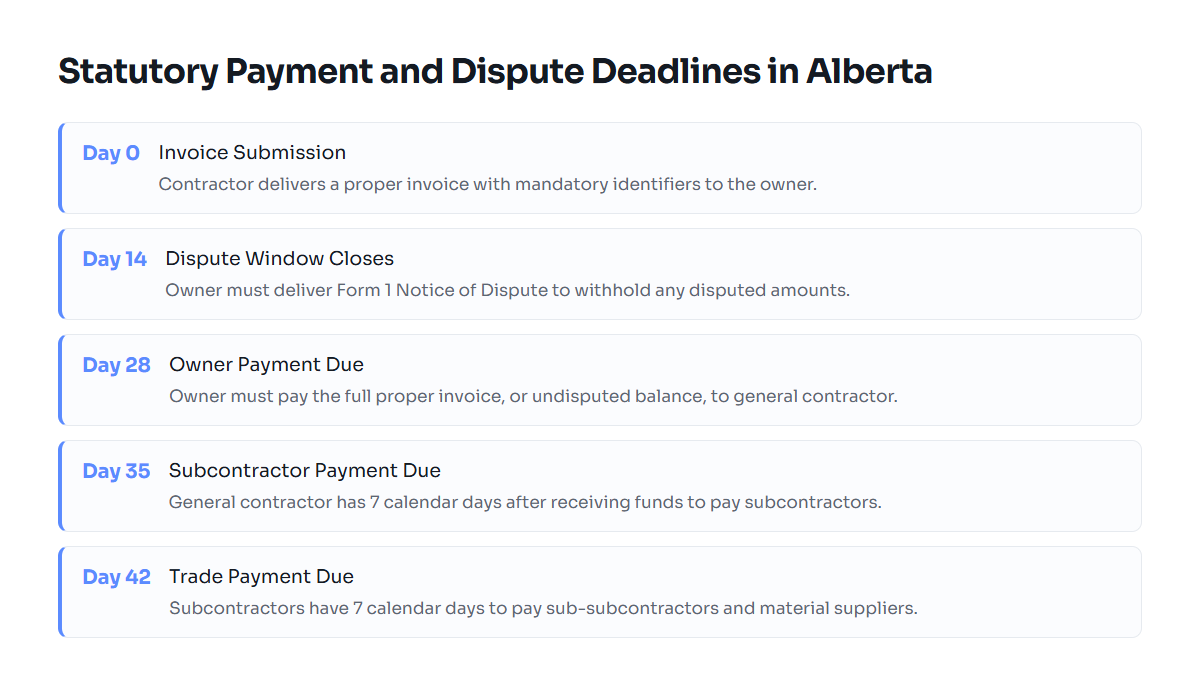
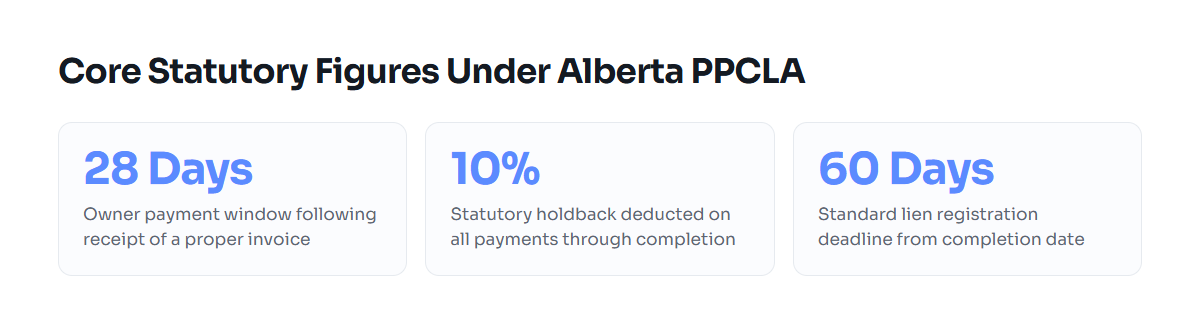
Alberta's Prompt Payment and Construction Lien Act (PPCLA) requires project owners to pay contractors within 28 calendar days of receiving a proper invoice. Contractors must then pay subcontractors within seven calendar days of receiving payment. If an owner disputes an invoice, they must issue a formal Notice of Dispute within 14 calendar days, specifying the disputed portion and paying any undisputed remainder on time.
How the Alberta Prompt Payment Rules Work
The Prompt Payment and Construction Lien Act governs payments across the contractual chain in Alberta. The legislation applies to general contractors, trade subcontractors, engineers, architects, project consultants, and material suppliers working under commercial or residential contracts. It sets clear, non-negotiable statutory timelines that override conflicting contract clauses.
The payment timeline triggers only when you submit what the legislation defines as a "proper invoice." If an invoice lacks the statutory elements, the 28-day clock does not start. Once an owner receives a proper invoice, they have two options: pay the total within 28 days, or issue a formal Notice of Dispute (Form 1 under the statutory regulations) within 14 calendar days. A client cannot simply sit on the bill or send a casual email stating they are reviewing charges.
When an owner pays a general contractor, the contractor has seven calendar days to pay direct subcontractors. Subcontractors then have seven calendar days to pay their sub-subcontractors or trades. If the owner pays only part of the invoice or withholds funds under a dispute, the contractor must pay downstream trades their full share or deliver a formal downstream Notice of Non-Payment within seven calendar days.
Understanding these timelines prevents cash flow crunches. When dealing with commercial clients who stall, reviewing Payment Terms Net 30 in Canada: Rules and Timelines helps distinguish between standard commercial courtesies and binding statutory obligations under provincial law.
Structuring Invoices and Managing Payment Workflows
A proper invoice requires specific data points to trigger the statutory protections of the Act. Leaving off your legal entity name or failing to reference the contract can invalidate the submission as a proper invoice, delaying your payment clock.
For freelancers, engineering consultants, and specialty trades, establishing clear billing procedures from day one prevents disputes. Whether you handle billing manually or use a platform like BoltBill Pro, every invoice must document the work clearly. If your practice operates on project retainers or progress milestones, your billing schedule must align with the minimum standard: submitting an invoice at least once every 31 days unless your written contract provides for testing or commissioning milestones.
How to Write Payment Details on an Invoice (Canadian Example)
To avoid payment rejections, your invoice should lay out banking, tax, and project details in plain language. Below is a concrete layout for how to write payment details on invoice Canada example:
- Sender Information: Legal business name, operating name (if different), business address, phone number, and CRA Business Number.
- Client Information: Client corporate entity name, project manager contact, and physical address.
- Project Identifiers: Purchase Order (PO) number, contract reference number, and site address (including municipal permit or building permit number if applicable).
- Invoice Details: Unique invoice number, date of issue (which sets the receipt date), and payment due date.
- Tax Breakdown: 5% federal Goods and Services Tax (GST) listed as a separate line item with your 9-digit CRA GST/HST registration number (e.g., 123456789 RT 0001). Alberta has no Provincial Sales Tax (PST).
- Payment Instructions: Direct deposit / EFT routing instructions (Institution Number, Transit Number, Account Number), Interac e-Transfer email recipient, or physical remittance address for cheques.
For quick calculations of provincial tax components across projects inside and outside Alberta, you can verify your numbers using our free GST/HST Invoice Calculator.
Worked Billing Example: Milestone Claim with Statutory Holdback
Consider an Alberta mechanical contractor invoicing a rough-in milestone on a commercial renovation in Calgary under a $100,000 base contract. Under Section 18 of the PPCLA, a mandatory statutory lien holdback of 10% must be retained on all work completed until the lien filing period expires.
Suppose the contractor completes $30,000 worth of work during the current monthly billing period:
- Value of work completed this period: $30,000.00
- Less 10% statutory holdback retained: -$3,000.00
- Net amount payable before tax: $27,000.00
- 5% GST on net payable ($27,000.00 × 0.05): $1,350.00
- Total amount currently due: $28,350.00
- Accumulated holdback held by owner to date: $3,000.00
The owner must pay the $28,350.00 within 28 days of receiving this proper invoice, unless a dispute notice is issued for specific deficiencies within 14 days. The $3,000 holdback remains in the owner's holdback account until 60 days after contract completion or certificate of substantial performance, provided no liens are registered.
Alberta-Specific Requirements: PPCLA Rules and Holdbacks
The Prompt Payment and Construction Lien Act establishes strict administrative rules that distinguish Alberta from other Canadian jurisdictions:
- Statutory Holdback: 10% of the value of work or materials provided must be retained by the payer at each tier.
- Lien Filing Period: 60 calendar days from the date of completion, abandonment, or issuance of a certificate of substantial performance (extended to 90 calendar days for improvements related to oil and gas wells or concrete work).
- Progress Billing Frequency: Contractors must provide a proper invoice to an owner at least every 31 days, unless the contract stipulates otherwise for specific testing or commissioning conditions.
- Progressive Holdback Release: For contracts exceeding $10,000,000, or contracts that explicitly provide for phased completion over multiple years, holdback funds can be released annually or by phase rather than waiting until the entire project ends.
- Adjudication Process: Fast-track interim dispute resolution is administered by an Authorized Nominating Authority (such as ARC Group Canada). The adjudicator's determination is binding on the parties until a court or formal arbitration rules otherwise.
These legal protections function alongside federal tax obligations. The Canada Revenue Agency (CRA) requires all businesses to retain full records of invoices, receipts, contracts, and banking statements for at least six years from the end of the last tax year to which they relate.
Choosing Your Invoicing and Accounting Setup
Small businesses and independent contractors in Alberta manage their billing workflows through several common setups. Deciding how to manage your books depends on your transaction volume, software comfort, and project complexity.
| Setup Option | Best For | Monthly Cost | Core Strength | Core Limitation |
|---|---|---|---|---|
| BoltBill Pro + Self-Managed | Freelancers, consultants, small trade crews | Low / Predictable | Fast proper invoicing, clear payment tracking | Does not file tax returns |
| Fixed Fee Bookkeeping | Growing trades with multiple staff ($500k+ revenue) | $400 - $1,200/mo | Full reconciliation, compliance offloaded | Higher fixed overhead |
| QuickBooks Online (QBO) Self-Setup | Solo operators with basic bookkeeping literacy | $30 - $90/mo | Wide integration ecosystem, bank feeds | Steep learning curve, easy to miscategorize holdbacks |
| QBO + Professional Setup Support | Established businesses migrating from desktop/paper | $500 - $2,500 one-time | Configured chart of accounts, correct tax setup | Upfront professional cost |
Many Alberta businesses look into fixed fee bookkeeping in Alberta to avoid surprise billing from accounting firms during tax season. A fixed monthly fee covers bank reconciliations, GST return preparation, and payroll, leaving you free to focus on field operations or client delivery.
Alternatively, if you prefer handling the day-to-day entries yourself, hiring a local specialist for QuickBooks Online setup in Alberta ensures your chart of accounts separates work-in-progress, accounts receivable, and holdback receivables accurately. Ongoing QuickBooks Online support in Alberta helps ensure your quarterly filings remain clean and prevents year-end accounting clean-up bills.
If you encounter difficult clients who ignore deadlines despite your statutory paperwork, consult our guide on How to Deal with Late Paying Clients in Canada for concrete escalation steps.
Checklist: What to Have Ready Before You Invoice
Before issuing your next progress invoice on an Alberta project, ensure you have gathered every required component. Missing any item gives the payer legal grounds to reject the invoice as improper, resetting your 28-day statutory clock.
- Written Contract Reference: Confirm your project PO number or subcontract agreement date matches the master contract.
- Detailed Scope Breakdown: List clear descriptions of services performed, materials supplied, and percentage of completion for each line item.
- Correct Tax Identifiers: Display your 9-digit CRA Business Number clearly next to the 5% GST line item.
- Holdback Accounting: Clearly show gross value completed, the 10% statutory deduction, and net billing amount for the current period.
- Payment Methods and Remittance Details: Provide exact EFT transit details or electronic payment instructions directly on the invoice face.
- Supporting Documentation: Attach relevant field delivery tickets, municipal inspection approval slips (such as City of Calgary or City of Edmonton safety codes sign-offs), or consultant review certificates where required by contract.
- Record Archiving: Store a digital copy of the delivered invoice along with verifiable proof of receipt (such as an email delivery confirmation) to support your six-year CRA audit trail.
Free tools: GST/HST invoice calculator · hourly rate calculator
Common questions
What qualifies as a proper invoice under the Prompt Payment Act in Alberta?
A proper invoice must include your business name, contact information, the date of issue, a clear description of services or materials provided, the contract authority or PO number, the amount requested with a breakdown of 5% GST, and payment remittance instructions. Unless the contract specifies otherwise, proper invoices must be submitted to the owner at least every 31 days.
What happens if an owner disputes my invoice in Alberta?
The owner must issue a formal Notice of Dispute (Form 1) within 14 calendar days of receiving your proper invoice. The notice must specify the disputed amount and explain the reasons for non-payment. The owner remains legally obligated to pay any undisputed portion of the invoice within the standard 28-day window.
How does statutory holdback work under the PPCLA?
Payers must withhold 10% of the value of work or materials provided at each stage of the contractual chain. This statutory holdback is retained to protect potential lien claimants and must be held until the 60-day lien registration period expires following project completion or the issuance of a certificate of substantial performance.
Does the Alberta Prompt Payment Act apply to consultants and design professionals?
Yes. The Prompt Payment and Construction Lien Act explicitly protects professional engineers, architects, land surveyors, and other project consultants who provide services related to an improvement on land. Their invoices are subject to the same 28-day payment timeline and adjudication rules as trades.
How does dispute adjudication work under the Act?
If an invoice remains unpaid or disputed, either party may refer the matter to an Authorized Nominating Authority for fast-track interim adjudication. An independent adjudicator reviews project submissions and issues a binding ruling within roughly 30 days, requiring payment while allowing ongoing work to proceed without full litigation.
Related guides
How to Deal with Late Paying Clients in Canada
A systematic workflow to recover overdue invoices in Canada without torching client relationships.
Payment Terms Net 30 in Canada: Rules and Timelines
A clear breakdown of how Net 30 payment terms operate under Canadian contract law, provincial prompt payment rules, and CRA tax requirements.
How to Invoice Someone as a Freelancer
A direct guide on how to invoice someone as a freelancer in Canada, covering CRA tax rules, provincial rates, payment terms, and record keeping.
How to Write a Quote: Complete Canadian Guide
A practical guide for Canadian contractors, consultants, and freelancers on how to write a binding quote with clear scope, tax rates, and payment terms.