BoltBill Pro guide
Subcontractor Invoice Requirements in Canada
Learn the legal subcontractor invoice requirements in Canada, covering CRA tax rules, Alberta prompt payment timelines, and statutory holdbacks.

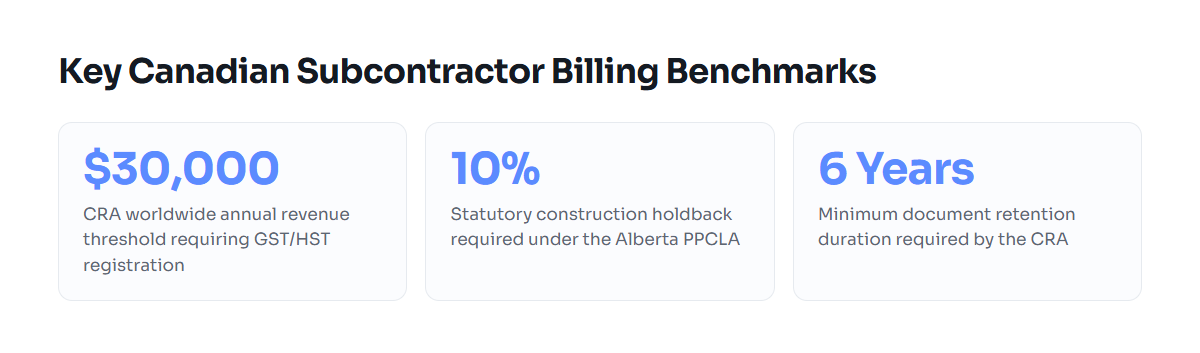
In Canada, subcontractor invoice requirements demand specific tax and project details to ensure legal compliance and prompt payment. Every invoice must state your business name, date, invoice number, a clear scope description, and payment terms. If your annual worldwide taxable revenues exceed $30,000, you must also include your 9-digit Canada Revenue Agency (CRA) Business Number and show the exact GST/HST charged. For construction trades, invoices must account for statutory lien holdbacks and meet provincial prompt payment rules.
The Essential Checklist for a CRA-Compliant Subcontractor Invoice
Subcontractors frequently cross the boundary between independent business operations and project disputes simply through incomplete paperwork. Under the CRA Excise Tax Act, your customer cannot claim an Input Tax Credit (ITC) to recover the sales tax you billed unless your document contains mandatory business identifiers. Failing to provide these details delays your payment and creates tax exposure for the general contractor.
For any billing under $100, the CRA requires the subcontractor name, invoice date, total amount payable, and the GST/HST rate charged. However, virtually every construction or consulting contract exceeds this baseline. When an invoice totals $100 or more, the CRA Input Tax Credit documentation requirements dictate that the invoice must include:
- The subcontractor legal business name or registered trade name.
- The client or general contractor name.
- The invoice date and a unique invoice tracking number.
- The 9-digit CRA Business Number (BN) with the RT program identifier (e.g., 123456789 RT 0001).
- A brief description of each service rendered or material supplied.
- The total amount charged, showing the sales tax broken out separately or a clear statement that the subtotal includes tax at the applicable provincial rate.
- The agreed payment terms, specifying both the due date and accepted remittance methods.
For trades managing milestone draws or field variations, tracking these components manually often leads to administrative friction. You can explore our foundational guide on Invoicing and Quoting for Trades and Contractors to review structural workflows that keep project documentation consistent across jobs.
Statutory Holdbacks and Prompt Payment Rules in Legislation
Subcontractors in the construction industry must comply with rules beyond general sales tax guidelines. Every Canadian province enforces construction lien legislation that alters invoice settlement workflows. In Alberta, the Prompt Payment and Construction Lien Act (PPCLA) governs commercial payment cycles and protects everyone down the contractual chain.
Alberta Prompt Payment Timelines
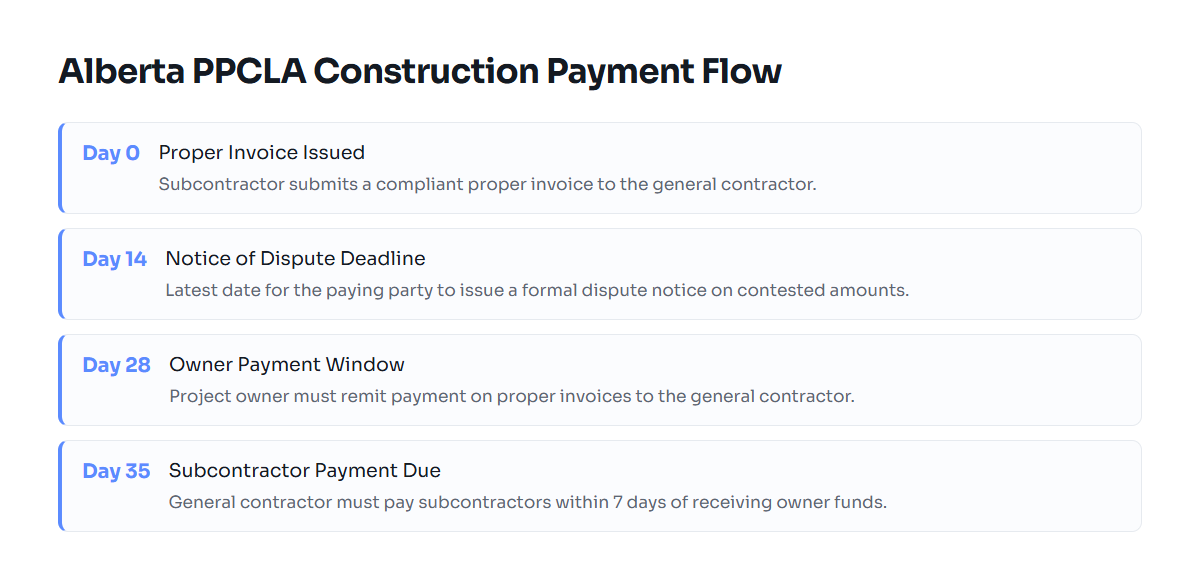
Under the PPCLA, delivering a valid billing begins with issuing a proper invoice. A proper invoice triggers a strict statutory clock: the project owner must pay the general contractor within 28 calendar days of receiving it. Once the general contractor receives full or partial payment, they must pay their subcontractors within seven calendar days. If the general contractor intends to dispute an invoice, they must serve a formal Notice of Dispute within 14 calendar days of receipt.
Statutory Lien Holdbacks
Every commercial construction contract in Alberta requires a mandatory 10 percent holdback from each progress claim under the PPCLA. The general contractor retains this 10 percent retainage from the value of actual work done and materials supplied to create a statutory lien fund. This reserve protects trade workers, suppliers, and lower-tier trades should a higher-tier entity default. The retained funds are released only after the 60-day lien filing period expires following substantial performance of the primary contract.
| Province | Statutory Holdback Rate | Lien Registration Period | Prompt Payment Statute |
|---|---|---|---|
| Alberta | 10% | 60 calendar days | Prompt Payment and Construction Lien Act |
| British Columbia | 10% | 45 calendar days | Builders Lien Act |
| Ontario | 10% | 60 calendar days | Construction Act |
| Saskatchewan | 10% | 40 calendar days | Builders' Lien Act |
Working Out a Real Project Invoice: Calculations and Tax Treatment
Applying these requirements correctly prevents administrative rejections. Sales tax treatment depends on the place of supply where the service or property is delivered. Alberta applies 5% GST; Ontario applies 13% HST; British Columbia applies 5% GST alongside provincial rules; and Quebec assesses 5% GST plus 9.975% QST.
A common error involves calculating sales taxes on top of the holdback calculation. Under standard CRA interpretations, GST or HST applies to the full value of the work completed before deducting the statutory holdback, even though the holdback itself is retained until project closeout.
Consider an HVAC mechanical subcontractor in Calgary billing a progress claim under an approved subcontract. The subcontractor completes $15,000 in ductwork installation during the month:
- Gross Work Completed: $15,000.00
- Less 10% Statutory Holdback: -$1,500.00
- Net Progress Draw Subtotal: $13,500.00
- Add 5% GST (calculated on gross $15,000.00): $750.00
- Total Amount Payable on Current Claim: $14,250.00
- Cumulative Retainage Held to Date: $1,500.00
Review our pre-formatted Contractor Invoice Template for Canada: CRA Rules to ensure your line items present these adjustments clearly. The billing document must present the gross value, the holdback deduction, the applicable tax, and the net payment due so the project accounting department can verify the numbers quickly.
Common Misconceptions in Subcontractor Billing
Billing errors cost independent trades and consultants both time and cash flow. Several widespread misconceptions persist across Canadian job sites.
Misconception 1: Small Suppliers Do Not Need an Invoice Number
Sole proprietors operating below the $30,000 mandatory CRA registration threshold often assume they do not need formal invoicing structures. While you do not charge sales tax if you qualify as a small supplier, your invoice must still feature an invoice number, full legal details, and clear descriptions. General contractors will not release payment against vague slips of paper, and corporate audits require verifiable audit trails.
Misconception 2: GST Is Calculated Only on the Net Amount Paid
Calculating GST on the net payment after holdback is an audit failure. The CRA considers the full value of the completed service as taxable when billed. If you apply the tax rate solely to the 90 percent draw, your sales tax collections will not reconcile against project revenues, leaving you liable for uncollected balances.
Misconception 3: An Estimate Serves as an Invoice
Estimates and purchase orders confirm scope and price, but they do not demand payment. An invoice must be an unambiguous accounting document requesting funds for work delivered. In provinces with prompt payment rules, sending a revised quote or work summary never starts the statutory payment countdown.
Related Requirements: Audits, Permitting, and Record Retention
Subcontractors operating in specialized engineering fields or mechanical trades must satisfy jurisdictional tracking requirements alongside standard CRA rules. If you run a specialized trade business, see our technical breakdown on How to Invoice as an Electrician in Canada for trade-specific safety and permit references.
CRA Record Retention Rules
The CRA requires Canadian businesses to retain all books, records, source documents, and invoices for a minimum of six years from the end of the latest tax year to which they relate. These files can be stored physically or digitally, provided the digital files remain accessible and legible during an official review.
Safety Codes and Inspection Sign-offs
In Alberta, building trades must coordinate billing with permit requirements established under the Safety Codes Act. Progress draws for plumbing, gas, and electrical work frequently require building inspection certificates or permit verification numbers printed directly on the payment application. General contractors routinely withhold payment until municipal or agency inspection paperwork confirms that concealed mechanical or structural work passes local bylaws.
Payment Terms and Banking Details
To avoid payment hold-ups, state your preferred payment method on the invoice face. Include the business email address for Interac e-Transfer or direct deposit banking details (Transit Number, Institution Number, and Account Number). State clearly: "Net 30 days pursuant to contract terms; 2% per month interest charged on overdue balances." Concrete instructions speed up remittance and resolve payment questions immediately.
Free tools: GST/HST invoice calculator · hourly rate calculator
Common questions
What specific tax details must a Canadian subcontractor show on an invoice?
If registered for GST/HST, you must include your business name, date, customer name, total payable, and your 9-digit CRA Business Number with the RT suffix. The invoice must clearly identify the tax rate applied or state that GST/HST is included.
How does the statutory holdback work on an Alberta construction invoice?
Under Alberta's Prompt Payment and Construction Lien Act, general contractors retain 10% from every progress payment as a lien fund. Subcontractors calculate the sales tax on the full gross value of work done, then subtract the 10% holdback from the total payable amount.
How long do I need to keep subcontractor invoices for CRA audit purposes?
The CRA requires self-employed individuals, corporations, and subcontractors to retain all tax invoices, receipts, and supporting records for a minimum of six years from the end of the tax year to which they relate.
Can a general contractor refuse payment if my invoice lacks a GST number?
Yes. General contractors cannot claim Input Tax Credits without your CRA Business Number if you bill them for sales tax. Missing or incorrect registration details give clients legitimate grounds to hold payment until you issue a corrected invoice.
What payment terms should appear on a Canadian contractor invoice?
Your invoice should clearly display the payment due date (e.g., Net 30), any agreed interest rates for late accounts, and complete payment instructions, such as direct deposit details or an email address set up for Interac e-Transfer auto-deposit.
Related guides
Invoicing and Quoting for Trades and Contractors
A complete Canadian guide to quoting, proper invoices, provincial holdbacks, and prompt payment compliance for contractors, trades, and consulting engineers.
Progress Draw Payments in Canadian Construction
A complete guide to progress draw payments, statutory holdbacks, and prompt payment rules for Canadian contractors and trades.
Contractor Invoice Template for Canada: CRA Rules
A compliant Canadian contractor invoice template meeting CRA GST/HST rules, provincial sales taxes, and Alberta Prompt Payment requirements.
How to Invoice as an Electrician in Canada
A complete guide for Canadian electricians on drafting compliant invoices, managing GST, and navigating provincial prompt payment rules.