BoltBill Pro guide
Contractor Invoice Template for Canada: CRA Rules
Download a CRA-compliant contractor invoice template for Canada. Meet Alberta PPCLA rules, statutory holdbacks, and provincial sales tax requirements.

A compliant invoice template for contractors in Canada must display your legal business name, invoice date, unique invoice number, a description of the work completed, and your 9-digit Business Number with the RT program identifier if you collect GST/HST. In Alberta, a proper invoice under the Prompt Payment and Construction Lien Act must also identify the contract authority, state whether the bill is a progress claim, show statutory holdbacks, and cite testing or inspection approvals when required.
Essential Fields for Canadian Contractor Invoices
General contractors, specialty trades, and independent consultants cannot use a generic receipt template. The Canada Revenue Agency (CRA) sets explicit documentary requirements under the Excise Tax Act for any business charging Goods and Services Tax (GST) or Harmonized Sales Tax (HST). When you bill over $150, the CRA demands specific information so your commercial clients can claim their Input Tax Credits (ITCs). If your invoice lacks these details, your client's accounting department will reject the invoice or risk an audit penalty.
Every Canadian contractor billing document requires these core fields:
- Supplier Identification: Your registered business name or operating name, address, telephone number, and email.
- CRA Business Number: Your 9-digit business registration number followed by RT0001 (e.g., 123456789 RT 0001). This confirms you are registered to collect federal tax.
- Recipient Details: The client's legal name, site address, and billing address.
- Invoice Metadata: A unique, sequential invoice number, the invoice issue date, and payment terms (e.g., Net 28 days to match provincial prompt payment statutes).
- Clear Scope Description: An itemized breakdown of labour, materials, equipment rentals, or milestone deliverables. Broad descriptions like "services rendered" fail both CRA audits and prompt payment standards.
- Tax Breakdown: Explicit line items showing the applicable GST, HST, or Provincial Sales Tax (PST/QST). Never lump sales tax into a single unitemized total.
- Holdback Deduction: If working under a provincial lien statute, display the statutory holdback clearly deducted before arriving at the net amount due.
CRA Invoicing Thresholds
The CRA categorizes invoicing requirements across three distinct transaction tiers under GST/HST memoranda:
| Invoice Total | Mandatory CRA Invoicing Elements | Input Tax Credit Eligibility |
|---|---|---|
| Under $30.00 | Supplier name, date of invoice, and total amount payable. | Eligible with minimal proof of payment. |
| $30.00 to $149.99 | Supplier name, date, total amount paid or payable, explicit tax charged or a statement that GST/HST is included, and your 9-digit CRA Business Number. | Eligible if the business number is verified. |
| $150.00 and above | All previous fields, plus the recipient's name, terms of payment, and a detailed description of each item or service provided. | Mandatory for commercial clients claiming ITCs. |
For independent trades billing hourly or per project, see our practical guide on How to Invoice as an Electrician in Canada for trade-specific scopes and safety authority permit referencing.
Provincial Tax and Statutory Holdback Frameworks
Invoicing across provincial borders requires matching the destination province's tax regime. Place of supply rules dictate that you charge the sales tax rate of the province where the property is located or where the service is delivered, rather than where your office sits.
| Province / Territory | Tax Type | Federal Rate | Provincial Rate | Total Combined Rate |
|---|---|---|---|---|
| Alberta, Northwest Territories, Nunavut, Yukon | GST | 5% | 0% | 5% |
| British Columbia | GST + PST | 5% | 7% | 12% |
| Saskatchewan | GST + PST | 5% | 6% | 11% |
| Manitoba | GST + PST | 5% | 7% | 12% |
| Ontario | HST | — | — | 13% |
| Quebec | GST + QST | 5% | 9.975% | 14.975% |
| New Brunswick, Newfoundland, Nova Scotia, PEI | HST | — | — | 15% |
Holdback Rules Under Construction Lien Legislation
In commercial and residential construction, statutory lien holdbacks protect subtrades, suppliers, and workers down the contractual chain. In Alberta, the Prompt Payment and Construction Lien Act (PPCLA) governs this process. Owners and general contractors must retain 10% from every progress payment made to a contractor. This money sits in a separate holdback account until lien periods expire.
A contractor invoice must document this arithmetic cleanly. If you fail to separate the base contract, the holdback, and the applicable sales tax, your invoice will create disputes between project accountants, quantity surveyors, and lending institutions.
How to Bill a Milestone: Worked Progress Billing Example
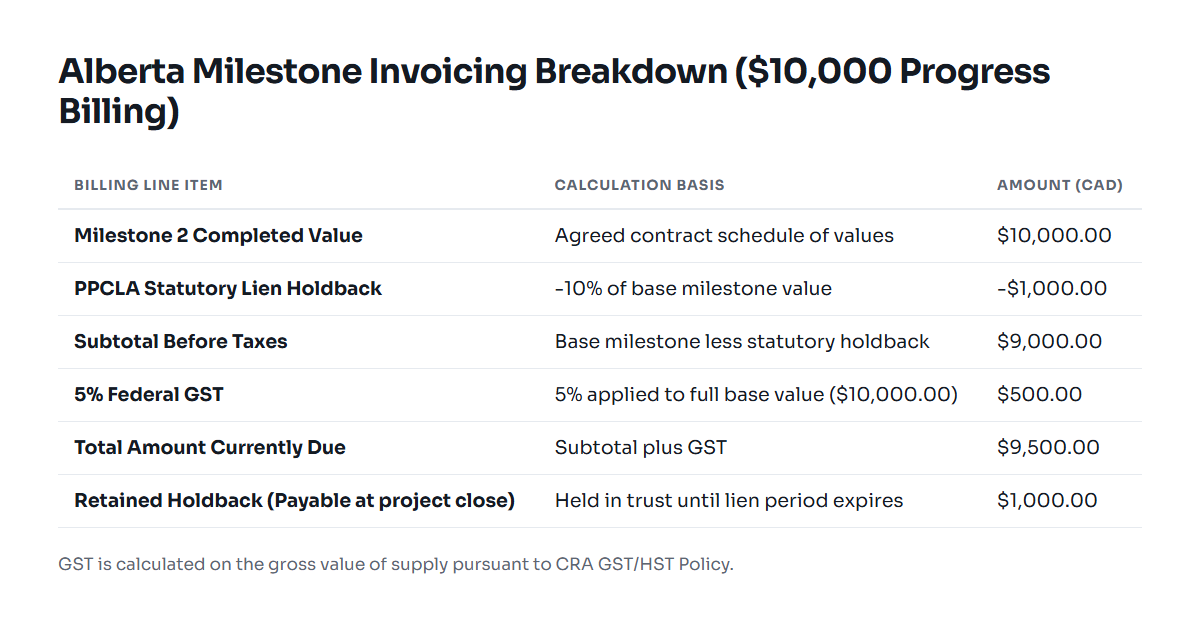
Consider a mechanical contractor in Calgary billing an owner for the second milestone on a commercial ventilation upgrade. The milestone value completed during this billing period is $10,000.00 CAD.
Under the Alberta PPCLA, the invoice must reflect the 10% statutory lien holdback. In Canada, GST applies to the full value of the service delivered ($10,000.00), not the net amount after holdback. The calculation unfolds as follows:
- Base Completed Work (Milestone 2): $10,000.00
- Less 10% PPCLA Statutory Holdback: -$1,000.00
- Subtotal Payable Before Tax: $9,000.00
- 5% GST (calculated on full $10,000.00 base value): $500.00
- Total Amount Due for Billing Period: $9,500.00
- Cumulative Retained Holdback to Date: $1,000.00
The contractor collects $9,500.00 today. The $1,000.00 holdback becomes billable through a separate holdback release invoice once the project reaches substantial performance and the statutory 60-day lien registration period lapses with no registered liens.
Field Notes: Avoiding Invoice Rejections in Canada
Billing errors cost contractors weeks of cash flow. Construction owners and general contractors routinely dispute invoices for administrative defects to preserve their own working capital. Watch for these common operational traps:
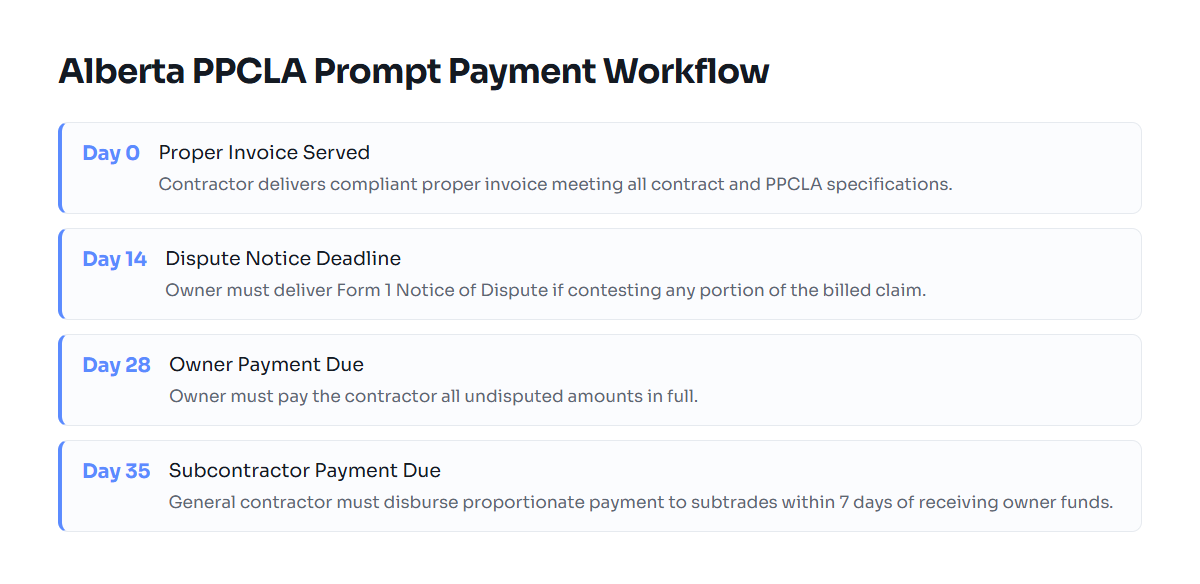
- Omitting the PPCLA "Proper Invoice" Label: Under Alberta law, your payment clock (28 calendar days for the owner to pay) only begins when you serve a formal "proper invoice." If your invoice lacks the contract reference, purchase order (PO) number, or testing certificates agreed to in the prime contract, the owner has 10 days to deliver a formal Notice of Dispute.
- Miscalculating Tax on Holdbacks: Many small contractors subtract the holdback and then apply 5% GST to the net remaining balance ($9,000 × 5% = $450). This violates CRA Excise Tax Act rules. The CRA treats the full $10,000 as consideration earned during the reporting period, meaning you must remit $500 in GST. Calculating tax on the net shortchanges the CRA and creates reconciliation headaches for the client's accounting department.
- Missing Permit and Inspection Tracking: Municipal trade permits (such as electrical, plumbing, or building permits issued by the City of Calgary or Edmonton) should be listed on milestone billings. Institutional clients frequently withhold progress disbursements until trade inspection release reports match the line items on the claim.
- Poor Record Retention: The CRA requires you to maintain all supporting books, receipts, and invoices for six years from the end of the last tax year to which they relate. Store both your issued invoices and payment confirmations digitally in off-site or cloud storage.
Using BoltBill Pro for Canadian Contractor Billing
Instead of wrestling with manual spreadsheets where a broken formula ruins your holdback calculations or misapplies provincial sales tax, professional billing tools automate compliance. Review our straightforward pricing to see how our platform handles progress billing, statutory holdback tracking, and CRA-compliant layouts out of the box.
Whether you run an engineering consultancy, an electrical shop, or an independent project management firm, BoltBill Pro produces audit-ready Canadian invoices that keep your cash flow moving and protect your lien rights under provincial law.
Common questions
What must be included on an invoice for a contractor in Canada?
A contractor invoice must show your business name, address, date, unique invoice number, a specific description of work, and your CRA Business Number with the RT identifier if registered. Invoices of $150 or more must also state the client's name and payment terms.
Do I charge GST on the holdback amount in Canada?
Yes. The Canada Revenue Agency requires GST or HST to be calculated on the full gross value of the work performed during the billing period, not on the net amount after deducting the statutory holdback.
What makes an invoice a 'proper invoice' under Alberta's PPCLA?
Under Alberta's Prompt Payment and Construction Lien Act, a proper invoice must contain the contractor's name and address, date, contract or PO authority, description of services, amount requested, a statement identifying it as a proper invoice, and holdback amounts.
How long do Canadian contractors need to keep copies of issued invoices?
The CRA requires businesses and self-employed contractors to retain all books, records, and issued invoices for a minimum of six years from the end of the tax year to which they apply.
What is the prompt payment timeline for contractor invoices in Alberta?
Once an owner receives a proper invoice under the PPCLA, they have 28 calendar days to issue full payment or deliver a Notice of Dispute within 14 calendar days for any disputed amounts. General contractors must pay subcontractors within seven days of receiving payment.
Related guides
How to Invoice as an Electrician in Canada
A complete guide for Canadian electricians on drafting compliant invoices, managing GST, and navigating provincial prompt payment rules.
Billing Methods for Consultants, Contractors, and Trades
A complete guide to hourly, fixed-fee, milestone, and progress billing methods for Canadian independent contractors, trades, and consultants.
How to Invoice as a Freelancer in Canada
A complete guide to Canadian freelance invoicing, covering CRA mandatory line items, GST/HST registration rules, provincial tax tables, and payment terms.
Invoicing Software Pricing Comparison for Canadians
A transparent look at invoicing software pricing models, hidden fees, and compliance costs for Canadian consultants, trades, and professional firms.