BoltBill Pro guide
How to Invoice as an Electrician in Canada
Learn how to invoice as an electrician in Canada. Master CRA invoice requirements, GST rules, Alberta prompt payment laws, and statutory holdbacks.

To invoice as an electrician in Canada, issue a clear document detailing labour hours or flat-rate milestones, itemized materials, city permit disbursements, and your nine-digit Canada Revenue Agency (CRA) business number with the correct GST/HST rate. If you work as a subcontractor on commercial or new residential jobs, you must format your billing as a proper invoice to trigger statutory prompt payment timelines and account for mandatory construction holdbacks.
The Anatomy of an Electrician Invoice
Billing for trade work demands distinct separation between labour, materials, equipment rentals, and regulatory fees. Clients need clarity to approve payments without friction, and the CRA requires specific disclosures once your sales exceed statutory thresholds.
For Canadian trade contractors, two primary models dictate your invoice format:
- Time and Materials (T&M): Every billable hour is listed beside the applicable hourly rate (such as journeyperson vs. apprentice rates). Materials show the actual cost plus your agreed contractor markup, accompanied by receipts or standard unit rates.
- Fixed-Price or Milestone Billing: The invoice bills against an agreed contract price or project percentage. Each invoice references the original estimate, the current percentage of completion, previously billed amounts, and the remaining contract balance.
Regardless of billing type, separate your municipal electrical permit fees from your regular labour and materials. In jurisdictions like Alberta, electrical permits issued under the Safety Codes Act are official regulatory costs. If you pass this cost directly to the client without a markup, it functions as a disbursement. If you mark up the permit cost to account for administrative time, the CRA considers that entire line item taxable trade revenue subject to GST.
Using structured BoltBill Pro templates ensures your service address, electrical permit number, and itemized materials remain organised in a layout general contractors and homeowners understand immediately.
Governing Rules: CRA Standards, Prompt Payment, and Holdbacks
Canadian electrical contractors operate under two distinct legal frameworks: federal tax law enforced by the CRA, and provincial construction statutes governing payment timelines and liens.
1. CRA Invoicing and Record-Keeping Rules
Under the Canadian Excise Tax Act, if your business collects more than $30,000 in gross revenue across four consecutive calendar quarters, you must register for a GST/HST account. For any invoice of $150 or more, the CRA mandates that your invoice clearly states:
- Your registered business name or operating name.
- The invoice date.
- Your nine-digit CRA Business Number (ending in RT0001).
- The purchaser's legal name or trade name.
- A description of the electrical work provided.
- The total amount paid or payable.
- The specific GST/HST amount charged, or a statement indicating that the total includes tax at the applicable provincial rate.
- The payment terms (such as "Net 30 days").
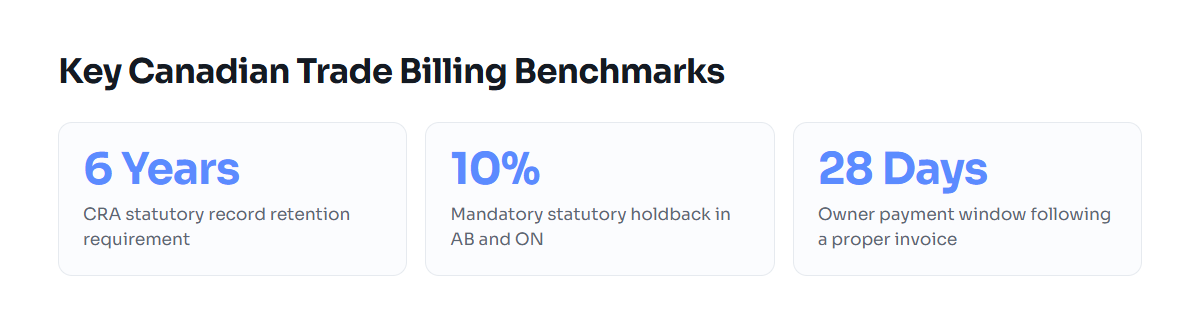
The CRA requires contractors to retain copies of all issued sales invoices, material expense receipts, subcontractor invoices, and bank statements for six years from the end of the relevant tax year.
2. Provincial Prompt Payment Legislation
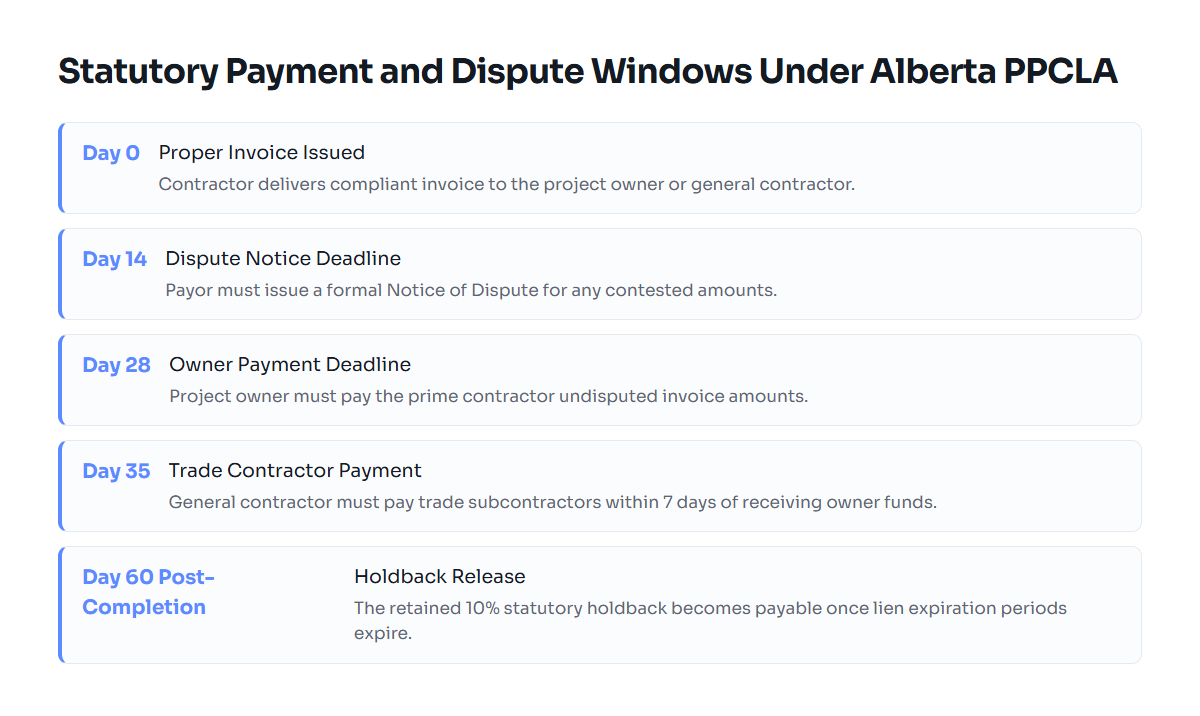
In Alberta, the Prompt Payment and Construction Lien Act (PPCLA) governs payment cycles for all construction contracts signed on or after August 29, 2022. Once an electrical trade issues a formal "proper invoice" to an owner or prime contractor, statutory clocks begin running:
- Owner Payment: The project owner must pay the general contractor within 28 calendar days of receiving a proper invoice.
- Subcontractor Payment: The general contractor must pay trade subcontractors within 7 calendar days of receiving payment from the owner (35 calendar days total from original proper invoice submission).
- Notice of Dispute: If an owner or prime contractor disputes an invoice, they must deliver a formal Notice of Dispute within 14 calendar days, detailing the exact items contested. Undisputed portions must still be paid on time.
3. Statutory Holdback Requirements
Provincial lien legislation protects owners and workers by mandating that a percentage of every invoice be held back until the project reaches substantial performance. In Alberta, Section 18 of the PPCLA mandates a 10% statutory holdback on the value of all work and materials supplied. The holdback funds must be retained for 60 calendar days following the certification of substantial performance or project completion (extended to 90 calendar days for work on oil and gas improvements).
| Province | Sales Tax Rate on Electrical Labour & Materials | Prompt Payment Invoicing Law | Statutory Construction Holdback |
|---|---|---|---|
| Alberta | 5% GST | Prompt Payment and Construction Lien Act (28-day cycle) | 10% retained for 60 days |
| British Columbia | 5% GST + 7% PST (PST applies to non-real-property supplies) | Standard contract terms (No standalone prompt payment act) | 10% retained for 55 days |
| Ontario | 13% HST | Construction Act (28-day owner cycle, 7-day trade cycle) | 10% retained for 60 days |
| Saskatchewan | 5% GST + 6% PST | The Builders' Lien (Prompt Payment) Act (28-day cycle) | 10% retained for 40 days |
Worked Billing Example: Commercial Subpanel Installation
Consider an electrical contractor in Calgary subcontracted by a general contractor to install a 100A commercial subpanel and wire dedicated mechanical circuits. The agreed contract price is $4,200.00 plus GST, billed at completion.
1. Work Completed
- Journeyperson labour: 16 hours at $105.00/hour = $1,680.00
- Apprentice labour: 12 hours at $60.00/hour = $720.00
- Materials (Panel, 3-pole breakers, 4/0 AL feeder cable, conduit): $1,550.00
- City of Calgary Safety Codes Electrical Permit (pass-through disbursement): $250.00
2. Calculating Subtotals and Holdback
The total value of work and materials provided on the project equals $3,950.00 ($1,680 + $720 + $1,550). The permit disbursement of $250.00 is billed separately.
- Total Work and Materials Subject to Holdback: $3,950.00
- Less 10% Statutory PPCLA Holdback: -$395.00
- Net Work and Materials Payable Now: $3,555.00
- City Electrical Permit (Disbursement, zero markup): $250.00
- Taxable Base for GST (Work, Materials, and Permit Markup, excluding straight disbursement): $3,950.00
- GST (5% on $3,950.00): $197.50
3. Final Invoice Presentation
The invoice sent to the general contractor reads as follows:
- Gross Work Performed to Date: $4,200.00
- Less 10% Statutory Holdback: -$395.00
- GST (5% on taxable supply of $3,950.00): $197.50
- Total Current Due: $4,002.50
- Total Retained Holdback (Payable Day 60 Post-Completion): $395.00
Reviewing our straightforward pricing model shows that managing these dual-total calculations requires dedicated tools rather than generic office spreadsheets that risk miscalculating tax bases on holdback sums.
Where Electrical Invoicing Goes Wrong in Practice
Billing errors cost electrical contractors thousands in delayed draws and disputed claims. Review these frequent pitfalls:
Failing the Statutory "Proper Invoice" Test
Under provincial prompt payment acts, missing basic requirements invalidates your submission. If your invoice omits the contract authority, the work location, or a description of work performed, the prime contractor has no legal obligation to pay within the 28-day window. The statutory clock does not even begin until an amended, compliant invoice is submitted.
Applying Tax Incorrectly to Holdbacks
A common trade mistake is calculating GST only on the net amount after deducting the 10% holdback. The CRA requires GST to be calculated on the full gross value of the taxable service provided during that billing cycle, regardless of whether a portion is retained by the payor as statutory holdback. Under Section 168 of the Excise Tax Act, the GST on the holdback portion becomes payable when the holdback is actually released or when the holdback period expires, whichever is earlier.
Vague Change Orders
Electricians frequently encounter unexpected panel configurations or buried conduit paths. Billing "extra wiring as discussed on site: $800" on the final draw invites non-payment. Every change must cite the written change directive number, the additional wire footage, labour hours, and authorization signature from the project superintendent.
For practical field workflows on document retention and project documentation, check the BoltBill blog for comprehensive guides across diverse trades.
The Electrical Contractor Invoicing Checklist
Follow these steps every time you prepare and issue a billing package:
- Confirm Permit Status: Verify that your rough-in or final inspection notice from the provincial safety authority or municipal inspection department is signed off or booked.
- Include Complete Business Credentials: Display your legal operating name, address, business phone number, and 9-digit CRA Business Number (e.g., 123456789 RT0001).
- Document Site Specifics: Include the municipal permit number, project site address, and prime contractor purchase order (PO) or contract number.
- Itemize Supplies and Scope: Provide a clear breakdown of journeyperson and apprentice labour, materials, rental charges (such as scissor lifts), and exact permit disbursements.
- Calculate Holdbacks Accurately: Deduct the statutory 10% lien holdback from the work subtotal where mandated by provincial acts.
- Apply Correct Regional Tax: Charge 5% GST in Alberta, or the appropriate HST/PST combination in other provinces, applied to the gross taxable value of services.
- State Prompt Payment Terms: State clearly: "Issued pursuant to the Prompt Payment and Construction Lien Act. Terms: Net 28 days."
- Archive Records: Save your final PDF invoice along with associated supplier delivery slips and safety inspections in secure storage for the required 6-year CRA window.
Common questions
Do I need to charge GST if my electrical business is brand new?
You do not need to register for or charge GST if your gross taxable revenues remain under the CRA small supplier threshold of $30,000 across four consecutive calendar quarters. Once your gross sales exceed $30,000, you must register with the CRA immediately and charge GST/HST on subsequent invoices.
How does statutory holdback work on an electrical invoice?
In provinces like Alberta and Ontario, clients or general contractors retain 10% of every invoice value until 60 days after the project reaches substantial performance. You must clearly show the total gross work, deduct the 10% holdback line item, and bill the remaining 90% as the current payable amount.
Can I bill electrical permit fees directly to the client?
Yes, you can bill municipal safety code permit fees as a separate line item. If billed at exact cost without markup, it is treated as a reimbursement disbursement; if you add an administrative fee or markup, the CRA considers that full item taxable revenue.
What happens if a general contractor refuses to pay my invoice in Alberta?
Under Alberta's Prompt Payment and Construction Lien Act, a contractor disputing your billing must send a formal Notice of Dispute within 14 days of receiving your proper invoice. If no notice is provided, they are legally required to pay your invoice in full within the statutory deadline or enter adjudication.
How long must an electrician keep past billing records in Canada?
The Canada Revenue Agency requires businesses to maintain complete financial records, including issued sales invoices, material expense receipts, and subcontractor contracts, for at least six years from the end of the tax year they relate to.
Related guides
Invoicing Software Pricing Comparison for Canadians
A transparent look at invoicing software pricing models, hidden fees, and compliance costs for Canadian consultants, trades, and professional firms.
What Has to Be on a Canadian Invoice
A complete guide to the mandatory fields, tax registration numbers, and provincial rules required on Canadian business invoices.
Milestone Billing vs Hourly: Which Model Fits?
A direct comparison of milestone billing versus hourly rates for Canadian independent businesses, covering cash flow risks, statutory holdbacks, and prompt payment rules.
How to Deal with Late Paying Clients in Canada
A systematic workflow to recover overdue invoices in Canada without torching client relationships.