BoltBill Pro guide
Best Invoicing Software for Small Business in Canada
Find the best invoicing software for Canadian small businesses. Compare GST/HST compliance, holdback support, and milestone billing without bloated fees.

The best invoicing software for small business in Canada is a platform that automatically calculates provincial sales taxes, formats invoices to satisfy Canada Revenue Agency audit rules, and tracks milestone or progress claims without charging enterprise prices. For sole proprietors, trades, and independent professionals, simplicity, accurate tax line items, and clear payment terms matter far more than bloated double-entry accounting features.
The Core Requirements for Small Business Invoicing
Small business owners often purchase complex accounting systems when their actual daily bottleneck is billing clients and getting paid. An electrician wiring a commercial infill in Edmonton, an engineering consultant delivering a geotechnical assessment in Red Deer, and a freelance copywriter in Toronto share identical invoicing problems: they must issue an accurate bill quickly, show the right sales taxes, and create an auditable paper trail.
The right software separates the act of billing from deep bookkeeping. It lets you generate professional bills on-site or at your desk, track unpaid receivables, and send payment receipts. Many businesses discover that all-in-one software suites become expensive quickly as their client roster grows. You can review alternative platforms in our guide to a QuickBooks Alternative for Small Business Canada.
When evaluating software, assess three core capabilities first:
- Tax calculation accuracy: The software must apply the correct provincial rates (GST, PST, HST, or QST) based on the place of supply, rather than forcing you to adjust tax totals manually.
- Contract flexibility: It should support hourly rates, fixed-fee deliverables, progress billing by percentage, and statutory holdbacks.
- Audit-ready records: The tool must generate sequential invoice numbers and store unalterable historical records that satisfy tax authorities.
What the Law and Tax Code Require on Every Invoice
In Canada, your invoice is a legal document. The Canada Revenue Agency (CRA) enforces explicit requirements under the Excise Tax Act for businesses registered to collect the Goods and Services Tax (GST) or Harmonized Sales Tax (HST). If you invoice another business, that client cannot claim an Input Tax Credit (ITC) to recover the tax paid unless your invoice contains specific mandatory details.
Under CRA guidelines, transactions are grouped into dollar tiers, each with distinct information requirements:
- Under $30: Requires your business name (or operating name), the date of the invoice, and the total amount payable.
- $30 to $149.99: Must include your business name, the date, your 9-digit Business Number (GST/HST registration number), the total amount charged, and a clear indication of which items are taxable or the exact rate applied (such as 5% GST).
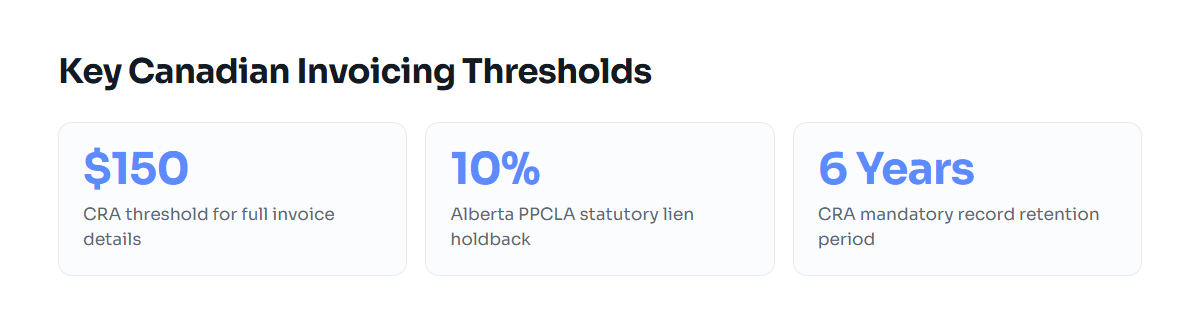
- $150 and over: Requires all previous elements plus the recipient's name or business name, a description of the goods or services provided, and the specific terms of payment. The invoice must clearly state the exact dollar amount of tax charged or state that the total amount includes the tax at the specified rate.
For operations in Alberta, you charge only the 5% federal GST. If you perform work for or ship deliverables to a client in British Columbia, Saskatchewan, or Manitoba, you must handle combinations of GST and Provincial Sales Tax (PST) according to provincial place-of-supply rules. Work billed to clients in Ontario requires 13% HST, while the Atlantic provinces require 15% HST. In Quebec, businesses must calculate 5% GST alongside 9.975% Quebec Sales Tax (QST). Quality Canadian invoicing software applies these rates automatically according to where the client receives the service.
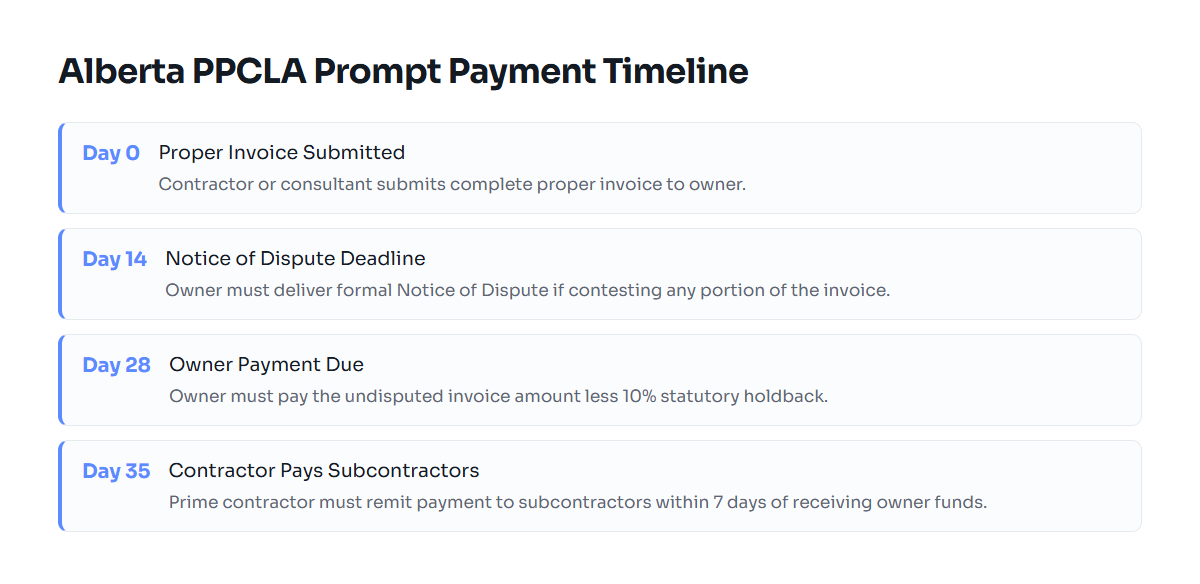
For contractors and design professionals working in Alberta, provincial construction law adds another operational layer. The Alberta Prompt Payment and Construction Lien Act (PPCLA) governs billing schedules on construction contracts. Under the PPCLA, submitting a formal "proper invoice" triggers a strict 28-day statutory payment clock for the owner. A proper invoice under the PPCLA must include your legal name and contact details, the date, a description of the work performed, the authority under which the work was done (such as a purchase order or contract number), the amount requested, the billing period, and a statement that the document is intended to constitute a proper invoice.
How Invoicing Works on a Real Project
To see these statutory requirements in practice, consider an independent mechanical engineering consultant based in Calgary who has been hired to design an HVAC upgrade for a commercial retail building. The contract is fixed at $20,000 plus applicable taxes, with billing tied to completion milestones. The contract also falls under construction-related professional services subject to the Alberta PPCLA.
The agreement specifies three billing milestones:
- Milestone 1: 50% upon completion of design drawings and permit application submission ($10,000).
- Milestone 2: 40% upon substantial completion of contractor installation review ($8,000).
- Milestone 3: 10% upon final sign-off, delivery of record drawings, and project closeout ($2,000).
When Milestone 1 is completed, the consultant generates a progress invoice. Under Section 18 of the PPCLA, contracts for improvements require a 10% statutory lien holdback on the value of work actually performed. The consultant calculates the invoice line items as follows:
- Contract Base Fee (Milestone 1 - 50% Complete): $10,000.00
- Less 10% Statutory Holdback: -$1,000.00
- Net Work Completed Payable: $9,000.00
- GST (5% applied to the $10,000.00 work value): $500.00
- Total Amount Payable Now: $9,500.00
- Retained Holdback (Due after lien period expires): $1,000.00
Notice the tax calculation: under the Excise Tax Act, GST applies to the full value of the service delivered ($10,000), not to the net amount after the holdback deduction. If your invoicing tool cannot separate statutory holdbacks from the taxable subtotal, your tax reporting will show discrepancies during an audit.
Below is a direct comparison of features to look for across typical small business invoicing options:
| Evaluation Feature | Generic Invoicing Tools | Heavy Accounting Suites | BoltBill Pro Workflow |
|---|---|---|---|
| Canadian Tax Support | Single-rate field; manual multi-province handling | Automatic tax tables with complex chart of accounts | Automatic GST/PST/HST/QST based on client jurisdiction |
| Statutory Holdback Support | None; requires manual negative line item hacks | Requires custom sub-ledger configuration | Dedicated holdback field with running balance tracking |
| Prompt Payment Timelines | Standard Net-30 display only | Manual calendar alerts | PPCLA-compliant terms and date-of-receipt tracking |
| Phase & Milestone Billing | Basic recurring lines | Complex Work-in-Progress (WIP) modules | Direct milestone and percentage-of-contract billing |
| Setup Time | Fast (under 15 minutes) | Slow (several hours or accountant setup) | Fast (ready in minutes) |
For a detailed breakdown of costs across different vendor tiers, read our Invoicing Software Pricing Comparison for Canadians.
Common Misconceptions in Small Business Billing
Many self-employed individuals pick up operational bad habits from informal online advice. Here are four widespread misconceptions that cause cash flow delays or CRA audit penalties:
Misconception 1: "You need full double-entry accounting software just to send invoices."
General ledgers, bank reconciliation engines, and inventory depreciation tables are essential for comprehensive year-end corporate accounting, but they add friction to day-to-day invoicing. A tradesperson or consultant only needs to produce a compliant bill, email it, receive payment, and export records for their accountant at tax season. Using an over-engineered suite often results in unpaid invoices sitting unsent because the interface is cumbersome.
Misconception 2: "If my revenue is below $30,000, I don't need to put tax information on my invoice."
The $30,000 small supplier threshold under the Excise Tax Act determines whether you must register for a GST/HST account. If your worldwide taxable revenues remain below $30,000 over four consecutive calendar quarters, you do not have to register. However, if you are not registered, you are legally forbidden from charging GST or HST to your clients. Once you do register—even voluntarily—you must display your 9-digit Business Number on every invoice of $30 or more and remit all taxes collected.
Misconception 3: "Holdbacks are optional courtesies negotiated between parties."
In provinces with lien legislation, statutory holdbacks are mandatory legal obligations, not optional contract terms. In Alberta, Section 18 of the PPCLA mandates that the person primarily liable on a contract must retain a 10% holdback from each payment until the lien filing period has elapsed. Failing to track this deduction accurately leaves you vulnerable to disputes with owners, general contractors, or subcontractors.
Misconception 4: "Digital invoices do not need to be retained once taxes are paid."
Many business owners delete electronic billing records or let their SaaS subscriptions lapse, assuming that bank statements provide sufficient documentation. Bank deposits show only that money arrived; they do not show the itemized scope of work, tax breakdown, or customer identity required by auditors.
Related Record-Keeping and Statutory Requirements
Selecting software is only half the battle; maintaining defensible business practices completes the picture. The following operational rules apply directly to invoicing in Canada:
CRA Record Retention Rules
Under subsection 230(4) of the Income Tax Act and Section 286 of the Excise Tax Act, business owners must keep records and supporting documents for six years from the end of the last tax year to which they relate. These records include copies of every invoice issued, every purchase receipt, and every proof of payment. If your invoicing tool stores your data in the cloud, ensure you can export historical records in standard formats like PDF and CSV so that your historical archives remain accessible if you ever change software providers.
Alberta Prompt Payment Rules
If your business provides services, materials, or equipment for construction or engineering improvements in Alberta, the PPCLA sets statutory payment deadlines. Once you deliver a proper invoice to an owner, the owner must pay the full amount (less the 10% statutory holdback) within 28 calendar days. If the owner disputes any portion of the invoice, they must deliver a formal Notice of Dispute within 14 calendar days of receiving your bill. If a contractor receives payment from an owner, that contractor must pay their subcontractors within 7 calendar days. Using billing software that logs the exact transmission date helps establish the factual timeline if a prompt payment dispute goes to adjudication.
Choosing the best invoicing tool comes down to clear alignment with how your small business gets paid. If you deliver trade, technical, or consulting services across Canada, select a streamlined solution like BoltBill Pro that eliminates clutter, computes provincial taxes accurately, and protects your bottom line.
Free tools: GST/HST invoice calculator · hourly rate calculator
Common questions
What makes an invoice legally valid in Canada?
For transactions of $150 or more, the Canada Revenue Agency requires your business name, client name, invoice date, sequential invoice number, 9-digit Business Number, description of services, payment terms, and an itemized breakdown of taxes applied.
How does provincial sales tax work when billing out-of-province clients?
Under Canadian place-of-supply rules, you charge sales tax based on where the service or deliverable is received by the customer. For example, an Alberta business billing an Ontario client must collect 13% HST rather than 5% GST.
How do construction holdbacks work on Canadian invoices?
Statutory lien legislation requires withholding a percentage of each progress payment—such as 10% in Alberta under the PPCLA. The invoice lists the total work value, deducts the 10% holdback, and applies GST to the full work value.
Do I need dedicated accounting software just to send invoices?
No. Dedicated invoicing software handles client billing, tax calculations, and payment tracking with far less friction than full double-entry accounting software, allowing you to pass summarized reports to your accountant at year-end.
How long must Canadian small businesses keep past invoices?
Under both the Income Tax Act and the Excise Tax Act, the Canada Revenue Agency requires you to retain all sales invoices and supporting financial records for at least six years from the end of the relevant tax year.
Related guides
Invoicing Software Pricing Comparison for Canadians
A clear breakdown of Canadian billing and invoicing software costs, from basic free tiers to full bid-to-bill engineering systems.
Zoho Invoice Alternative for Canadian Small Business
Zoho Invoice is free, but Canadian tax handling, provincial sales taxes, and statutory holdbacks often demand a software alternative built for Canadian rules.
QuickBooks Alternative for Small Business Canada
A practical comparison of Canadian invoicing alternatives to QuickBooks for contractors, freelancers, and small operations.
How to Write a Quote: Complete Canadian Guide
A practical guide for Canadian contractors, consultants, and freelancers on how to write a binding quote with clear scope, tax rates, and payment terms.