BoltBill Pro guide
Self Employed Invoice Guide for Canadians
Learn what a self employed invoice requires in Canada. Covers CRA rules, GST/HST rates, payment details, Alberta prompt payment, and record keeping.

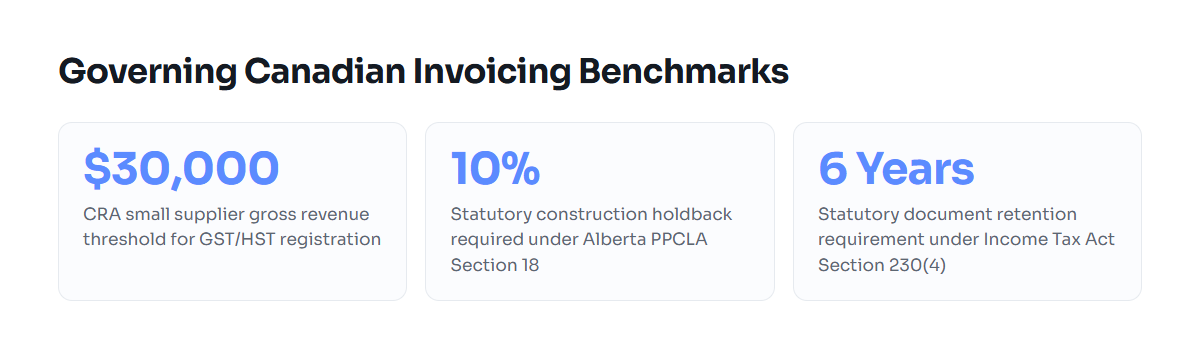
A self-employed invoice is an itemized commercial document issued by an independent operator to request payment for work performed or materials supplied. Under Canadian rules, it establishes legal debt, specifies payment terms, and serves as an official tax record. Once your gross taxable sales cross $30,000 across four consecutive calendar quarters, your invoice must also display your federal business number and detail the applicable sales taxes.
Essential Information on a Canadian Self-Employed Invoice
Whether you operate as an independent tradesperson in Edmonton, an engineering consultant in Calgary, or a freelance copywriter in Toronto, every invoice you issue must satisfy standard business requirements and Canada Revenue Agency (CRA) documentation rules. Omitting basic information leads to delayed payments and audit disputes.
If you are drafting your first invoice, consult our step-by-step walkthrough in First Invoice as Self Employed: Complete Canadian Guide. Every valid invoice requires the following elements:
- Header and identification: Your legal name or registered operating name, business address, phone number, and email.
- Client information: The legal name and address of the individual or company paying the bill.
- Unique invoice number: A sequential identifier (for example, INV-00101) that appears only once in your records.
- Dates: The date the invoice is issued and the exact payment due date. Avoid writing "due upon receipt" without an explicit calendar date.
- Description of services or goods: Clear line items detailing the hours worked, hourly rate, unit quantities, or milestone descriptions. Avoid ambiguous labels like "consulting services."
- Tax registration number: Your 9-digit CRA Business Number followed by the program identifier RT0001 if you are registered for GST/HST.
- Subtotal, tax breakdown, and total: The subtotal before taxes, the exact tax percentage and dollar amount broken out by category (such as GST or HST), and the final balance due.
- Payment instructions: Concrete instructions on how to pay, including Interac e-Transfer addresses, direct deposit transit numbers, or credit card links.
For independent knowledge workers wanting advice on client communication, read our guide on How to Invoice as a Freelancer in Canada.
How to Write Payment Details on an Invoice (Canadian Example)
Never assume a client knows how to pay you. Stating "payable via bank transfer" forces the client's accounting department to contact you for banking particulars, adding days to your collection cycle. Provide exact instructions directly above or below the invoice total:
- Interac e-Transfer: State the exact recipient email address and clarify whether auto-deposit is active. If auto-deposit is not active, provide the security question and send the answer via a separate communications channel.
- Electronic Funds Transfer (EFT) / Direct Deposit: List your Canadian banking details clearly: Financial Institution Number (3 digits), Branch Transit Number (5 digits), and Account Number (7 to 12 digits). Include the exact name on the bank account.
- Cheque: Specify the exact payee name and the physical mailing address where the cheque must be sent.
- Late payment policy: State the statutory or contractual interest charged on overdue balances (for example, "Interest of 1.5% per month / 19.56% per annum charged on balances outstanding past 30 days").
Statutory Invoicing Rules: CRA and Provincial Acts
Invoicing in Canada is governed by federal tax legislation and provincial payment acts. Failing to meet these rules can prevent your business clients from claiming Input Tax Credits (ITCs) and can invalidate statutory prompt-payment protections.
CRA Input Tax Credit Thresholds
Under the federal Excise Tax Act, the CRA sets strict documentary requirements before a commercial client can claim an ITC on your invoice. If your invoice lacks the required data, the CRA can deny your client's tax deduction:
| Invoice Total | Mandatory CRA Invoicing Elements |
|---|---|
| Under $30.00 | Supplier name, invoice date, and total amount payable. |
| $30.00 to $149.99 | Supplier name, invoice date, total amount, breakdown of tax charged (or a statement that tax is included and the exact rate), and your 9-digit GST/HST Business Number. |
| $150.00 and above | All previous items, plus the client's legal name, a brief description of goods or services, terms of payment, and a clear breakdown showing the subtotal, tax rate, and tax amount. |
If you have not registered for a GST/HST account because your worldwide taxable revenues remain under the CRA's $30,000 small supplier threshold, you must not calculate or collect tax on your invoices. Do not add a line for GST if you do not have an active RT0001 account with the CRA.
Prompt Payment Rules and Construction Invoices
If you bill on construction, trade, or engineering projects, provincial statutes dictate when an invoice is legally valid. In Alberta, the Prompt Payment and Construction Lien Act (PPCLA) governs payments down the contracting chain.
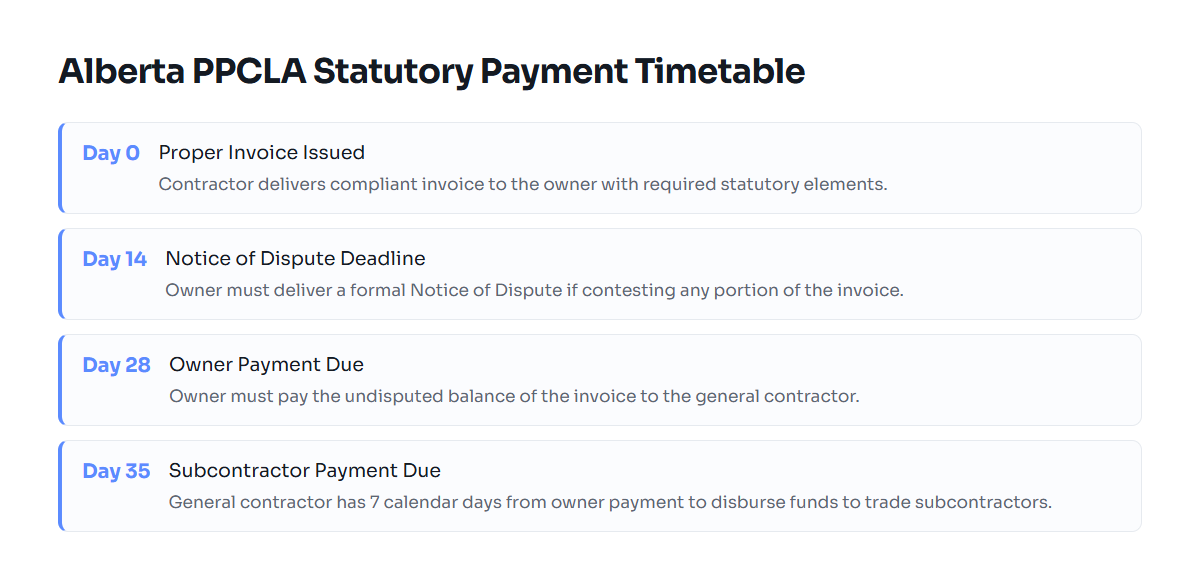
Under the PPCLA, you must submit a "proper invoice" to trigger the statutory 28-day payment clock. Section 32.1 of the Act establishes that an invoice must contain the contractor's name and address, the date of the invoice, the period during which work was done, the authority (contract or purchase order) under which work was completed, a description of the work, the amount requested, a statement identifying that the document is intended as a proper invoice, and payment terms. Once a proper invoice is submitted to an owner, payment must be made within 28 calendar days. The contractor then has 7 calendar days to pay their subcontractors.
The PPCLA also governs statutory holdbacks. Under Section 18 of the Act, an owner or payer must retain a 10% holdback on all payments made on a contract for work or materials until the lien period expires. If your contract is subject to the PPCLA, your invoices should separate the gross billing, the 10% statutory holdback deduction, the applicable GST, and the net amount payable.
Worked Billing Example: Alberta Independent Practice
Consider an independent field engineer or technical consultant in Calgary billing a local general contractor for QA/QC inspections on a commercial foundation pour. The agreement calls for an hourly fee, vehicle mileage, and reimbursement for concrete core lab testing.
Project Scenario
- Consulting time: 16 hours at $150.00 per hour
- Vehicle travel: 120 km at the CRA automobile allowance rate ($0.70 per km for the first 5,000 km in 2024)
- Pass-through disbursement: Third-party laboratory compression testing cost of $400.00
- Jurisdiction: Alberta (5% GST only; no PST or HST)
- Prompt payment terms: 28 calendar days pursuant to the PPCLA
Invoice Calculations
- Professional Fees: 16 hours × $150.00 = $2,400.00
- Disbursements: (120 km × $0.70/km = $84.00) + $400.00 lab test = $484.00
- Subtotal: $2,400.00 + $484.00 = $2,884.00
- GST Calculation (5%): $2,884.00 × 0.05 = $144.20. You can verify your tax calculations with our GST/HST Invoice Calculator.
- Total Invoice Amount: $2,884.00 + $144.20 = $3,028.20
If the project is subject to the mandatory 10% PPCLA statutory holdback on services and materials, the billing separates the holdback from current receivables:
- Base Subtotal: $2,884.00
- Less 10% Holdback: -$288.40
- Net Current Subtotal: $2,595.60
- GST on Gross Work (5% on $2,884.00): $144.20
- Total Amount Due Now: $2,739.80
- Holdback Retained (Due upon release of lien period): $288.40
If you invoice clients in other provinces, your tax line shifts depending on the place of supply rules. In Ontario, you apply 13% HST. In British Columbia, professional services are generally subject to 5% GST, while taxable goods may trigger 7% PST. In Quebec, services provided to local businesses carry 5% GST and 9.975% QST. Sole practitioners looking for direct templates can review How to Invoice Someone as a Freelancer.
Five Common Invoicing Mistakes Self-Employed Canadians Make
Mistakes on invoices waste administrative hours, sour professional relationships, and attract CRA scrutiny. Watch for these recurring errors:
1. Charging GST/HST Without a Registered CRA Business Number
Charging sales tax without an active GST/HST account is a serious violation under the Excise Tax Act. Clients who audit their vendor files will request your registration number. If you cannot produce an active RT0001 registration, they will withhold payment or demand a refund of the tax remitted.
2. Relying on Informal Terms Like "Payable Upon Receipt"
Ambiguous terms invite late payments. Without an explicit calendar date (such as "Payment Due: November 15, 2024"), accounts payable departments queue your invoice behind suppliers who have clear Net 30 or statutory prompt payment deadlines.
3. Altering Past Invoices Instead of Issuing Credit Notes
If a client disputes a charge or requests an adjustment after you have issued an invoice, do not simply open the file, change the dollar amounts, and re-send it with the same invoice number. Deleting or modifying issued records breaks your CRA audit trail. The compliant procedure is to issue a formal Credit Note referencing the original invoice number, followed by a revised invoice if necessary.
4. Misapplying Provincial Place-of-Supply Rules
If you live in Calgary (5% GST) but provide engineering reviews or graphic design services for a client whose primary Canadian establishment receiving the benefit is located in Halifax, you must charge Nova Scotia's 15% HST. The place of supply for professional services is determined primarily by the client's address and the location of the benefit, not your home office.
5. Neglecting Dedicated Invoicing Infrastructure
Manual word processor or spreadsheet templates are acceptable for your first few billings. As your volume grows, manual systems create numbering duplicates, broken formulas, and missing tax details. Using dedicated software like BoltBill Pro ensures consistent formatting, automated tax calculations, and auditable records. You can review our flexible plans on our pricing page.
Records Retention and Provincial Tax Administration
Issuing an invoice is only half the compliance obligation. Under Section 230(4) of the Income Tax Act and Section 286(1) of the Excise Tax Act, you must maintain all books, records, paper invoices, and electronic billing files for a minimum of six years from the end of the last tax year to which they relate.
If your 2024 fiscal year ends on December 31, 2024, the CRA requires you to retain all supporting sales invoices, expense receipts, and bank deposit records until December 31, 2030. Electronic records must remain accessible and readable. A corrupted hard drive or an inaccessible closed software account does not excuse missing records during an audit.
For independent contractors operating in regulated trades, municipal permits and inspections intertwine with your billing milestones. In Alberta, electrical, plumbing, and gas work require safety codes permits issued under the Safety Codes Act. Best practice for trade contractors is to tie final invoicing milestones to passed municipal inspection reports, referencing the permit number directly on the face of the invoice. This eliminates payment disputes by providing verifiable proof of code compliance.
For further operational resources, visit the BoltBill blog to explore our complete collection of Canadian billing and contracting guides.
Free tools: GST/HST invoice calculator · hourly rate calculator
Common questions
Do I have to charge GST on my self-employed invoice if I earn under $30,000?
No. Under CRA rules, you are considered a small supplier and are not required to register for or charge GST/HST until your gross taxable revenues exceed $30,000 over four consecutive calendar quarters. Charging sales tax without a registered CRA business number is illegal.
What is the prompt payment timeline under Alberta's PPCLA?
Under the Alberta Prompt Payment and Construction Lien Act, an owner must pay a contractor within 28 calendar days of receiving a proper invoice. A general contractor must then pay their subcontractors within 7 calendar days of receiving payment from the owner.
How long do I need to keep copies of my Canadian invoices?
The CRA requires you to keep all copies of issued sales invoices, expense receipts, and financial records for six years from the end of the tax year to which they relate. These records can be stored electronically as long as they remain readable.
How do I determine which provincial sales tax to charge a client?
You charge tax according to the CRA place-of-supply rules, which depend on where the client receives or benefits from the service. If you are located in Alberta but complete work for a client in Ontario, you must charge 13% HST.
Can I edit an invoice if a client requests a change after it has been sent?
Do not delete or overwrite an issued invoice. To maintain an unbroken CRA audit trail, issue a formal credit note against the original invoice number and issue a revised invoice with a new unique number.
Related guides
How to Invoice Someone as a Freelancer
A direct guide on how to invoice someone as a freelancer in Canada, covering CRA tax rules, provincial rates, payment terms, and record keeping.
First Invoice as Self Employed: Complete Canadian Guide
A complete guide to sending your first invoice as a self-employed Canadian, covering CRA tax rules, payment terms, and practical billing steps.
How to Invoice as a Freelancer in Canada
A complete guide to Canadian freelance invoicing, covering CRA mandatory line items, GST/HST registration rules, provincial tax tables, and payment terms.
Subcontractor Invoice Template for Excel in Canada
A compliant Excel subcontractor invoice template handles statutory holdbacks, CRA business numbers, and provincial sales taxes without calculation errors.